





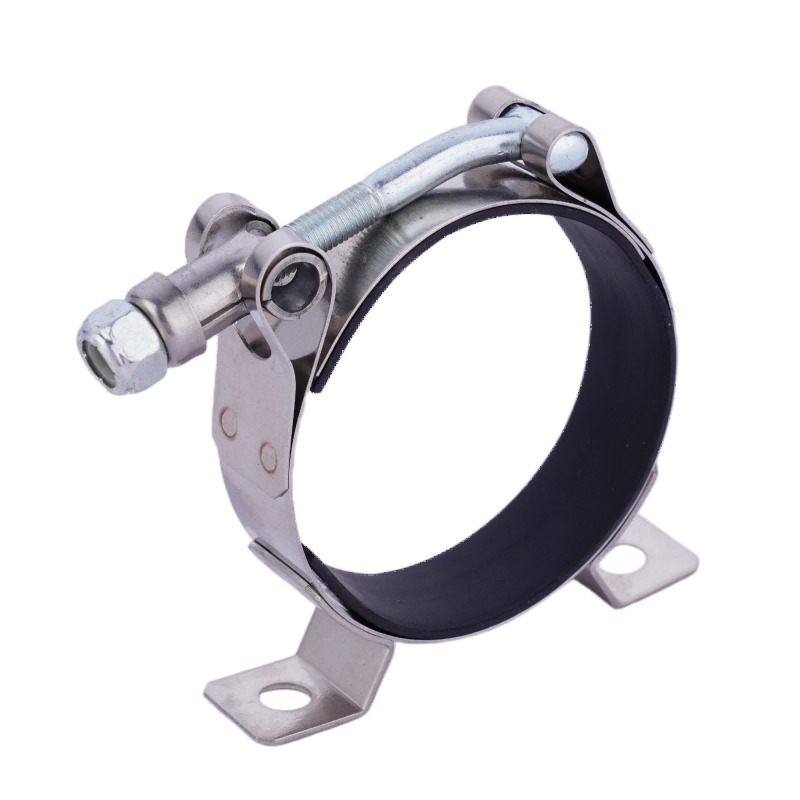
Зажимы с постоянным натяжением use a spring to keep steady pressure on a hose as it expands and contracts, so they hold their grip through every heat cycle—unlike a standard worm-gear clamp.
Heat cycles cause a real problem. Worm-gear clamps lock at a fixed torque, and SAE International research on cooling system integrity shows they lose a measurable percentage of initial clamping force within the first several heat cycles. Stress relaxation causes that loss, which is why mechanics often retorque clamps after the first few heat cycles.
A constant tension hose clamp’s design fixes this: the spring inside keeps the seal tight. HWKG’s constant tension clamps take this further, using a stainless spring band that holds steady pressure across the full temperature range, with OEM and bulk supply available. This article explains the mechanism, the types, and how to install them.
Основные выводы
- Constant tension clamps use a spring to keep steady pressure on hoses as they get bigger and smaller.
- Standard worm-gear clamps lose their hold over time because of heat cycles and hose compression.
- Constant tension clamps keep a tight seal through thousands of heat cycles without needing to be retightened.
- Pick constant tension clamps for cooling systems, turbo pipes, and silicone hoses to stop leaks.
- Put constant tension clamps on the right way, and check them often so they keep working well for a long time.
Why Standard Hose Clamps Fail
Thermal Expansion and Contraction
Heat changes the shape of every part under a clamp. When an engine warms up, the metal hose barb expands while the rubber or silicone hose expands at a different rate. Both parts shrink back as the engine cools. This back-and-forth movement works like a tiny ratchet. The steel worm-gear clamp does not track the movement perfectly. So the hose material gets squeezed and stretched again and again under the band. After hundreds of these cycles, friction can no longer hold the screw in place. The mechanism backs off a little, or the band settles into a larger effective diameter. The effect gets worse in parts with extreme temperature swings, like an upper radiator hose going from ambient air to over 200°F or turbocharge pipes swinging past 250°F.
A worm-gear clamp sets one fixed tension at installation. It cannot adjust later. As a truck engine heats and cools, the heater hose expands and contracts, and the clamp’s grip slowly relaxes. The band does not spring back. The screw does not self-adjust. A clamp that felt tight on day one can sit clearly looser six months later. Heavy-duty applications with constant thermal stress and vibration, like Class 8 trucks, show this problem far more than moderate passenger-car use.
Cold Flow and Hose Compression
Cold flow means hose material creeps out from under the clamp after installation. Rubber and silicone slowly move away from the band, so the clamp load drops even without any temperature change. Heat cycling and pressure changes speed up this process. A worm-gear clamp cannot make up for this, because its fixed position does not respond to a thinner hose wall.
The result shows up as real failures. Boost leaks appear on charge-air pipes, and coolant seeps from hose ends. This seepage often comes and goes, showing up only after hard heat cycles or under load. That pattern is a hallmark of thermal-cycling-induced worm-gear clamp failure.
| What changes over time? | Worm-gear clamp | Constant tension clamp |
|---|---|---|
| Hose compresses or relaxes | Clamp load drops | Spring maintains clamp load |
| Pipe expands hot, shrinks cold | May loosen or walk slightly | Maintains pressure through the range |
| Boost spikes or vibration | Can micro-move, then seep | Better sealing stability over cycles |
| Soft silicone boot | Easy to over-tighten and cut | More consistent load when sized correctly |
During the 1980s and 1990s, OEMs increasingly adopted constant tension clamps. This shift lined up with the rise of silicone and EPDM hose compounds and with growing warranty claim data. That data showed worm gear clamps were failing in service at rates that were costly for manufacturers.
HWKG brings more than 20 years of experience building hose clamps for these extreme conditions. Engineers who understand why standard clamps fail can choose a design that holds its seal instead.
The Spring Mechanism in Constant Tension Clamps
A screw sets tension one time. A spring keeps setting it. Constant tension changes that. Spring force, not screw friction, holds the joint together. That difference defines every constant tension clamps design on the market.
How Spring Force Maintains Clamp Load
A constant tension clamp depends on spring force, not just screw tension, to keep applying a steady clamping force. As the hose material relaxes and its diameter changes, this spring action adjusts the clamp load on its own, helping keep a reliable seal under changing conditions. The spring maintains clamp load without any retorquing, and it will maintain sealing load through the full temperature range.
A Belleville washer is a cone-shaped disc. It gets squeezed during tightening and acts like a spring. When the rubber relaxes, the washer springs back and makes up for it. The washer stores mechanical energy that offsets bolt relaxation and embedment effects. This keeps effective clamping force steady even as fasteners lose strain capacity. The result is a consistent clamp load across thousands of cycles. That is constant tension in action.
For persistent loosening, moving to a spring-style constant-tension clamp or a quality worm-drive clamp with a Belleville washer stack helps maintain preload.
The load-deflection curve explains why this works. A properly proportioned Belleville washer stays nearly flat over a wide portion of travel.
| Аспект | Behavior | Effect on Clamping Force |
|---|---|---|
| Load-deflection curve | Non-linear; stays nearly flat over a wide portion of travel | Near-constant force maintained even as parts wear or shift with temperature |
| Height-to-thickness ratio (h/t) approaching 1.41 | Curve develops a broad, nearly horizontal plateau across roughly the middle half of travel | Load barely changes with deflection, enabling constant clamping force that resists wear, thermal growth, and assembly tolerance |
| Large working deflection (15–85% of h range) | Length change maps to a small slice of a much larger elastic range | Shrinking gap costs only a modest fraction of preload, preserving clamp load during thermal cycling |
A properly chosen Belleville exerts a preload slightly higher than the desired minimum clamp load. Even if the bolt relaxes, the spring remains engaged. This turns a bolted joint into a spring-loaded system that adapts to expansion, contraction, and vibration. It maintains pressure on the hose wall instead of letting it fade.
Band Style vs. Spring Style
Constant tension comes in two main styles. Band-style constant tension clamps use a flat steel band. A single-wire spring clamp delivers higher clamping force than a band. The band style sits lower than single wire but higher than other common types. A constant tension band clamp spreads that force across a wider contact area, which protects soft hose covers and delivers high sealing force without cutting the rubber.
HWKG’s band clamps integrate a steel band with an EPDM rubber cushion to absorb vibration and protect pipes and cables. This design suits hydraulic equipment and other high-vibration systems.
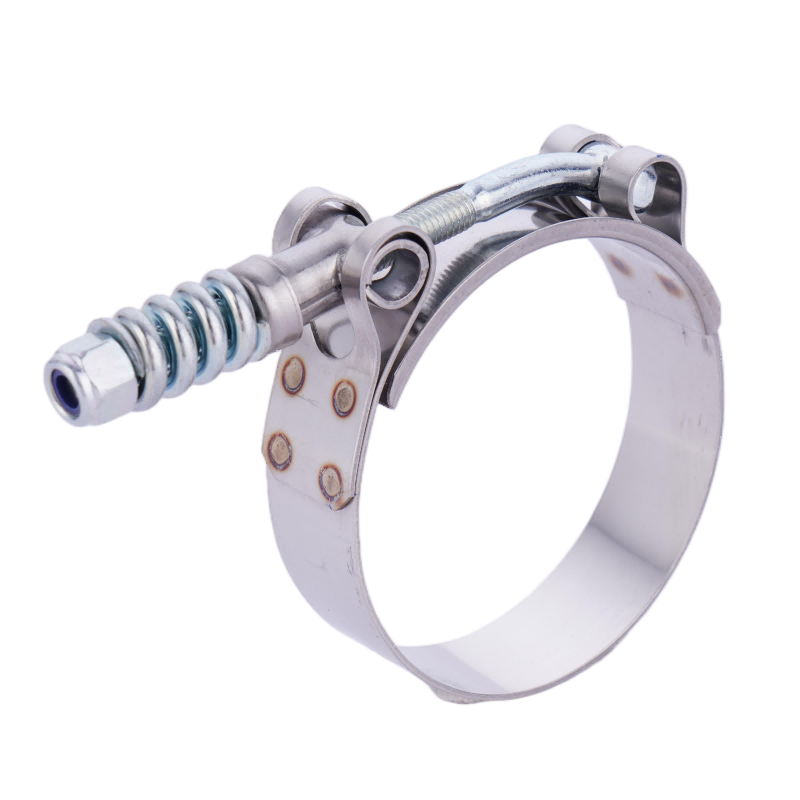
A constant tension spring clamp works differently. The spring itself is the load element, so it responds instantly to diameter changes. Both styles share one goal: hold a tight seal through every heat cycle. Each one can maintain sealing pressure as the hose shrinks and grows. That consistent load is what separates them from a fixed worm-gear band. Constant tension keeps the band alive.
Constant Tension Hose Clamps vs. Worm-Gear
Key Differences in Clamping Force
A worm-gear clamp keeps a set screw tension. Once it is tightened, the band stays at that same diameter. A constant tension clamp works in a different way. It uses spring-compensated force, so the band moves as the hose changes size. This one difference explains every other comparison between the two designs.
The worm-gear design cannot react to cold flow or thermal expansion and contraction. The hose wall gets thinner over time, and the clamp load falls with it. A constant tension clamp fights both of these effects. The spring stores energy and lets it go as the hose shrinks, which keeps the seal tight through thousands of cycles. That self-adjusting action is why constant tension clamps stop the slow leaks that trouble fixed-band designs.
| Особенность | Benefit for Charge Air Systems |
|---|---|
| Self-compensating spring | Keeps clamping force as the hose softens under heat — no re-torquing needed |
| Vibration immunity | Spring action soaks up vibration that would otherwise back off a screw clamp |
| Smooth inner liner (Aero-Seal type) | Spreads load evenly around the hose circumference, stopping cutting or point deformation |
| Suitability for silicone hoses | Silicone compresses a lot under heat, making constant-torque the standard choice in performance and OEM systems |
Когда следует выбирать режим постоянного натяжения
Several conditions favor constant tension over a worm-gear band. Severe, steady thermal cycling tops the list. Upper and lower radiator hoses, heater core connections, and coolant bypass lines all see repeated hot-cold swings. Silicone hose installations also call for it. Silicone expands more than EPDM and has a smoother surface, so a worm-gear clamp can cut into the material at the band edges under vibration.
Turbo and charge-air plumbing demands constant tension as well. Boost pipes face extreme temperature swings and pressure pulses at the same time. A worm-gear clamp that relaxed through thermal cycling can fail completely when a hard boost event pushes the hose off the fitting. Difficult access for retorquing is another reason to choose it. High-pressure environments, including boosted engines and high-flow circuits, also warrant constant tension or T-bolt designs, unlike low-pressure emission control hoses.
HWKG manufactures worm drive, bolt, band, and pipe coupling hose clamps for these varied applications. Each style matches a different pressure and temperature demand.
Applications, Sizing, and Installation
Common Uses in Automotive and Industrial Systems
Constant tension clamps are used in many industries. Car cooling systems use them on coolant tanks and radiator hoses. Small engine fuel filters depend on constant tension band clamp designs. Spa systems and flow control valves also call for them. Industrial systems in every field use these clamps to seal reliably.
Charge-air systems, coolant circuits, hydraulic equipment, and water supply and drainage all gain from them. Turbo inlet and outlet charge pipes need constant tension hose clamps because boost pressure and heat cycles put stress on the connection. Heavy-duty trucks, farm machinery, and marine engine cooling systems count on them. HVAC chilled water and refrigerant connections also use them. A maker like HWKG supplies worm drive, bolt, band, and pipe coupling clamps to fill these different needs.
Sizing, Installation, and Maintenance Tips
Good sizing begins with measuring. A technician measures the hose outside diameter after it sits over the fitting, using calipers instead of a tape measure. The clamp’s adjustable range must cover that diameter, and the screw should sit near the middle of its range. For temperature swings, pick a spring-style constant tension clamp or a T-bolt clamp with a stainless band and screw. A 304 or 316 stainless steel band fights off rust. Zinc-plated carbon steel does not last as well.
Installation takes care. Tightening too much crushes the hose and lowers sealing effectiveness. A technician places the clamp evenly, about 1/4 inch from the hose end, right over the barbed area. The band must sit parallel to the hose end. Constant tension clamp pliers work best; standard pliers can harm the clamp. After installation, the clamp should sit squarely with tabs facing away from sharp edges. Do not squeeze more after installation, because that can hurt the spring.
Maintenance is key for long service. Check for rust, distortion, or hose deformation under the clamp. In dusty or high-temperature places, check every three months. Replace any clamp that loses tension, even if it looks fine. After the first full heat cycle, let the engine cool and check again. A supplier or factory with a digital quality management system and automated production lines ensures precision in every batch. Custom solutions from an experienced manufacturer help match the right clamp to each application.
Constant tension clamps work by using a spring to hold steady pressure through temperature changes. The spring compensates as the hose expands and contracts, so the seal stays tight. This design prevents the leaks and failures that plague standard worm-gear clamps. Constant tension hose clamps are the gold standard for cooling and heating systems, and most modern cars use them from the factory. Before the next hose repair, check which clamp type the system needs. Constant tension clamps cost little more, yet they protect the whole cooling system. Inspect the vehicle’s clamps today, or ask a professional for the right fit.
Часто задаваемые вопросы
How does a constant tension clamp keep its grip?
A spring element inside the clamp stores energy. When the hose shrinks or relaxes, the spring expands and pushes the band tighter. When the hose grows, the spring compresses and absorbs the change. This action holds steady pressure without any retorquing.
Do constant tension clamps work on silicone hoses?
Yes. Silicone expands more than EPDM rubber under heat. A fixed worm-gear clamp can cut into silicone or lose its grip. A spring-loaded clamp adjusts to the material’s movement and spreads force across a wider band. This design protects the hose surface.
When should a technician choose a constant tension clamp over a worm-gear clamp?
A technician picks a constant tension clamp for coolant lines, charge-air pipes, and high-vibration systems. These places see repeated hot-cold swings. A worm-gear clamp holds one fixed diameter. The spring design self-adjusts and prevents the slow leaks that appear after many heat cycles.
How does a technician install and maintain these clamps?
The technician measures the hose outside diameter with calipers. The clamp goes about 1/4 inch from the hose end, over the barbed area. Constant tension clamp pliers work best. After the first heat cycle, the technician checks for corrosion or lost tension and replaces any weak clamp.