


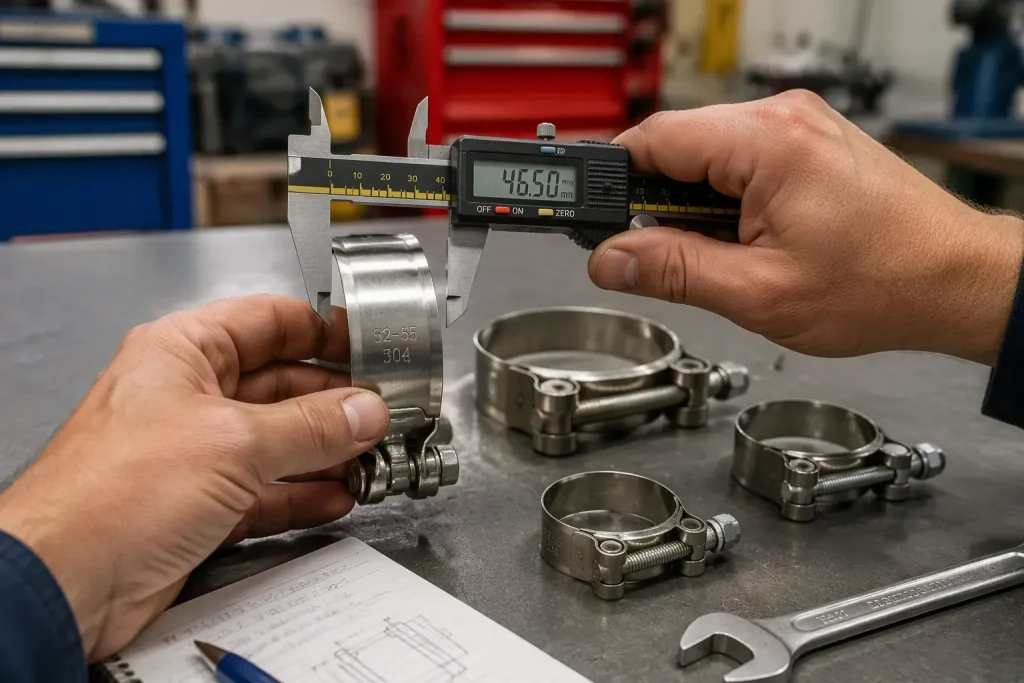
Sizing a Abrazadera de manguera con perno en T starts with the hose outside diameter, measured with the tail fully inserted. That number is then matched to the clamp size range printed on the part, which gives a reliable fit on the first try.
HWKG’s T-bolt hose clamps take this further, including spring-loaded T-bolt hose clamps alongside abrazaderas de tornillo sin fin, abrazaderas de manguera de tensión constante, y abrazaderas de banda, backed by digital quality control.A short list of common measuring mistakes follows, so a hose clamp install stays leak-free and the hose stays intact.
Puntos clave
- Measure the hose’s outside diameter while the hose is fully on the fitting.
- Make sure your measurement falls in the middle of a clamp’s size range.
- Use a torque wrench to tighten the clamp to the recommended torque.
- Don’t make common mistakes, such as measuring the bore or over-tightening.
- Use T-bolt clamps for high-pressure jobs, and use other clamps for low-pressure lines.
Measure the hose outside diameter
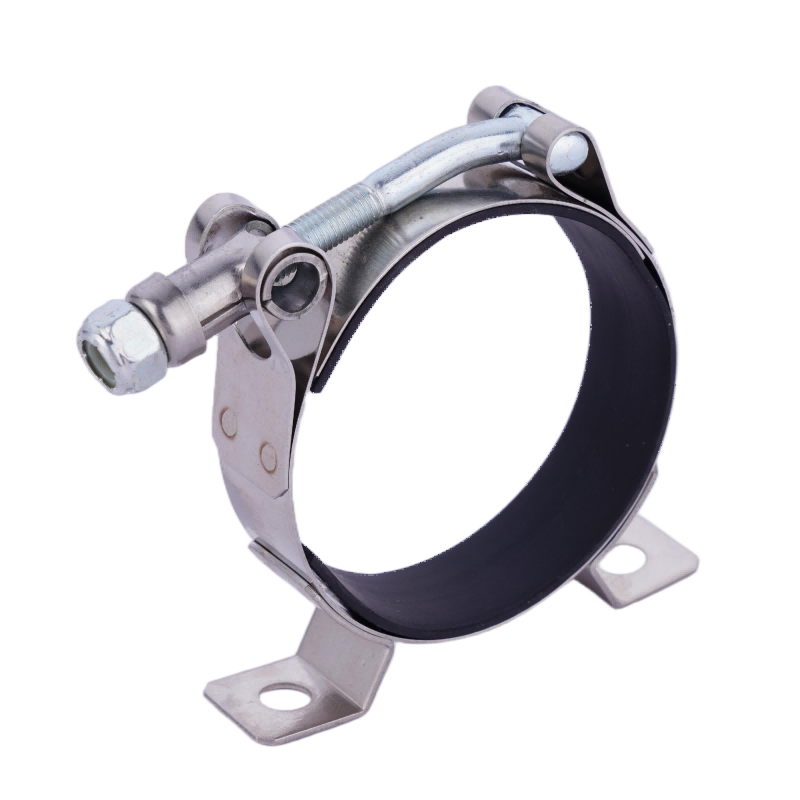
T-bolt clamps are sized by the hose outside diameter, not by the bore or the fitting size. A clamp chosen from the bore number will often land at the wrong end of its range. The hose must also be fully assembled before anyone takes a reading. Push the hose firmly onto the fitting, pipe, or barb until it seats completely, with the tail inserted. A loose or half-seated hose changes shape under the band and gives a false number.
Tools and steps for an accurate reading
Digital or dial calipers give the most precise reading for small and medium hoses. A pi tape works well on large diameters and in tight spaces where caliper jaws cannot reach. A flexible metal tape or a piece of non-stretchy string serves as a backup. Follow these steps to measure for a t-bolt clamp:
- Seat the hose fully on the fitting and find the clamp position, usually just behind the raised barb or ridge.
- Zero the calipers before use, then open the large outer jaws.
- Close the jaws gently around the hose at the clamp position. Do not squeeze hard enough to compress the hose material.
- Keep the jaws square to the hose axis. An angled reading can add a noticeable error, so a skewed caliper is a useless caliper.
- Read the value in inches or millimeters and note the unit.
For an out-of-round hose, take the reading at three or four points and average the results. A pi tape reads the diameter directly and typically offers resolution down to 0.001 inches, depending on the model, per Pi Tape. That precision helps when measuring hose OD on large assemblies.
Circumference and the pi formula
Without calipers, wrap a flexible tape or string snugly around the hose at the clamp position and record the outside circumference of the hose assembly. Then divide that number by pi, roughly 3.14159, to get the diameter. The formula reads: OD = circumference ÷ π. A circumference of 3 inches gives a diameter of about 0.955 inches. CMRP shows the same math on a larger part: a circumference of 5.97 inches divided by 3.1415 equals 1.900 inches. This method works for any hose clamp size check, though the result is only as good as the circumference of the hose reading itself.
Match OD to T-bolt clamps
A measured OD means little until it maps to a catalog number. The matching step turns a raw reading into a clamp size, and it rewards care. A clamp picked at random from a bin may close, yet it can sit at the edge of its travel and lose holding force.
Read size codes and series
Part numbers on t-bolt clamps often read as hundredths of an inch. A code of 0300 means 3.00 inches, and that figure marks the bottom of the clamp’s stated minimum-maximum diameter range, not the middle. A clamp labeled 0300 therefore spans from 3.00 inches upward to its upper limit. Readers who treat the code as the target size will land at the low end every time.
SAE sizing adds a second layer. The SAE J1508 standard uses numerical size codes such as Size 28 or Size 100, and HWKG publishes a t-bolt clamp size chart that pairs each SAE number with a metric and inch range. Size 28, for example, covers 44–52 mm or 1 3/4″–2″. A sizing guide of this kind removes guesswork, because the reader compares the measured OD against a printed range instead of a single number.
HWKG builds these clamps as an IATF 16949 certified manufacturer, and the line conforms to SAE J1508. The TX19Q and TX19B models cover the common ranges. The 304 stainless W4 grade, per HWKG, withstands 400 hours of ASTM B117 salt spray and continuous heat to 450°C.
Target the middle of the range
The industry fit standard asks for overlap between the hose’s outer diameter and the clamp’s stated minimum-maximum diameter range of at least 1–2 mm. The ideal position sits near the middle of that band. A clamp at its extreme edge has little room to compensate for hose swell, thermal growth, or slight measurement error.
Suppose the measured OD reads 50 mm. Size 34, at 50–58 mm, places the hose at the very bottom of the range. Size 30, at 46–54 mm, puts 50 mm close to center, and that choice gives the band room to tighten evenly. This logic defines the proper size for t-bolt clamps: overlap first, centering second.
Finding the nominal size for your hose clamp application starts with the measured OD, then moves to the chart. The nominal clamp size is simply the range that holds the OD near its midpoint. A reader who follows this order gets a hose clamp size that seals without stress.
Tighten the T-bolt clamp correctly
Torque and even tightening
A T-bolt clamp holds best when the installer follows a torque spec. Hose Candy reports that many t-bolt clamps call for 6–8 Nm (53–70 in-lbs) on turbocharger and intercooler hoses. A torque wrench takes out the guesswork that a hand-tightened nut leaves behind.
Even tightening matters as much as the final number. Components Solutions Group notes that bolt torque patterns use star sequences and multiple passes to spread the load. On a T-bolt clamp, the installer tightens in stages and checks the gap at the trunnion. The nylon-insert hex nut resists backing out under vibration, and HWKG offers self-locking structures rated to 250°C with nylon and 500°C in all-metal form.
When T-bolt clamps are not suitable
These clamps work great on high-pressure, high-vibration lines. Turbocharger boots, charge air cooler piping, exhaust sections, and irrigation mains all benefit from the strong radial seal and the smooth beveled edges. JLCMC notes that T-bolt clamps suit charge air, turbo boots, thick-wall hose, and low-stretch silicone, yet they need accurate sizing, add weight, and demand wrench clearance.
Other connections call for a lighter style. The right hose clamp depends on pressure, hose wall, and access:
- Wire hose clamps fit drain hoses, appliances, low-pressure tubing, and some corrugated profiles, per Dislab Precision.
- Mini hose clamps serve small tubing, pumps, and compact equipment, and they reward a gentle hand on thin-wall plastic or silicone.
- Worm gear clamps handle low-pressure air intake ducts, vacuum lines, and some fuel return lines, per Hose Candy.
- Spring clamps work well on low-pressure fuel hoses and small engine applications.
A buyer who measures the OD, checks the clamp size chart, and confirms the line pressure picks the right family. The measured od then guides the final choice, and the diameter of the hose decides whether a T-bolt clamp or a lighter style fits the job.
Common measuring mistakes
Most sizing errors trace back to the same handful of habits. A careful measure costs less time than a return, and a wrong hose clamp size means a leak or a cut hose.
Wrong surface or loose hose
A loose hose gives a false reading every time. ZS Fastener warns that silicone hose wall thickness, typically 0.10–0.18 in. per layer, adds to the total OD the clamp must hold. Anyone who sizes against the bare tube ends up with an undersized clamp.
Measuring the bore instead of the hose’s outer diameter is the second common slip. The bore describes the inside diameter, and it says nothing about the band’s grip surface. Readers should measure correctly at the clamping zone, over the hose cover, and skip the raised bead at the pipe end. Using calipers without squeezing the hose keeps the number honest.
Skipping the chart or over-tightening
Eyeballing a hose clamp from a parts bin invites trouble. A t-bolt clamp size chart pairs each range with its inch and metric limits, and the measured od should land inside one of them. Mammoth Parts publishes these ranges:
| Clamp range | Approximate inches |
|---|---|
| 63–70 mm | 2.48–2.76 in |
| 73–81 mm | 2.87–3.19 in |
| 83–90 mm | 3.27–3.54 in |
| 97–105 mm | 3.82–4.13 in |
A reading near a limit or inside two ranges deserves a second check before ordering.
Over-tightening past spec ranks as the other frequent error. Sunze’s guide pairs band sizes with recommended tightening, from 8 N·m (71 lb-in) for the 017–028 codes up to 20 N·m (177 lb-in) for the 139–252 codes. Cranking a hose clamp beyond that figure crushes the hose and distorts the band. Choosing a clamp size at the extreme edge of its range compounds the problem, since the band has no travel left to compensate. The nominal clamp size should sit near the middle, and the t-bolt clamps should reach torque in stages.
A good fit comes from following a simple order. First, measure the hose outside diameter with the tail pushed all the way in. Next, match that od to the middle of a t-bolt clamp range. Last, tighten the hose clamp to the torque spec.
Measuring the right way stops leaks, cuts, and harm to soft hose walls. A correct diameter reading guides every choice you make after it. A clamp size picked near the middle of its range keeps holding force steady through vibration and heat cycles.
Readers who need help can contact HWKG for sizing help, OEM/ODM customization, or product questions. The team helps buyers from 3D modeling through rapid tooling.
Preguntas frecuentes
How does a reader measure a hose with no calipers on hand?
A flexible tape or a non-stretchy string works well. Wrap it snugly around the hose at the clamp position and record the circumference. Divide that figure by pi to get the diameter. The result is only as good as the wrap, so keep the tape square to the hose axis.
What does the number on a t-bolt clamp actually mean?
The code reads as hundredths of an inch. A 0300 stamp means 3.00 inches, and that value marks the bottom of the clamp’s range. The band travels upward from there. A reader who treats the code as the target size lands at the low end every time.
Can a buyer skip the size chart and pick a hose clamp by eye?
No. A hose clamp size chart pairs each range with its inch and metric limits. The measured od should land inside one range, near the middle. A clamp at the extreme edge has no travel left for hose swell or heat growth. Eyeballing invites leaks and cut hose walls.
Which clamp size fits a hose that sits between two ranges?
Pick the range that holds the measured diameter closest to its midpoint. Overlap of at least 1–2 mm between the hose OD and the clamp range is the industry fit standard. A clamp near the center keeps holding force steady through vibration and heat cycles.
Does a T-bolt clamp need a torque wrench?
Yes. Tighten in stages and check the trunnion gap. The nylon-insert hex nut resists backing out, and self-locking structures handle 250°C with nylon and 500°C in all-metal form.