



P-type clamps, also known as hose clamps or cable clamps, are widely used due to the variety of sizes available. The most common sizes are 1/2 inch and 12 mm. Understanding P-type clamp sizes helps in selecting the appropriate clamp. This is crucial for securing cables, hoses, or pipes.
Key Takeaways
- P-type clamps come in various sizes. Common sizes range from 1/4 inch to 2 inches. Understanding these sizes will help you choose the right clamp for your job.
- First, measure the outer diameter of your cable, hose, or pipe. This ensures the P-type clamp is installed securely and without damage.
- Different jobs require different sizes of P-type clamps. Smaller clamps are typically used in automobiles. Larger clamps are used in ships and gardens.
- Be sure to consider the material of the P-type clamp. Stainless steel, aluminum, and plastic each have their advantages. These materials affect the clamp’s lifespan and installation performance.
- Hengwei can customize P clamp sizes to meet specific needs. If the standard sizes do not meet your requirements, you can submit custom size requests.
P-Type Clamp Size Overview

Common Size Range
Hengwei is a top manufacturer of hose clamps and P-type clamps. The company sells clamps in both standard and custom sizes, allowing users to find clamps suitable for a wide range of applications. P-type clamps are suitable for various cables, hoses, and pipes. Most companies, such as Hengwei, produce clamps with inner diameters ranging from a minimum of 6.2 mm (approximately 1/4 inch) to a maximum of 51.0 mm (approximately 2 inches). Some special-purpose clamps are even larger to meet the needs of specific projects.
The following table lists commonly used P-type clamp sizes:
| Inside Diameter (mm) | Inside Diameter (inches) |
|---|---|
| 6.2 | 1/4 |
| 8.0 | 5/16 |
| 10.0 | 3/8 |
| 12.0 | 1/2 |
| 16.0 | 5/8 |
| 19.0 | 3/4 |
| 25.0 | 1 |
| 32.0 | 1 1/4 |
| 38.0 | 1 1/2 |
| 44.0 | 1 3/4 |
| 51.0 | 2 |
Common Sizes (Inches and Millimeters)
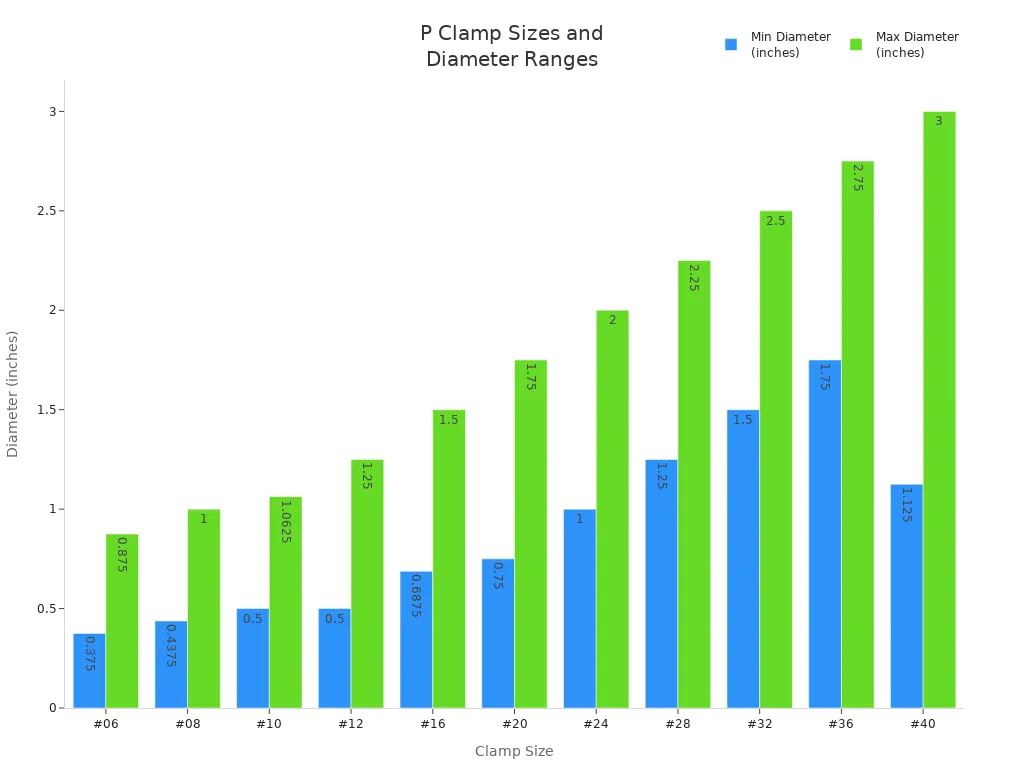
P clamp sizes are expressed in inches and millimeters. This helps users select the appropriate clamp for their project. For example, a clamp with an inner diameter of 12 millimeters is suitable for 1/2-inch pipes or cables. Some clamps use numbers such as #06 or #12 to indicate their size.
The table below lists commonly used P-clamp sizes in kitchens, gardens, and boats:
| Clamp Size | Outside Diameter Range |
|---|---|
| #06 | 3/8″ – 7/8″ |
| #08 | 7/16″ – 1″ |
| #10 | 1/2″ – 1 1/16″ |
| #12 | 1/2″ – 1 1/4″ |
| #16 | 11/16″ – 1 1/2″ |
| #20 | 3/4″ – 1 3/4″ |
| #24 | 1″ – 2″ |
| #28 | 1 1/4″ – 2 1/4″ |
| #32 | 1 1/2″ – 2 1/2″ |
| #36 | 1 3/4″ – 2 3/4″ |
| #40 | 1 1/8″ – 3″ |
Commonly Used Sizes in Different Industries
Different industries use different sizes of P-clamps based on their specific needs. In the automotive industry, the most common P-clamp sizes range from 0-10 mm. These small clamps are ideal for securing cables and hoses in confined spaces, such as the engine compartment or dashboard interior. P-clamps in the 25-50 mm range are also becoming increasingly popular as larger vehicles require more robust clamps.
| Diameter Range (mm) | Usage Frequency in Automotive Industry | Notes |
|---|---|---|
| 0-10 | Most frequently used (dominant) | Used in small assemblies and lightweight vehicles. |
| 25-50 | Emerging segment | Used in mid-sized vehicles for robust clamping. |
| Over 100 | Fastest growing segment | Used in heavy-duty vehicles and machinery. |
P-type clamps, such as #06 (3/8″ – 7/8″) and #12 (1/2″ – 1 1/4″), are very common in kitchens, gardens, and boats. These sizes are suitable for most household hoses, pipes, and cables. For example, neoprene P-type clamps with an inner diameter of 34 mm (1 1 1/32 inches) are commonly used in automobiles, camping, and mining to secure pipes, wires, and cables.
- Automotive: 0-10 mm and 25-50 mm sizes are suitable for cables, fuel lines, and hoses.
- Kitchen: #06 to #12 sizes are suitable for water pipes and electrical hoses.
- Garden: #16 to #24 sizes are suitable for irrigation and outdoor equipment.
- Boat: #10 to #20 sizes are suitable for securing wires and pipes on board.
P-type clamps ensure the safety of cables, hoses, and pipes in various industries. Hengwei offers a variety of sizes and customization options to help users find the most suitable fixture for their projects.
P-type fixture size measurement

Diameter Measurement Methods
People determine the size of P-clamps by checking the inside diameter. This tells them what items can fit inside the clamp. Several tools are available to help measure the diameter.Telescoping gauges line up by themselves and give fast, correct results.
- Telescopic gauges align automatically and provide quick, accurate measurements.
- Micrometers are ideal for precisely measuring small clamps.
- Sunnen inside micrometers are excellent for checking minute differences.
These tools help people choose the right clamps. Precise measurements prevent leaks and ensure a secure connection.
Using Calipers for Precise Dimension Measurements
Calipers are commonly used to measure the size of P-clamps. Simply insert the calipers inside the clamp to obtain the measurement. Digital calipers display the values on a screen, making them easy to use. Manual calipers require you to manually read the scale. Calipers work with most clamps, but micrometers are better for small clamps. People use calipers to check the inside diameter and thickness of clamps. This helps them choose the right clamp for the job.
Tip: Always measure the item you need first, and then check the clamp size to ensure a fit.
Read the Manufacturer’s Label
Manufacturers affix size labels to P-type clamps. The labels show the inner diameter, in millimeters or inches. Some labels use codes such as #06 or #12. Hengwei affixes clear labels to its clamps. These labels help users quickly select the appropriate clamp. Users can also refer to Hengwei’s size chart for size comparison. Hengwei adheres to strict specifications to ensure dimensional accuracy. The company holds numerous certifications:
| Certification | Description |
|---|---|
| ISO9001 | Quality management system certification |
| IATF16949 | International quality management system for automotive industry production parts |
| ISO14001 | National environmental management system |
| ISO45001 | Health and safety management system |
| CUPC | Certification from the American International Plumbing and Heating Mechanical Certification Association |
These certifications demonstrate Hengwei’s commitment to quality and precision. You can trust Hengwei clamps; their products match the labels and meet your needs.
Choosing the Right P-Type Clamp Size
Matching the Clamp to the Cable, Hoose, or Pipe
To choose the right P-type clamp size, you need to know the diameter of the object you want to secure. Measure the outer diameter of the cable, hose, or pipe. This ensures the clamp is installed securely, neither too tight nor too loose. Your specific application is also important. For example, clamps used for fluid lines must withstand greater pressure than clamps used for cables.
The following table lists some important considerations:
| Factor | Description |
|---|---|
| Application Type | Some clamps work better for fluid lines, others for hoses and cables. |
| Pressure & Load | High-pressure jobs need special clamps to stay safe. |
| Environment | The material you pick should last in the place you use it. |
| Material & Size | The right size stops hoses from breaking or failing. |
| Maintenance Considerations | Reusable clamps help if you check them often. |
When selecting clamps, always choose the appropriate size based on the diameter and intended use of the item.
Consider Insulation or Outer Layers
Many cables and hoses have additional layers such as insulation. These layers increase the thickness of the item. When measuring, be sure to take all layers into account. This avoids choosing clamps that are too small. If the clamp is too tight, it may damage the insulation or the item itself. If the outer layer is thick, a larger clamp may be necessary.
Tip: Always measure the item, including all layers, before selecting clamps.
Tips for Accurate Selection
Choosing the right clamp involves more than just measuring dimensions. You should also consider the environment in which the clamp will be used. Outdoors or on a ship, stainless steel or rubber-lined clamps have a longer lifespan. In places with frequent movement, a tight clamp can prevent items from shifting or abrading. Hengwei can customize clamps for special purposes. If needed, their team can design different sizes or materials.
P-clamps are available in a variety of sizes to meet almost any application. Carefully selecting the right P-clamp ensures the secure hold of cables, hoses, and pipes.
Size Differences and Standards
Material and Manufacturer Differences
Different companies use different materials to manufacture P-clamps. Some use steel, aluminum, or fiberglass-reinforced plastic. Steel clamps are strong and durable. Aluminum clamps are lighter and suitable for simple operations. Fiberglass-reinforced plastic is tough, durable, and resistant to wear. Different materials affect the performance and installation of the clamp. Metal clamps are heavier and require careful installation. Plastic clamps are lighter and help prevent wobbling.
Note: Many P-clamps come with rubber or plastic gaskets. These gaskets protect cables and conduits and prevent the clamp from shifting.
Custom and Special Sizes
Some operations require specially sized P-clamps. Companies like Hengwei customize clamps to meet these needs. Custom clamps may vary in arm length, shape, or material. These variations help the clamp fit special tools or confined spaces.
| Type | Flex System |
|---|---|
| Material | Nickel plated |
| Dimensions | 5 in x 0.5 in x 5 in (127 mm x 13 mm x 127 mm) |
| Item Number | 30400011 |
The Impact of Material on Installation Results
The material of a P-type clamp affects its installation results and performance. Stainless steel with a rubber liner ensures safety and prevents friction. EPDM liner securely holds pipes and cables without damage. The liner also absorbs vibration and prevents water ingress. Rubber liner is prone to deformation in high or low temperature environments. EPDM rubber is oil and heat resistant, resulting in superior clamp performance.
- The material also affects the clamp’s weight and strength.
- Metal clamps are strong and less prone to deformation.
- Fiberglass-reinforced plastic clamps produce less noise and vibration.
- Rubber liners help the clamp fit better and protect the fixed object.
P-type clamp sizes vary depending on the material, manufacturer, and specific requirements. These differences help users find the best clamp for various applications.
P-type clamp sizes vary depending on the application, so measuring and selecting the appropriate size is crucial. Users should always check the clamp dimensions and the dimensions of the fixed object. Manufacturers like Hengwei provide size charts that simplify these steps:
- Measure the thickest part of the hose.
- Record the dimension in millimeters or inches.
- Refer to a clamp size chart for comparison.
- Choose a clamp that is neither too tight nor too loose.
- Measure again after installing the hose.
Having a list of commonly used sizes is helpful in many ways:
| Feature | Benefit |
|---|---|
| Faster installation time | Makes the job quicker and saves work costs |
| Quick-lock feature | Lets you change things fast when putting clamps on |
| Minimizes risk of FOD | Keeps harnesses safe and working well |
| Flexible assembly | Helps you build different projects easily |
| Weight savings | Saves money by using less heavy material |
FAQ
What are the uses of P-clamps?
P-clamps are used to secure cables, hoses, or pipes, preventing them from shifting or being damaged. Many jobs use P-clamps to ensure safety and tidiness.
How to measure the size of a P-clamp?
Check the inner diameter of the clamp. Use calipers or a ruler to measure the appropriate size. Always measure the item containing all layers before selecting clamps.
Can Hengwei customize P-clamp sizes?
Yes. Hengwei can customize P-clamps to special sizes for different projects. Their team will design clamps based on unique shapes, materials, or installation locations.
What materials are P-clamps made of?
| Material | Feature |
|---|---|
| Stainless steel | Strong and does not rust |
| Aluminum | Light and easy to use |
| Plastic | Cuts down on shaking |
| Rubber-lined | Keeps surfaces safe |