





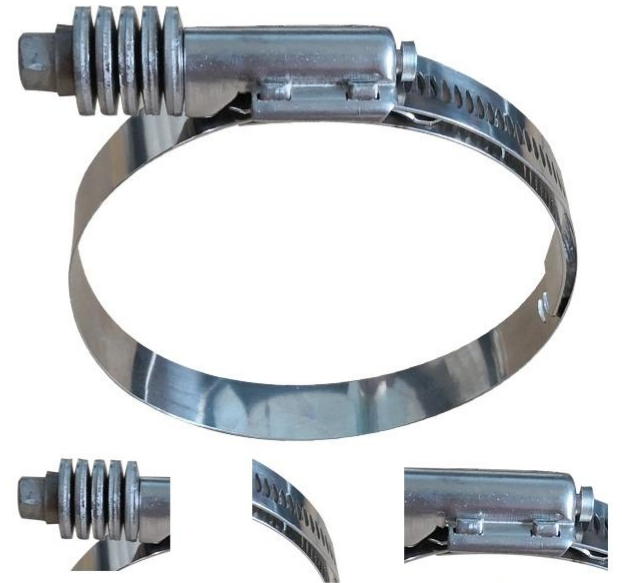
You can reuse Spannvorrichtungen mit konstanter Spannung, but only under strict conditions and after a careful inspection. A driver faces a choice between saving money and risking a serious failure. Is saving a few dollars on a clamp worth the risk of a coolant leak on the highway? This guide explains how to evaluate a clamp for reuse, what to inspect, and when replacement is the safer choice.
Die wichtigsten Erkenntnisse
- Reusing constant tension clamps could cause metal fatigue and corrosion. Inspect for rust, cracks, and spring wear.
- Replace clamps on important systems like fuel lines and turbochargers. A new clamp costs very little compared to fixing engine damage.
- Follow the safest rule: if you are unsure, get rid of it. A new clamp is cheap insurance for dependable performance.
Why Reusing constant tension clamps is Risky
A constant tension spring clamps keeps steady pressure on a hose connection. The metal band bends again and again as temperatures change and hoses squeeze. Over time, this constant movement wears down the material. Even good constant-tension clamps eventually stop working well.
The Mechanics of Tension and Wear
Heating and cooling cycles put repeated stress on the clamp. Each cycle bends the metal band. These bends slowly add up,causing metal fatigue over time, potentially before the hose clamp reaches the end of its service life. After hundreds of cycles, the spring steel loses its strength.
Corrosion makes this wear happen much faster. Road salt has chloride ions that attack the metal surface. These ions create small pits on the band. Each pit becomes a weak spot when the band bends. The stress at these pits increases drastically. Once a tiny crack starts at a pit, it spreads quickly.
Data from different areas backs this up. Clamps fail much more often in salt-belt places like Cleveland. Warmer, drier spots like Phoenix see far fewer failures. This shows that corrosion accelerates fatigue under thermal cycling.
Heat from nearby parts also hurts the metal. Brakes or exhaust pipes can get hot enough to soften spring steel in certain spots. That softening makes the clamp even weaker against fatigue.
The High Cost of a Failed Clamp
A weak worm-drive clamp cannot hold tight anymore. The connection loosens little by little. Coolant hoses may start with small leaks that get worse. Fuel lines face similar problems where vibration is strong. Every connection needs the right amount of clamping force.
When a clamp fails, the damage goes beyond a simple drip. An engine can overheat and warp its cylinder heads. Losing coolant can wreck the engine completely. One bad clamp on a fuel line can even start a fire.
Now compare that to the price of a new clamp. Good self-adjusting clamps from trusted brands cost just a few dollars. A wholesale supplier like HWKG factory sells strong stainless steel heavy-duty hose clamps made with care. These products are tested hard to make sure they last.
Special clamps exist for unique jobs, but the cost of a new one is still small. A failure, on the other hand, could mean repair bills in the hundreds or thousands. Smart shoppers pick dependability over saving a little money now.
How to Inspect Constant Tension Clamps for Reuse
A careful check shows if a clamp can be used again or is too risky. The process takes just a few minutes, but you must be honest. A clamp that looks fine at first glance might have serious damage hidden under dirt or light rust.
The Visual and Physical Inspection Checklist
Start by cleaning the clamp well. Grease, old coolant, and road dirt can hide problems. Use a wire brush or brake cleaner to remove these layers and see the real surface. After cleaning, look at the whole band in good light.
Rust means you need to act fast. Corrosion shows up as orange flakes or small pits on the metal. Rust grows and takes up more space, which lowers the clamp’s holding power. The band gets weaker, loses its grip, and could break under pressure.
Check for cracks, bends, or sharp edges on the band. A bent band cannot spread pressure evenly around the hose. Bends often happen when someone stretched the clamp too far. A stretched band never returns to its original size, so the connection stays loose.
Now test the spring action. Squeeze the clamp’s ears all the way open, then let go. A healthy spring hose clamp snaps back fast and cleanly. If the ears stick, feel soft, or return slowly, the spring is worn out. Throw it away without thinking twice.
Put the clamp on the hose without the fitting as a last test. It should fit snugly. If the hose slides through easily, the clamp has lost too much tension. Also mark the clamp’s position before removing it. Many clamps have a correct side that lines up with the hose bead. Putting it on backward can cause leaks.
One mechanic found clamps that looked perfect but had tiny cracks from corrosion. They broke during reuse. Visual checks cannot always find this damage.
When to Discard and Buy New
Some conditions mean you must replace the clamp no matter how it looks. Any visible spring wear, rust pits, or over-stretching means the clamp goes in the trash. High-torque systems like fuel injection or power steering need new parts every time.
Where the clamp was used also matters. A clamp from a high-vibration area or near extreme heat, like an exhaust or turbocharger, should never be used again. Those environments cause metal fatigue that the eye cannot see.
Industry practice gives guidance. Original equipment makers usually say to replace any clamp taken off a pressurized system. Aftermarket suppliers suggest checking and replacing if damage appears. Experienced mechanics reuse clamps on non-critical lines but replace anything that could cause a breakdown.
The safest rule is simple: when in doubt, throw it out. A new stainless steel clamp from a good maker costs little. Wholesale suppliers and factories make these parts with care, so they work reliably. Protecting coolant hoses and other connections with new hardware costs far less than fixing engine damage from a failed clamp.
When Not to Reuse a Constant Tension Clamp
Critical Uses That Require New Clamps
Some systems need a new spring hose clamp every time. Fuel lines need exact clamping force. Reusing a clamp on these lines is unwise. High-pressure power steering hoses need exact tension to stop leaks. Any pressurized system, like coolant hoses, requires a new clamp. German luxury car makers say to use the clamp only once. The BMW N54 engine manual says you must replace it after removal to stop boost leaks.
How Vibration and Temperature Affect the Clamp
The clamp’s spring steel band stores energy even when it is tight. Under fast vibration, this part absorbs shock like a damper. But this self-compensation works only when the spring is not worn out. Very high heat and vibration reduce the stored energy. The clamp loses its ability to adjust for heat expansion and absorb vibration.
| Zustand | Empfehlung | Grund |
|---|---|---|
| Normal environment, no damage | Reuse | Clamping force and self-compensation are still good |
| High heat and strong rust | Do not reuse | Clamping force and self-compensation may have dropped |
| Spring tired and bent | Do not reuse | Self-compensation does not work well |
| Used a long time with surface rust | Do not reuse | Clamping performance may be worse |
What Happens If You Reuse a Clamp on Turbocharger or Exhaust
Reusing a clamp on a turbocharger or exhaust is risky. A leak lets compressed air escape before it reaches the combustion chamber. The engine loses power during acceleration. If the compressor housing leaks, oil goes into the combustion chamber and burns. This makes the engine run rough or smoke more. A bad air-fuel mix causes poor burning and more fuel use. A V-profile clamp shapes to its own flange over time. Taking it off and using on a different flange leads to bad fit and leaks. The metal bends when tightened, which weakens it for good.
The decision requires evaluating condition, history, and application criticality. Reusable constant tension clamps offer flexibility for non-critical systems. One-time use clamps provide a secure seal for high-risk applications. Yet, the risk often outweighs the savings. The safest rule: when in doubt, throw it out. A new spring hose clamp is cheap insurance for reliable operation.
Häufig gestellte Fragen
How many times can a constant tension clamp be reused?
No maker gives a single number that works for all clamps. Every time you take a clamp off and put it back on, the spring band gets more stress. A clamp taken off once from a place with little shaking might be okay to use again. Taking it off many times makes the metal weaker step by step. Most suppliers say to use a new clamp for important systems.
Does cleaning a clamp restore its original clamping force?
Cleaning gets rid of dirt and rust on the surface, but it cannot fix spring steel that is already worn out. Once heat cycles have taken away the metal’s strength, no cleaner can bring the tension back. A clean but weak clamp will still fail. Getting a new one is the only sure fix.
What makes HWKG stainless steel clamps a good replacement choice?
HWKG factory makes clamps using automated lines with digital checks for quality. Every stainless steel part goes through high-pressure testing and spark detection. Wholesale buyers get steady products backed by more than 20 years of making experience. Custom options are available for special uses.