





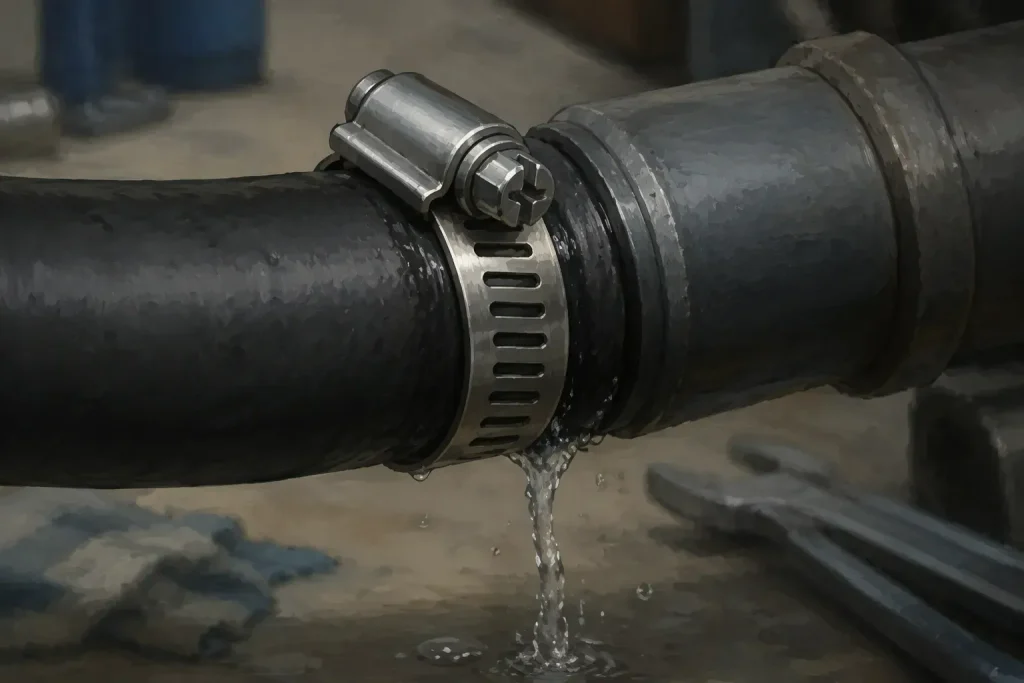
A tight Schlauchschelle only means the band sits snug against the hose, and tightness alone does not create a seal. Four problems cause most failures: incorrect installation and tightening force, a wrong clamp or hose size, a damaged or worn hose, and a deformed clamp that has lost its memory.A coolant leak that keeps returning usually traces back to one of these causes, and the screw can feel tight while fluid still seeps past the connection.
HWKG’s hose clamps take this further, with Schneckenantriebsklemmen, Schlauchschellen mit konstanter Spannung, T-Bolzen-Klemmen, band clamps, and pipe couplings, backed by digital quality control and in-house R&D.This guide covers each cause, the symptoms to watch for, and the fix, so a persistent coolant leak can be traced at the source.
Die wichtigsten Erkenntnisse
- A tight clamp does not always mean a good seal. Check how it is installed, its size, the hose condition, and the clamp shape.
- Most leaks come from the wrong tightening force or placement. Put the clamp behind the fitting bead and tighten it firmly without crushing it.
- Match the clamp and hose size to the fitting; measure the hose diameter and pick a clamp that fits right.
- Replace worn or damaged hoses and bent clamps; these cannot seal even if you tighten them perfectly.
- Find the real cause before you tighten it again; fixing the true problem stops leaks from coming back and saves time.
Why a Tight Hose Clamp Still Leaks

Tightness Is Not a Seal
Many drivers and maintenance technicians share a common habit. They turn the screw until it stops moving and assume the job is done. That action only proves the band has reached its mechanical limit. It does not prove the connection holds fluid. A hose clamp works by compressing rubber against a metal fitting. The seal depends on even pressure around the full circumference. A tight screw can sit on a hose that is too large, a fitting with a worn bead, or a band that has lost its shape. In each case, the band feels secure while leaks continue. The screw mechanism only pulls the band tighter. It does not center the hose on the fitting or reshape worn rubber.
Consider a common example. A technician replaces a radiator hose and tightens the band until the screw will not turn further. The connection still drips after the engine warms up. The band has compressed one side of the hose more than the other. The screw reached its limit, but the rubber never seated evenly against the fitting bead. Force cannot correct an uneven fit. It only hides the problem until pressure builds. The same pattern appears in plumbing and irrigation systems. A tight band on a misaligned pipe coupling leaves a slow drip that no amount of turning will stop. The clamp cannot compensate for a hose that has lost its flexibility.
The Four Real Causes
Diagnosis starts with recognizing that a clamp leak rarely comes from insufficient force. Four underlying problems explain most cases. First, incorrect installation and tightening force leave gaps or deform the band. Second, a wrong band or hose size prevents full compression against the fitting. Third, a damaged or worn hose cannot seal even under perfect pressure. Fourth, a deformed band or one that has lost its memory cannot hold tension over time. A hose that has swollen or softened cannot resist compression. The band may tighten, but the rubber yields under pressure and allows fluid to pass.
Each cause produces different symptoms. A leak at the clamp that appears only when the engine is cold points toward a fit or memory problem. Fluid that seeps steadily after tightening suggests a damaged hose or a misplaced band. A band that sits away from the fitting bead leaves a visible gap. A hose with hardened rubber feels stiff and may show small cracks near the connection. A band that has lost its spring cannot maintain pressure through temperature cycles. It may feel tight at room temperature and loose after the engine cools. A band that has lost its memory may look fine on the outside. The screw cannot restore that lost spring. Readers can match their own observations to the sections below. The body of this guide covers each cause in detail, with the checks and fixes that resolve it. Tightening harder rarely solves a fit problem. It often makes the next failure worse. A careful inspection of the hose, the fitting, and the clamps themselves prevents repeated leaking and saves the cost of a second repair. Different clamps suit different fittings, and matching the style to the application matters as much as the torque applied. Manufacturers like HWKG supply multiple styles for these varied uses. Experienced technicians check three things before reaching for a wrench. They inspect the hose surface for cracks and soft spots. They confirm the band sits behind the fitting bead. They verify the band matches the hose diameter. These steps prevent most repeat failures.
Incorrect Installation and Tightening Force
Installation errors cause most hose clamp failures. Incorrect installation is the most common cause of a leaking connection. A technician can choose the right part and still get a leak from poor placement or wrong force. The band needs the correct amount of tightening. Too little force leaves gaps between the rubber and the fitting. Too much force deforms the band and weakens its grip. Both mistakes produce the same result: a connection that looks secure but still drips. A first-time installer often turns the screw until it will not move. That habit hides the real problem instead of fixing it.
Coolant Leak at the Clamp: Symptoms
A coolant leak at the clamp often shows up as dried residue or a wet streak near the fitting. Drivers may notice a sweet smell after the engine warms up. A puddle under the radiator points to a steady leak. Some cases show fluid seeping around the clamp only when the system pressurizes. Others leave fluid oozing from under the clamp edge after the engine cools. A slow weeping leak may leave a white or crusty trail along the fitting. These signs suggest a placement or force problem rather than a worn hose. A technician should wipe the area clean, run the engine, and watch for the first sign of moisture. That step reveals whether the leak starts at the band edge or along the hose body. A coolant leak that returns right after a fresh install points to the band position. Small leaks grow once system pressure rises.
Correct Placement and Torque
Placement decides whether the band can seal. The clamp must sit just behind the fitting bead, not on top of it and not far back on the hose. A band placed too far from the bead leaves rubber unsupported. The hose can slip or balloon under pressure. A clamp that sits crooked will pull one side of the hose tighter than the other. The screw feels firm, but the seal stays uneven. A band on a curved section cannot compress evenly. The curve forces uneven pressure on one side and leaves a gap on the other. Two clamps fighting each other create the same problem. Each band pulls the rubber in a different direction, and neither seats properly. Installers should slide the band into position by hand before turning the screw. That habit catches placement errors early.
Correct force matters as much as position. Over-tightening crushes the hose wall and distorts the band. The band may cut into soft rubber or lose its round shape. A deformed band cannot apply clamp pressure around the full circumference. Technicians should tighten until the band compresses the hose firmly, then stop. The rubber should not bulge past the band edge. Worm drive, bolt, and band clamps each suit different jobs. Each of these clamps has its own feel at the correct tension. A manufacturer like HWKG supplies all three styles for automotive, plumbing, and sanitary work. Experienced technicians check the band after the first heat cycle. Rubber settles, and the band may need a small adjustment. Good placement and measured force prevent most repeat failures on coolant hoses.
Clamp Size and Hose Fit
Fit decides whether a clamp can seal at all. A hose too large for the fitting will not seal no matter how tight the clamp is. The rubber bunches instead of compressing evenly. A hose too small can be forced onto the fitting, yet it may still leak. The stretched rubber cannot relax against the bead, and small gaps open under pressure. Incorrect hose size is a frequent root cause that technicians overlook.
Leaking Hose at the Clamp: Fit Checks
A leaking hose at the clamp often shows a pattern. Fluid seeps evenly around the band edge, or the hose slips back from the bead under pressure. A technician should check the fitting diameter against the hose bore before tightening anything. The hose should slide on with mild resistance and sit fully over the bead. A loose fit or a forced fit both signal a size problem.
An undersized or mismatched clamp cannot fully compress the hose against the fitting. The band bottoms out on the fitting before the rubber seats. Improper clamp selection produces the same result. A wide band on a narrow hose buckles. A narrow band on a soft hose cuts in. The clamp must match both the hose diameter and the application.
Measuring Clamp and Hose
Measurement removes guesswork. A technician measures the hose outside diameter with the hose fitted, then selects a clamp whose range covers that figure near its middle. A clamp sized at the end of its range holds less reserve tension.
Clamp style matters as much as size. A manufacturer such as HWKG supplies worm drive, heavy-duty bolt, band, and pipe coupling clamps, and each style fits a different job. Worm drive clamps suit automotive coolant hoses and general repair. Heavy-duty bolt clamps fit high-vibration industrial lines. Band clamps with rubber cushions absorb vibration in sanitary and light plumbing work. Pipe couplings join cast iron, PVC, and steel pipes in drainage and irrigation. A supplier can advise on wholesale quantities and custom sizes for specific systems.
Clamp Deformation and Memory
Finding the Leak at the Clamp
A deformed band often hides its fault. Over-tightening crushes the band out of round, and the part loses its ability to fasten and seal. External impact bends the band in the same way. A bolt turned past its limit distorts the housing. The band may still feel firm under a screwdriver, yet it cannot press evenly around the fitting. A technician should confirm the leak is at the clamp before blaming the rubber. Wipe the joint dry, run the system, and watch where moisture first appears. When the leak is at the clamp interface, residue usually marks the band edge rather than the hose body.
Hose clamp memory is an overlooked cause of a persistent leak, especially for DIYers and apprentices. A band that has lost its spring or shape will not hold tension, even when it feels tight. Heat cycles relax the metal, and the band slowly releases its grip. The screw stays put, but the metal no longer springs back against the rubber. Many clamps fail from memory loss alone. A part with good memory returns to shape after compression. A tired one stays flattened.
When to Replace the Clamp
Corroded clamps and worn fittings also prevent full compression. Rust pits the band and roughens the fitting bead, and the rubber cannot seal against either surface. Before buying a new part, inspect the clamp for cracks, distortion, and heavy corrosion. Then inspect the hose for cracks, cuts, and hardened rubber. Hose damage and hose deformation both mimic a bad band. Soft or swollen rubber yields under pressure, and no band can fix that.
Replace the band when it will not hold shape, when the screw strips, or when corrosion has thinned the metal. Replace the hose when the rubber feels stiff or shows surface cracks. A supplier such as HWKG offers worm drive, bolt, and band clamps for coolant hoses and other systems, and matching the style to the job prevents repeat failures. If hose leaks at the clamp keep returning after a fresh install, check the hose and fitting first. A new band on a worn hose only postpones the next failure.
A tight clamp is not a sealed connection. The screw only proves the band has reached its limit.
Four causes explain most failures. Incorrect installation and force leave gaps or crush the band. A size or fit mismatch stops full compression. Hose damage defeats even pressure. Clamp deformation or memory loss releases tension over time.
Readers should check the hose and the fitting before turning the screw harder. A technician who finds the true cause fixes the leak once. Cranking the clamp down again rarely helps. Diagnose first, then repair. Do not retighten the clamp and hope the leak stops. Well-matched clamps reward careful inspection.
Häufig gestellte Fragen
Wie fest sollte eine Schlauchschelle angezogen sein?
The band should compress the hose firmly against the fitting without crushing the rubber. The hose should not bulge past the band edge. A technician stops turning once the connection feels solid. More force does not add sealing power. It only risks distorting the band.
Why does a coolant leak return after a fresh clamp install?
A returning leak usually points to a cause the installer missed. The hose may be swollen, the band may sit off the fitting bead, or the clamp may have lost its memory. A new band on a worn hose only postpones the next failure. Inspect the hose and fitting first.
Should a technician retighten a leaking clamp or replace it?
A small adjustment after the first heat cycle can help, since rubber settles. Persistent weeping calls for diagnosis instead. A band that will not hold shape, shows corrosion, or has a stripped screw needs replacement. Repeated tightening rarely fixes a fit or hose problem.
How does clamp style match the application?
Worm drive clamps suit automotive coolant hoses and general repair. Heavy-duty bolt clamps fit high-vibration industrial lines. Band clamps with rubber cushions absorb vibration in sanitary work. Pipe couplings join cast iron, PVC, and steel pipes. A reputable manufacturer or supplier can advise on wholesale quantities and custom sizes.
Can a wrong-size clamp cause a leak even when tight?
Yes. An undersized or mismatched clamp bottoms out before the rubber seats against the fitting. A band sized at the end of its range holds less reserve tension. Technicians should measure the fitted hose diameter and choose a clamp whose range covers that figure near its middle.