


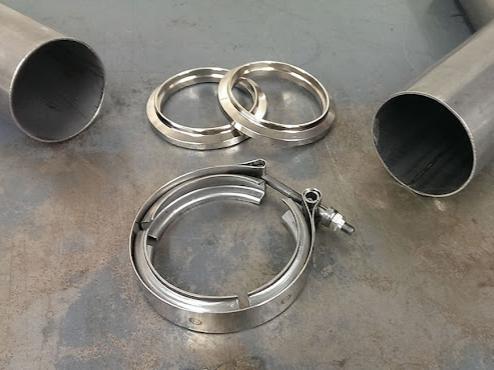
A T-bolt clamp is a heavy-duty hose clamp built for charged-air connections such as intercooler piping. Its wide band spreads high, even clamping force across the hose, which helps the connection hold under boost. That single trait explains why many experienced builders trust it on intercooler setups—though the ideal choice can still shift with boost level, pipe material, and budget. A stock daily driver and a high-boost race build rarely share the same hardware.
HWKG’s T-bolt clamps take this further, combining a wide stainless band with a rolled edge that protects the hose under load, and the same range covers worm drive clamps, quick release clamps, band clamps, and pipe couplings for other points in the system. Each clamp type earns its place in a specific scenario, and the sections below cover where each one fits best—so matching clamp style to your charged-air setup gets you a tighter, more reliable seal under load.
Key Takeaways
- T-bolt clamps are the best overall choice for intercooler piping because they hold tight under boost.
- Match the clamp type to your boost level and pipe material to prevent leaks and blow-offs.
- Use spring-loaded or constant-torque clamps on silicone hoses that see repeated heat cycles.
- Worm gear clamps work well for low-boost and budget builds, but they cost less and hold less force.
- Always measure the hose outside diameter to pick the right clamp size for a secure fit.
Key Factors for Hose Clamps

Boost Pressure and Clamping Force
Boost pressure sets the first filter for clamp selection. A clamp must hold the joint closed when charged air pushes outward. The pressure rating of each clamp type tells a builder where it belongs.
| Clamp Type | Pressure Rating | Notes for Intercooler/Turbo Piping |
|---|---|---|
| T-bolt clamps | 150–300 PSI | Standard choice for intercooler and turbocharger connections |
| Standard worm gear clamps | 15–30 PSI boost (works only with rigid internal support) | Not recommended above 20 PSI; use T-bolt or constant-tension spring clamps instead |
A T-bolt design delivers high clamp force across a wide band. That even load keeps the joint sealed when boost spikes. A worm clamp suits low-boost and stock applications well. It works best with rigid internal support and moderate pressure. Builders who plan to raise boost later should pick a clamp with headroom to spare.
Pipe Material, Heat, and Cost
Pipe material changes how a clamp behaves. Silicone couplers compress and expand with heat, so the clamp must keep tension through those cycles. Aluminum intercooler piping stays rigid, and the clamp mainly needs to grip without crushing the bead. Steel pipes tolerate strong clamping force with little risk of distortion.
Heat and cost round out the checklist. Charged air runs hot, and the clamp band must resist corrosion and thermal cycling over time. Stainless steel bands handle that duty well. Cost matters too, and the price gap between clamp styles is real. A builder on a tight budget can still find dependable hose clamps for a stock setup. Compliance is the last box to tick. Buyers should confirm the clamp meets the spec their application or inspector requires. Ease of installation also counts, since a clamp that fits the tool and the space saves time on the job.
Comparing Automotive Hose Clamps
Two clamp families dominate charged-air work. Worm gear clamps tighten through a screw-driven band, and T-bolt clamps pull a bolt through a trunnion to load a wide band. Each design serves a distinct range of boost and pipe material.
Worm Gear Clamps
A worm clamp suits low-boost and stock applications well. HWKG worm drive clamps show the pattern: a precision-perforated steel band, a one-piece housing, and high-torque fastening that holds a firm grip on the coupler. The band cuts perforations that the screw threads engage, and that engagement sets the clamp’s holding power.
Heat cycling exposes the limits of this design. Metal changes size with temperature, so clamping force varies and seals can loosen through thermal cycles. The uneven contact area where the worm screw meets the band is a known weak point. Under boost, a worm clamp can let an intercooler hose blow off. These are the conditions where constant-tension designs earn their keep:
- Clamping force shifts as metal expands and contracts with temperature
- The screw-to-band contact area loads unevenly
- Boost pressure can push a hose off the joint
- Hose relaxation over time reduces sealing force
Compliance is straightforward. Standard worm drive clamps follow SAE J1508, and high-torque versions meet SAE J1508 Type F. The table below shows typical band widths and torque values.
| Clamp Type | Band Width | Recommended Installation Torque | Standard |
|---|---|---|---|
| Standard Worm Drive Hose Clamp | 1/2″ (12.7 mm) | Not specified | SAE J1508 |
| High Torque Clamp | 1/2″ (12.7 mm) and 9/16″ (14.2 mm) | 10.0 Nm (88 lbf-in) for 1/2″ carbon-steel-screw, all-304 series | SAE J1508 Type F |
Cost favors worm clamps. They cost less than most alternatives and remain widely available from any supplier or factory. Best fit: stock boost levels, rigid pipes with a bead, and budget builds.
T-Bolt Clamps
The t-bolt clamp is the overall best pick for intercooler piping. A wide band spreads load across the coupler, and the bolt draws the band tight with high, even force. Stainless steel versions come in sizes for intercooler, radiator, and intake hoses. A 304 stainless steel band resists corrosion and holds up through heat cycles.
Performance is the headline. The wide band delivers 360-degree uniform pressure around the joint, and that even load keeps the seal intact when boost spikes. Rounded band edges protect soft silicone hoses from cut-in damage, a real concern on silicone intake/intercooler hoses that compress under heat. Builders who run higher boost get headroom that a worm clamp cannot match.
Fit covers most charged-air joints. A t-bolt clamp works on silicone couplers, aluminum hard pipe, and steel. Compliance varies by maker, so buyers should confirm the spec their application requires. Cost runs higher than worm gear, yet the price buys reliability under load. Best fit: intercooler and turbo connections, high-boost builds, and any joint where blow-off risk matters.
Spring-Loaded and Constant-Torque Clamps
Constant tension clamps help prevent boost leaks on heat-cycling silicone connections. These clamps keep a steady load on the joint as the coupler expands and contracts. Two designs carry that job: spring-loaded clamps and constant-torque clamps.
Spring-Loaded Clamps
A spring-loaded clamp uses a built-in spring to hold tension on the band. The spring opens as the hose expands with heat and pushes back with steady force. It follows the hose inward as the hose cools. That two-way action keeps grip without human adjustment. A worm gear clamp cannot do this. It stays fixed at its installed torque, so tension rises in heat and drops in cold. Stress relaxation also causes worm gear clamps to lose a measurable share of initial clamping force within the first several heat cycles.
Fit favors silicone. Silicone hose compresses a lot under heat, and the spring absorbs that movement. Spring-loaded clamps suit silicone couplers on charge pipes and radiator hoses. Compliance varies by maker, so buyers should confirm the spec their application requires. Cost runs higher than a basic worm clamp, yet the clamp pays back on joints that rarely get inspected. Best fit: silicone hoses that see repeated heat cycles.
Constant-Torque Clamps
A constant-torque clamp carries a pre-loaded spring in its housing. The spring maintains a pre-set load through thermal expansion, vibration, and hose compression. The design needs no re-torquing, and the spring action absorbs vibration that can back a screw thread loose. A smooth inner liner spreads load evenly and avoids cutting softer hose. Stainless bands resist corrosion over time.
Fit covers turbo charge pipes, engine cooling lines, and high-vibration spots. These clamps are the standard choice for silicone in performance and OEM cooling systems. Compliance depends on the manufacturer, so check the spec for the application. Cost is higher per clamp, and the adjustment range is narrower than a worm gear clamp. A calibrated torque wrench or a trained feel helps at install. Best fit: joints that need zero-leak performance and cannot be checked often.
V-Band and VanJen Clamps
Two more clamp styles serve hard-pipe joints on charged-air systems. V-band clamps join flanged pipe ends, and VanJen clamps lock a pipe into a coupler with a quick-release action.
V-Band Clamps
A V-band clamp pulls two flanged pipe ends together with a single band. The band carries a V-shaped profile that seats into matching flanges. Tightening one bolt draws the flanges into face-to-face contact. That design delivers strong, even load around the full joint, and it holds well under high boost.
Fit favors hard pipe. Weld a flange onto each aluminum or steel pipe end, and the clamp joins them without a silicone coupler. The joint stays rigid and resists blow-off at elevated pressure. Compliance varies by maker, so buyers should confirm the spec their application requires. Cost runs higher than a worm clamp, and the setup needs welding and flange alignment. Best fit: high-boost hard-pipe joints and connections that need frequent disassembly.
VanJen Clamps
VanJen clamps are a high-quality option used on some vehicles for charge pipe connections. The design combines a flared pipe end with a clamp ring and a mating coupler. A single latch or bolt secures the joint, and the connection releases quickly when a builder needs access.
Performance suits charged-air duty. The mechanical lock holds the pipe in place under boost, and the joint resists the flex that can work a coupler loose. Fit requires a matching flared pipe and coupler, so the clamp works as part of a dedicated connection system rather than a universal add-on. Stainless components resist corrosion over time. Compliance depends on the manufacturer, so check the spec for the application. Cost is higher than a basic clamp, and the system needs the right pipe preparation. Best fit: charge pipe connections on vehicles that use this system, and builds that value fast service access.
Choosing the Best Hose Clamp for Your Setup
Automotive hose clamps come in several types, and the right choice depends on the job. Boost level and pipe material quickly narrow down the options.
High-Boost and Silicone Pipe Builds
A joint under boost or heavy pressure needs a t-bolt clamp. The wide, solid band has no holes and spreads even 360-degree pressure around the hose. That grip matters on a front-mount intercooler, where a silicone coupler tends to slide off the pipe under load. A beaded pipe end plus a wide solid band keeps the joint in place.
Sizing is based on the measured hose outside diameter, not the nominal pipe size. A common 2.5 in ID silicone coupler with a thick multi-ply wall takes a clamp in the 2.75–3.06 in range, such as the OTE-4TB0275. A 3 in ID charge-air hose that sees big temperature changes moves up to a spring-loaded t-bolt clamp in the 3.06–3.38 in range, such as the OTE-4ST306B. Heavy trucks with 4 in ID charge-air hoses and heavy vibration use a heavy-duty spring-loaded version in the 4.06–4.38 in range.
| Scenario | Recommended clamp | Example sizing |
|---|---|---|
| Joint under boost or significant pressure | T-bolt clamp | — |
| Boost joint with large temperature swings | Spring-loaded T-bolt clamp | — |
| Silicone turbo coupler | T-bolt clamp with solid band | Size to measured hose OD |
| 3 in ID charge-air hose, large thermal movement | Spring-loaded T-bolt | OTE-4ST306B (3.06–3.38 in) |
| 4 in ID charge-air hose, heavy truck | Heavy-duty spring-loaded T-bolt | OTE-4ST406H (4.06–4.38 in) |
| 2.5 in ID silicone coupler, thick wall | T-bolt clamp | OTE-4TB0275 (2.75–3.06 in) |
Silicone creeps, and the joint moves with temperature. A fixed-loop clamp stops following the hose once it relaxes. Spring-loaded t-bolt clamps store energy in a coil spring and keep the band tight as the hose wall thins. That trait makes them the top choice for charge-air cooler hoses on diesel trucks and for silicone boost couplers with big temperature swings. On intercooler pipes with rigid beads, the same solid band principle applies.
Budget and Daily-Driver Builds
A daily driver rarely needs race-grade hardware. Worm gear clamps are still the value pick for radiator hoses and low-stress joints. Ideal-Tridon worm gear clamps cover everyday repairs at roughly $1.50–$5 per clamp. Constant tension clamps cost more, around $3–$8 per clamp, and hold force through heat cycles on the intercooler and coolant systems. Breeze constant-torque clamps use a wider band for large-diameter hoses, at roughly $4–$12 per clamp.
A buying note helps here. Breeze, Norma Group, and RG Ray all sit under the same parent company, so a buyer comparing those names is often comparing sister brands.
A wholesale supplier or factory can cover a full range for mixed builds. HWKG, a manufacturer with over 20 years of experience, offers heavy-duty bolt clamps with welded construction for uniform force, EPDM band clamps that absorb vibration and protect pipes, and pipe couplings that pair stainless bands with rubber sleeves for flexible, leak-proof joints. A custom order covers odd sizes. Budget sets exist too, such as the TICONN 40-piece set in 304 stainless covering 1/4 to 1-1/8 inches, yet reviewers report inconsistent build quality under moderate torque. Those sets suit light-duty tasks. Match clamp type to boost level and pipe material before buying.
The right clamp depends on the joint. T-bolt clamps suit most intercooler setups, and they hold even force under boost. V-band or VanJen clamps fit high-boost hard-pipe joints that need a rigid lock. Constant-torque or spring-loaded clamps keep heat-cycling silicone connections sealed. Worm gear clamps remain the value pick for low-boost budget builds.
- Most intercooler setups: t-bolt clamps
- High-boost hard-pipe joints: V-band or VanJen
- Heat-cycling silicone: constant-torque or spring-loaded
- Low-boost budget builds: worm gear
Buyers should match clamp type to boost level and pipe material before they order. That one check prevents a blown coupler later.
FAQ
Are T-bolt clamps worth the extra cost over worm gear clamps?
For charged-air joints, yes. A T-bolt clamp spreads even force across a wide band and holds that grip when boost spikes. A worm gear clamp costs less and serves stock boost well. The price gap buys reliability on any joint where blow-off risk matters.
How does a builder size a clamp for a silicone coupler?
Measure the hose outside diameter with the coupler installed, then pick a clamp range that covers that number. Nominal pipe size misleads here, because a thick multi-ply silicone wall adds real thickness. A clamp sized to the measured OD grips firmly without crushing the coupler.
Do constant-torque clamps really stop silicone boost leaks?
They help a great deal. Silicone compresses and expands through heat cycles, and a fixed clamp stops following that movement. A constant-torque or spring-loaded clamp stores spring energy and keeps steady load as the hose wall shifts. That trait suits joints nobody inspects often.
When should a build use V-band or VanJen clamps instead?
These clamps suit hard-pipe joints. A V-band clamp draws two welded flanges face to face and locks rigidly under high boost. VanJen clamps work as part of a dedicated flared-pipe system on some vehicles. Both need matching pipe preparation, so they are not universal add-ons.
Can a wholesale supplier cover mixed clamp sizes for a shop?
Yes. A manufacturer or wholesale supplier can fill a mixed order across clamp styles and odd sizes. HWKG, with over 20 years of experience, offers heavy-duty bolt clamps, EPDM band clamps, and pipe couplings, plus custom options. Buyers should confirm the spec their application requires before ordering.