





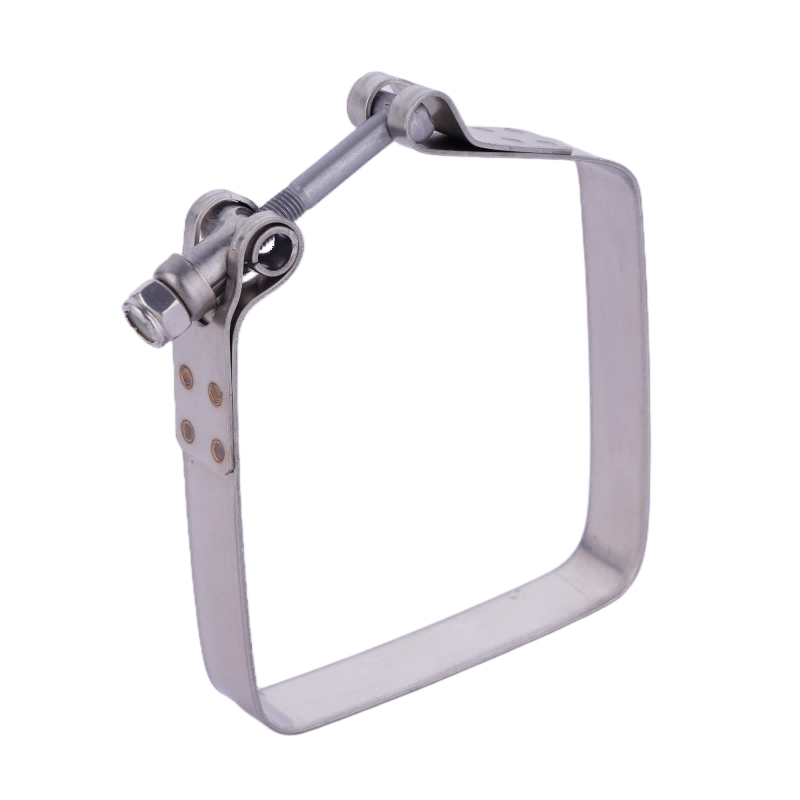
T-bolt hose clamps — also called T-clamps or bolt clamps — are heavy-duty fastening devices designed to create a uniform, high-torque seal around hoses, pipes, and ducts in high-pressure, high-vibration environments. Unlike standard worm drive clamps that rely on a perforated band and screw mechanism, T-bolt clamps use a solid band with a welded T-bolt and hex nut, distributing clamping force evenly around the full circumference of the hose.
Different Types of Hose Clamps
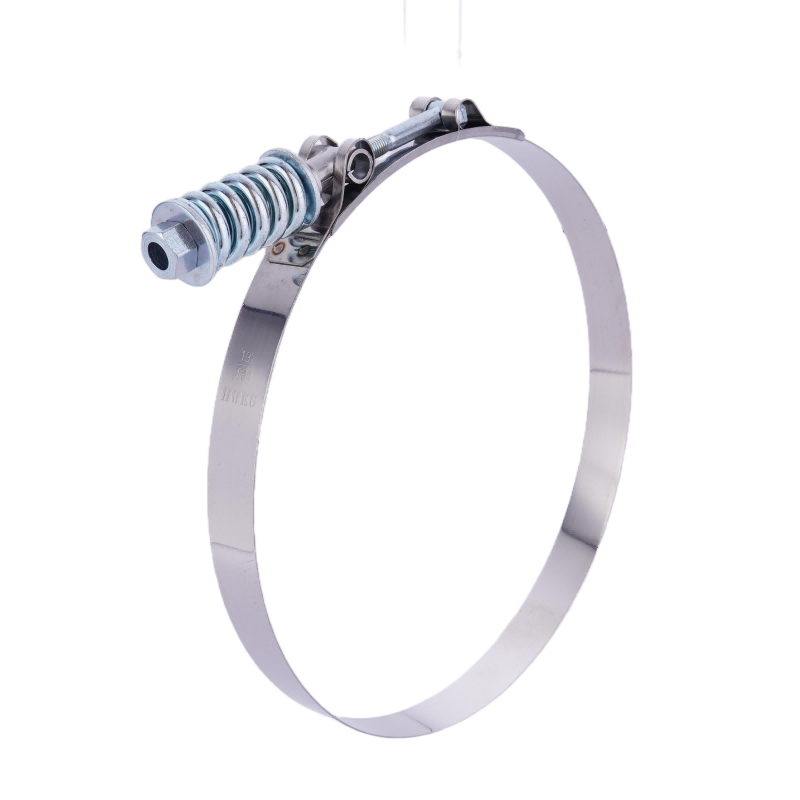
Hose Clamp Types: Quick-Reference Comparison
| Type | DIN 3017 Class | Mechanism | Typical Torque (Nm) | Band Width (mm) | Pressure Rating | Best For |
|---|---|---|---|---|---|---|
| T-Bolt | C1, C2 | Solid band + welded T-bolt + hex nut | 10–25 | 19 | High | Turbo/intercooler hoses, industrial high-pressure lines |
| Worm Drive | A, B | Perforated band + worm gear screw | 4–6 | 8, 12.7 | Low–Moderate | General automotive, plumbing, DIY |
| Bolt (Wide-Band) | D, E | Wide solid band + bolt tightening | 8–15 | 19–50+ | Moderate–High | Large-diameter pipes, industrial ducting |
| Band | — | Solid band + buckle or bolt | 8–20 | 12.7–25 | Moderate | Marine, chemical, outdoor signage |
| Spring | — | Spring steel, self-adjusting tension | N/A (pre-tensioned) | Variable | Low | Automotive cooling systems, thermal cycling |
Worm Drive Clamps
Worm gear hose clamps are very common. They have a band, a housing, and a screw. The screw fits into slots on the band. Turning the screw makes the clamp tighter or looser. Worm gear hose clamps fit many hose sizes. They give steady pressure and can be used again. Hengwei makes these clamps with careful checks for quality. People use them in cars, factories, oil, and gas work. They also work in kitchens and gardens.
Bolt Clamps
Bolt clamps are very strong and easy to put on. They have a wide band and a bolt to tighten. This gives more force and covers the hose all around. The smooth band keeps the hose safe from damage. You can use these clamps again. Factories use bolt clamps for pipes in oil, gas, and power plants. They are also used in big buildings for water and air systems. Bolt clamps help in transport, ships, and green energy too. Hengwei makes bolt clamps for hard jobs.
Band Clamps
Band clamps are another important kind of hose clamp. They do not rust and have smooth edges. The clamp spreads pressure evenly. Band clamps can handle heat and shaking. They keep their shape and grip, even in tough places. Hengwei sells band clamps for homes and factories. People use them for signs, cameras, chemical plants, ships, planes, cars, farms, high-pressure fluids, and racing.
Pipe Couplings
Pipe couplings are a special kind of hose clamp. They join pipes and hoses tightly. They use a band and a way to tighten it. Pipe couplings stop leaks and are important in plumbing and moving water. Hengwei sells pipe couplings that are checked for quality. People use them in kitchens, bathrooms, gardens, and factories. Pipe couplings make it easy to put pipes together and fix them. This is why factories and custom jobs like them.
Other Clamp Types
There are more hose clamps like ear hose clamps and quick release hose clamps. Ear hose clamps have a metal band and ears you pinch to tighten. They are light and do not rust. Quick release hose clamps can be taken off or put on fast. They are good when you need to fix things often. People use ear hose clamps and quick release hose clamps in cars, kitchens, and gardens.
Quick release hose clamps help you fix things faster.
Hengwei is a top maker and seller of hose clamps. They promise good quality and fair prices. The company uses new tools and checks to make sure every clamp is good. Hengwei sells worldwide and always tries new ideas. This makes them a good choice for custom and big orders.
Features and Applications of T Clamps
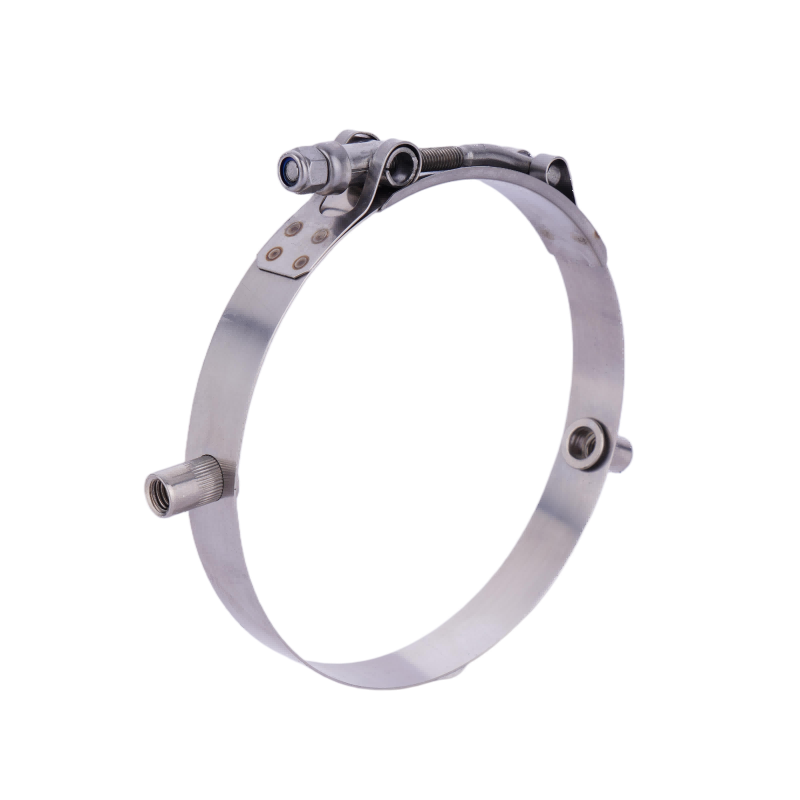
Applications by Industry
| Industry | Primary Clamp Type | Typical Use | Key Requirement |
|---|---|---|---|
| Automotive (Turbo/Intercooler) | T-Bolt (DIN 3017-3 C1) | Charge air hoses, silicone couplers | High torque (15–25 Nm), vibration resistance |
| Automotive (Cooling) | Spring / Worm Drive | Radiator hoses, heater hoses | Thermal cycling tolerance, moderate torque |
| Industrial Pump & Fluid | Bolt (Wide-Band) | Large-diameter suction/discharge hoses | Uniform pressure over wide hose, corrosion resistance (W4/W5) |
| Marine & Offshore | Band / T-Bolt | Exhaust hoses, fuel lines, bilge plumbing | 316 SS (W5), salt spray resistance |
| Food & Pharmaceutical | T-Bolt (W4) | CIP/SIP transfer hoses | 304 SS, smooth band no crevices, FDA/3-A compliance |
| HVAC & Ducting | Bolt (Wide-Band) / Band | Flexible duct connections, air handling | Large diameter, low–moderate torque |
| Agriculture & Irrigation | Worm Drive / T-Bolt | Irrigation lines, sprayer hoses | Cost-effective, corrosion tolerance |
How to Select a T-Bolt or Hose Clamp: 6-Step Checklist
- Measure the hose OD accurately. The clamp’s diameter range must bracket the hose outer diameter with the clamp at approximately 50% of its adjustment range when fully tightened.
- Match the material grade to the environment. Indoor / dry → W1 (zinc-plated carbon steel). Outdoor / general → W2 or W4 (304 SS). Food / pharmaceutical → W4 (304 SS, smooth band). Marine / salt spray → W5 (316 SS). Chemical exposure → consult material compatibility chart for specific media.
- Select the clamp type based on pressure and vibration. Low pressure, static (<3 bar) → worm drive. High pressure, vibration (>5 bar) → T-bolt. Thermal cycling → spring clamp (self-adjusting). Large diameter (>100 mm) → wide-band bolt clamp.
- Check the band width. Wider bands (19–25 mm) distribute clamping force better and reduce the risk of cutting into soft silicone or rubber hoses. Narrow bands (8–12.7 mm) are suitable for hard hoses and tight spaces.
- Verify torque specification. Standard worm drive: 4–6 Nm. T-bolt: 10–25 Nm (depending on band width and material). Over-torquing can strip threads or crush the hose; under-torquing causes leaks. Use a calibrated torque wrench for critical applications.
- Consider the hose material. Silicone hoses benefit from T-bolt clamps with a bridge piece (DIN 3017-3 shape C2) to prevent the band from cutting into the soft material. EPDM rubber hoses tolerate simpler clamp designs.
DIN 3017 Material Grade Reference
DIN 3017-4 Material Grade Selection
| Grade | Material | Corrosion Resistance | Typical Application |
|---|---|---|---|
| W1 | Zinc-plated carbon steel | Indoor, dry environments only | HVAC ducting, indoor plumbing |
| W2 | Chromated carbon steel | Outdoor, sheltered from direct rain | Construction, general outdoor |
| W3 | Stainless steel 301 | Moderate — higher strength than 304, lower corrosion resistance | High-strength band applications |
| W4 | Stainless steel 304 (1.4301) | Good — food-grade, general industrial | Food processing, automotive, general industry |
| W5 | Stainless steel 316 (1.4401) | Excellent — marine-grade, chloride resistant | Marine, offshore, chemical plants |
Always specify the W-grade in your purchase order. Example: “T-Bolt Clamp DIN 3017-3 C1 54-62/19 W4” specifies a standard T-bolt clamp, 54–62 mm range, 19 mm band width, in 304 stainless steel.
FAQ
How do hose clamps work in plumbing and automotive applications?
T-bolt clamps use a solid band with a welded T-bolt tightened by a hex nut, delivering 10–25 Nm of uniform clamping torque around the full circumference. Worm drive clamps use a perforated band engaged by a worm gear screw, producing 4–6 Nm of localized torque.
Key practical differences:
(1) T-bolt clamps don’t cut into soft silicone hoses because the band has no perforations; worm drive slots can extrude into soft hose material under high torque.
(2) T-bolt clamps tolerate high vibration (turbochargers, industrial pumps) without loosening; worm drive clamps can back off under sustained vibration.
(3) T-bolt clamps are not continuously adjustable — each size covers a narrow diameter range; worm drive clamps adjust across a wide range. Choose T-bolt for high-pressure, high-vibration, or silicone hose applications; worm drive for general-purpose, low-pressure, or variable-diameter needs.
Can T-bolt clamps be reused?
Yes — T-bolt clamps are designed for reuse. The solid band and welded T-bolt construction means the clamp structure does not degrade from repeated tightening cycles, unlike perforated worm drive bands that can strip.
However, inspect for:
(1) thread galling on the T-bolt — stainless-on-stainless threads can gall if tightened dry; use anti-seize compound for repeated assembly,
(2) band deformation — if the band has taken a permanent set from over-torquing, it may not return to full clamping force
(3) corrosion pitting — especially on W1/W2 grades used outdoors. Replace any clamp showing visible thread damage, permanent deformation, or pitting deeper than 10% of band thickness.