






A band clamp is a circular fastening device consisting of a flexible metal band and a mechanical tightening mechanism — typically a screw, bolt, or worm drive — that applies uniform radial pressure to secure hoses, ducts, pipes, or cables onto fittings. Its core function is to create a reliable, leak-proof seal while resisting vibration and thermal expansion across automotive, industrial, marine, and construction environments.
Key Takeaways
- A band clamp applies uniform radial pressure around a hose or pipe via a metal band and mechanical tightening mechanism, creating a leak-proof seal that resists vibration and thermal cycling.
- Choosing the correct band clamp requires a three-step evaluation: measure the hose outside diameter (OD) with the fitting installed, match the clamp type to operating pressure and temperature, and select the band material according to environmental exposure.
- Band clamps span five major categories — weldless ring, worm drive, T-bolt, V-band, and specialty — each engineered for distinct pressure ranges and industry applications, from low-pressure coolant lines to high-pressure turbo systems.
- Regular inspection — checking for band deformation, screw corrosion, and gasket integrity — extends service life and prevents catastrophic connection failure in high-pressure or high-vibration environments.
Banding Clamp Function
Key Components
Key components include the strapping tape, loops, and tensioning mechanism. Some strapping clips also feature protective covers and saddles for added support.
| Component | Description |
|---|---|
| Smart Band Compact | Strong polymer strap with glass fiber and different lengths. |
| Saddles and Protectors | Molded parts help clamp shapes to structures, used offshore. |
| Manual Installation Tools | Light tools with cutters and torque control for easy use. |
How Banding Clamps Work
A band clamp operates through a straightforward but precise mechanical principle: a flexible metal band encircles the hose or pipe, and a tightening mechanism — typically a worm-drive screw, T-bolt with hex nut, or latch — draws the band inward, reducing its effective diameter and applying uniform radial compression. This compression forces the hose wall against the fitting barb, creating a leak-proof mechanical seal.
The effectiveness of the seal depends on three factors:
(1) band tension — sufficient clamping force to overcome internal fluid pressure without deforming the hose;
(2) uniformity of pressure distribution — a smooth inner band surface (as found in band clamps per GlobalSpec definition) prevents point-load abrasion and leak paths;
(3) screw/bolt torque retention — the tightening mechanism must maintain its set torque despite vibration and thermal cycling. For applications with fluctuating temperatures, constant-tension designs (spring clamps) automatically compensate for hose material expansion and contraction (puxingclamp).
Installation requires matching the clamp’s working range to the hose OD measured with the fitting installed. The clamp should sit over the barbed section of the fitting, not at the hose end, and be tightened to manufacturer-specified torque.
Banding Clamp Types

Banding clamps come in many shapes and sizes. Each kind has a special job in cars, buildings, or home machines. Companies make different designs for different needs. Some clamps are best for pipes. Others are made for hoses or cables.
Worm Drive Clamps
The most widely used type, consisting of a perforated metal band engaged by a helical-threaded screw. As the screw turns, threads advance the band, reducing diameter uniformly. Two variants exist: American type (narrower band, 9–12.7 mm, punched slots) balances cost and performance for general industrial piping; German type (wider band with embossed/raised slots, DIN 3017 compliant) delivers higher torque capacity with reduced band deformation risk. Sub-types include British type (smooth internal surface, no slots contacting the hose), lined hose clamps (internal rubber/plastic liner for soft hoses), and handled hose clamps (tool-free thumb-screw operation). Covers: worm drive hose clamps, German/British type clamps, perforated/non-perforated band clamps, lined/handled hose clamps.
T-Bolt Clamps
Heavy-duty band clamps using a T-shaped bolt tightened by a hex nut on a wide stainless steel band. Engineered for high-pressure hydraulics, turbo systems, intercoolers, and exhaust connections where worm drive clamps cannot deliver sufficient torque or vibration resistance. The sturdy construction includes complete bushings, a bridge, and 3-point welds that provide structural security under continuous load (puxingclamp). Covers: bolt clamps, heavy-duty housing clamps.
V-Band Clamps
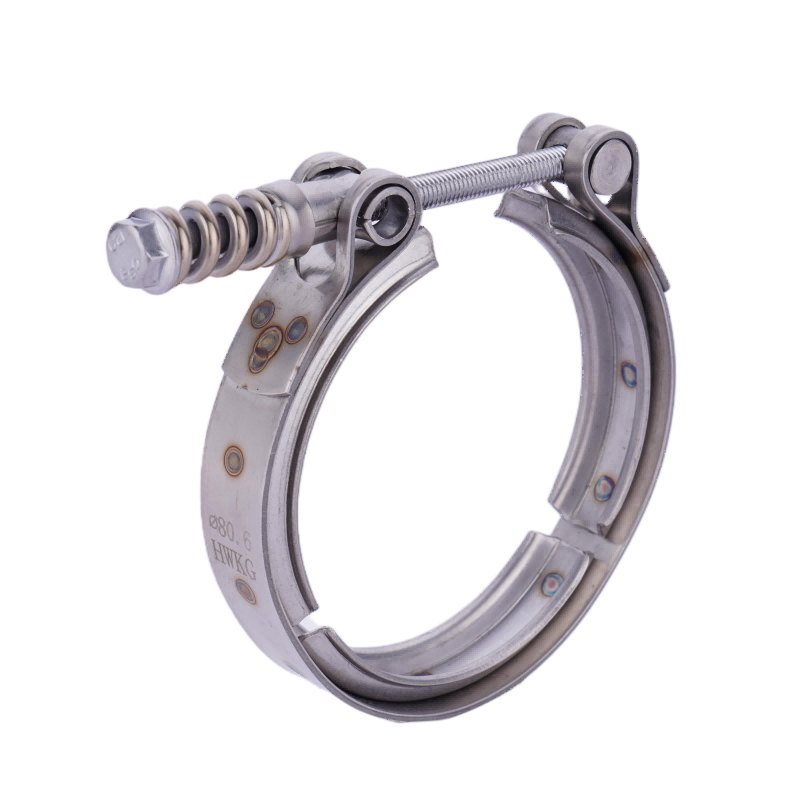
Circular clamps with a V-shaped internal profile that draws together two mating flanges when tightened by a screw or latch. The V-profile provides self-centering alignment and uniform axial clamping force, making these clamps essential for turbocharger connections, exhaust systems, and aerospace ducting where flange alignment is critical. Covers: V-band clamps, quick-release clamps (latch-type V-band variants).
Weldless Ring Clamps (Ear / Spring Clamps)
Clamps without screw mechanisms, relying instead on ear crimping or spring tension. Ear clamps (Oetiker style) use one or two protruding ears crimped with a dedicated pincer tool to permanently deform the band for a tamper-proof, low-profile seal — common in pneumatic systems and automotive fuel lines. Spring clamps (constant-tension clamps) use flexible spring steel that automatically adjusts to hose expansion and contraction during thermal cycling, maintaining consistent clamping force in automotive cooling systems. Covers: ear clamps, constant-tension clamps, spring clamps.
Specialty Band Clamps
Application-specific designs: metal clamps for pipes (split-ring and U-bolt variants for rigid pipe securing); rubber clamps (cushioned clamps with elastomer inserts for vibration damping in hydraulic tube routing); quick-release clamps (snap-close or ratchet mechanisms for frequent access applications). Covers: metal pipe clamps, rubber/cushioned clamps.
The material of a banding clamp is very important. Stainless steel is strong and does not rust easily. Chromium in stainless steel makes a shield that stops rust and damage. Other materials, like coated metals and plastics, do not protect as well. These may break in tough places.
| Material Type | Key Benefits | Applications |
|---|---|---|
| Stainless Steel | Corrosion resistance, durability | Outdoor, hydraulic, heavy-duty equipment |
| Coated Metals | Limited durability | Light-duty, less demanding environments |
| Plastic Fasteners | Easy to use, not for high stress | General use, household appliances |
New ideas focus on V-band clamps. These new designs help stop damage and lower risks when things get tough. Makers use better materials and smart plans to make clamps last longer.
Tip: Pick stainless steel clamps for outside or factory work. They last longer and keep away rust.
Banding clamps hold fire tubes, gas cookers, and car parts in place. Picking the right clamp keeps things safe and working well.
Banding Clamp Uses
Common Applications
Many industries need banding clamps to make strong connections. Factories, suppliers, and makers use these clamps in many places. The table below shows where companies use banding clamps and what they use them for:
| Industry | Typical applications | Pressure rating | Recommended material |
|---|---|---|---|
| Automotive | Fuel injection lines, cooling system hoses, turbocharger connections, exhaust systems | Low to High (varies by subsystem) | 304 SS, 316 SS (turbo/exhaust) |
| Marine & Offshore | Seawater cooling lines, fuel transfer hoses, deck machinery hydraulics | Medium to High | 316/316L SS (chloride-resistant) |
| Chemical Processing | Chemical transport lines, reactor coolant connections | Medium to High | 316 SS or Titanium |
| Oil & Gas / Petroleum | Fuel delivery hoses, drill rig hydraulics | High | 316 SS, T-bolt clamps |
| Food & Beverage | Sanitary washdown hoses, CIP (clean-in-place) lines | Low to Medium | 304/316 SS (FDA-compliant) |
| HVAC & Energy | Compressed air systems, ducting connections | Low to Medium | 304 SS, zinc-plated (indoor) |
| Construction & Mining | Heavy-duty hose connections, slurry transport lines | Medium to High | T-bolt, heavy-duty housing clamps |
| Agricultural Irrigation | Large-diameter irrigation hoses, pivot systems | Low to Medium | Band clamps (wide band), 304 SS |
Banding clamps have many good points over other fasteners. You can use them again. They do not shake loose easily. They look neat and tidy. Banding clamps last longer than zip ties or regular hose clamps. This is because they do not rust fast. This means you do not have to buy new ones often. It also keeps things safer.
Tip: Think about what you need before picking a banding clamp. Check the job, pressure, heat, and if there are chemicals. Pick stainless steel if you want strength and no rust. Always use the right size clamp for your hose.
Choosing a Banding Clamp
electing the correct band clamp is the difference between a reliable system and a recurring failure point. Follow this three-step evaluation framework, consolidated from industry best practices (puxingclamp, Mikalor, GlobalSpec):
Step 1: Measure the hose outside diameter (OD) accurately. Use calipers or a diameter tape to measure the installed OD — with the hose fully seated on the fitting — not the nominal hose size. Choose a clamp whose effective working range covers this measured OD such that the hose size falls near the middle of the clamp’s adjustment range, providing optimal tightening capacity.
Step 2: Match clamp type to operating conditions.
| Pressure level | Typical application | Recommended clamp type |
|---|---|---|
| Low | Air, water, light-duty domestic | Worm gear clamp (American type), wire clamp |
| Medium | Coolant, fuel, moderate hydraulics | Worm gear clamp (German type), spring/constant-tension clamp |
| High | Turbo systems, industrial hydraulics, compressors | T-bolt clamp, heavy-duty housing clamp |
Step 3: Select material based on environment and torque requirements. Use the Materials table (Chapter 5) as reference. For soft hose materials (rubber, silicone), select wider band clamps to distribute force and prevent deformation; for rigid pipes, narrower bands suffice. Typical torque ranges: 3 Nm for 8–12 mm hoses to 6 Nm for 35–45 mm hoses. Over-tightening damages the hose wall; under-tightening creates leak paths.
Common Mistakes & How to Avoid
| Mistake | Problem | Solution |
|---|---|---|
| Incorrect clamp sizing | An oversized clamp bottoms out before achieving seal; an undersized clamp over-stresses the band and hose wall | Measure hose OD with fitting installed; select clamp with working range centered on measured value |
| Ignoring pressure rating | Using a worm gear clamp on a high-pressure turbo line causes clamp failure and potential hose blow-off | Match clamp type to system pressure: worm drive for low-medium, T-bolt for high-pressure applications |
| Wrong material for environment | Zinc-plated steel in marine or chemical environments corrodes within months, losing clamping force | Use 316 SS for chloride/chemical exposure; 304 SS minimum for outdoor/humid conditions |
| Over-tightening | Excessive torque cuts into the hose wall, creating a failure point that leaks under pressure cycling | Follow manufacturer torque specs; use a calibrated torque wrench for critical connections |
| Neglecting vibration | Standard worm drive clamps loosen under continuous vibration, developing leak paths at the screw housing | Use constant-tension (spring) clamps or T-bolt clamps with prevailing-torque lock nuts for high-vibration environments |
Band clamps are precision-engineered fastening components whose performance depends on matching material grade, clamp type, and installation torque to the specific operating environment. The five-type classification — worm drive, T-bolt, V-band, weldless ring, and specialty — covers the full spectrum of industrial applications from low-pressure water lines to high-pressure turbocharger connections. Correct sizing, measured by installed hose OD rather than nominal diameter, combined with environment-appropriate material selection (304 SS for general use, 316 SS for marine/chemical exposure), is the foundation of a reliable, leak-proof connection. For OEM and industrial buyers requiring certified band clamps, HWKG manufactures worm drive, T-bolt, and specialty clamps compliant with DIN 3017 and SAE J1508, serving automotive, HVAC, and construction markets from its 35,000-square-meter ISO-certified facility.
FAQ
What are the main uses of clamps?
Clamps are used to secure hoses, pipes, or cables. They prevent leaks and ensure parts are firmly in place. Many industries use clamps, such as automotive repair and factory production.
How are clamps installed?
Workers apply the clamps to the object that needs to be secured and then tighten them using hand or pneumatic tools. This ensures a secure and safe connection.
Can clamps be reused?
Yes, many clamps can be reused multiple times. Workers should inspect the clamps for any damage before use. This helps ensure the safety of all personnel and guarantees the clamps are in good working order.