





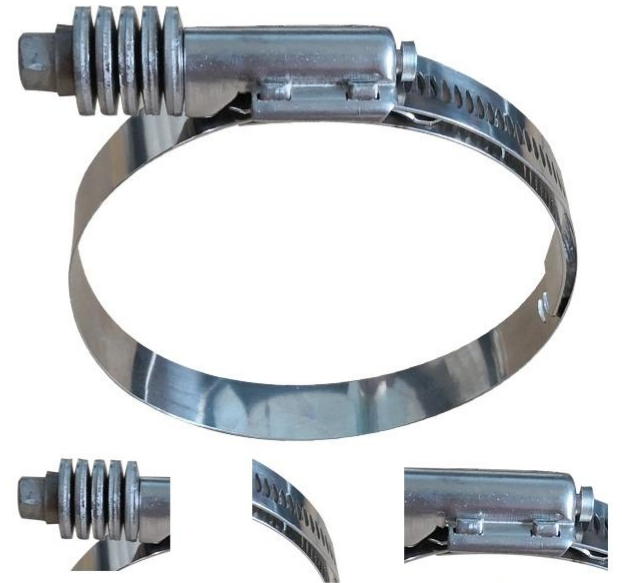
Constant‑tension hose clamps deliver outstanding sealing performance for assemblies exposed to repeated temperature swings, yet they are a specialised component — not a universal replacement for standard worm‑drive clamps. Proper selection depends on three core operating factors: the magnitude of thermal cycling, sustained vibration levels, and hose / fitting material pairings. Premium conventional hose clamps often remain the more practical choice for general‑duty applications.
主要收获
- Built with stacked Belleville disc springs, constant‑tension clamps automatically compensate for hose expansion and contraction to prevent thermally‑induced slow leaks.
- They offer maintenance‑free operation and good inherent vibration resistance, making them popular within automotive, motorsport, aerospace and electric‑vehicle cooling systems.
- Critical limitations apply: repeated heavy vibration or torsional loading can lead to spring fatigue and eventual seal failure. Fitment constraints and manufacturing quality heavily influence real‑world reliability.
Features of Constant‑Tension Clamps
Spring‑Loaded Working Principle
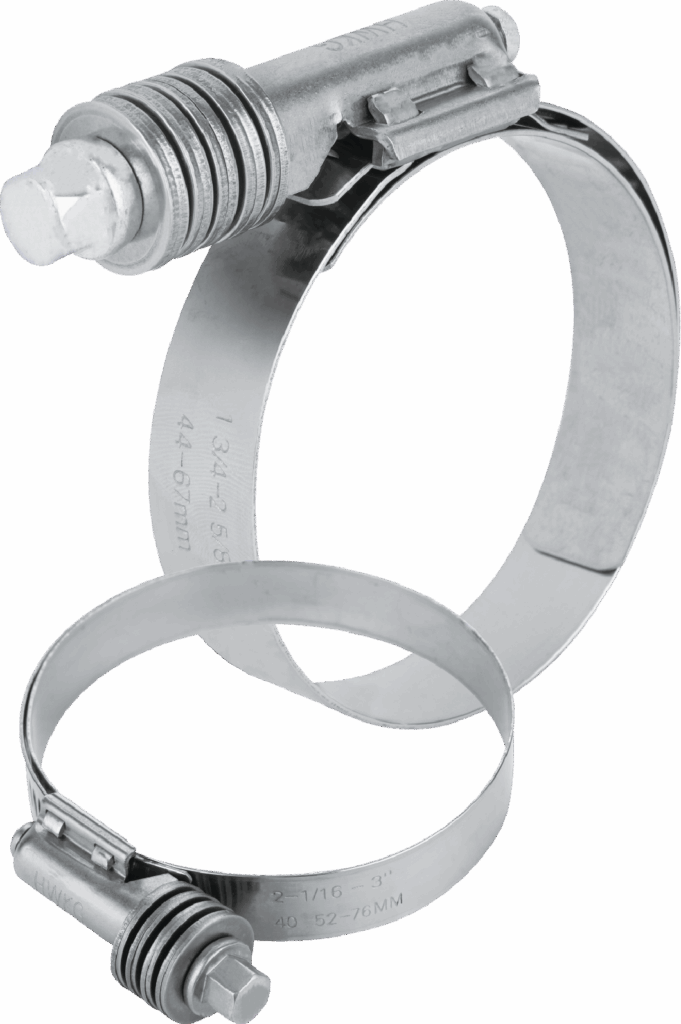
At the heart of every constant‑tension clamp sits a stack of Belleville disc springs that store mechanical energy. As system temperatures rise and fall, the spring stack expands and contracts, driving corresponding movement in the clamp band. This dynamic response offsets thermal growth and shrinkage of rubber and silicone hoses and mitigates cold‑flow leakage — a common long‑term failure mode for traditional worm‑drive clamps.
The clamp’s elastic hardware applies circumferential contact pressure across the hose outer diameter. Internal spring elements absorb shock and dissipate vibrational energy, moderating peak stress and allowing small, controlled relative movement between hose and fitting.
Stacked Belleville washers maintain consistent radial clamping force throughout service life. The self‑adjusting mechanism compensates for dimensional shift caused by temperature fluctuation or internal pressure spikes, minimising hose slippage and seepage. Critically, the spring‑limited force prevents human‑error over‑torquing, distributing load evenly without crushing or nicking hose walls as hoses swell or shrink.
Thermal‑Cycle Performance vs Worm‑Drive Clamps
Where standard worm‑drive clamps hold a static pre‑set torque, constant‑tension designs work with thermal cycling rather than fighting against it. The table below contrasts real‑world performance characteristics:
| 比较方面 | 恒张力夹钳 | Worm‑Drive Clamp |
|---|---|---|
| Long‑term tension stability | Self‑adjusts to maintain clamping force as hoses age or develop permanent compression set | Loses pre‑load gradually as hoses relax and age |
| Thermal‑cycle response | Withstands hundreds of thousands of thermal cycles (−20 °F to 200 °F) without loss of clamping grip | Screw and band thermal expansion leads to pre‑load loss, even when correctly torqued at installation |
| Vibration performance | Resists loosening; no threaded screw to back out | Vibration can unwind screw threads; thread stripping risk under high cyclic shock |
| Over‑tightening risk | Force capped by spring behaviour; will not crush or score hose surfaces | Over‑torquing is a frequent installer error, cutting hoses and creating stress‑rise points |
| Long‑term leak risk | Markedly reduces the chance of delayed, slow seepage months or years post‑fitment | More prone to gradual slow leaks on pressurised fluid circuits over time |
As temperatures climb and hose sealing demand increases, the spring stack increases effective clamping force automatically. No retorquing or scheduled manual adjustment is required. These hardware items are also known as constant‑torque clamps for this ability to preserve sealing pre‑load amid shifting thermal conditions.
Even with these advantages, constant‑tension band clamps carry real‑world trade‑offs. Continuous high‑magnitude vibration or torsional stress can fatigue the spring assembly and create leak paths. Installation is complicated within densely packed compartments, and end‑user performance varies sharply based on manufacturing tolerances and material grade. While superior for thermal‑cycling scenarios, they are not a drop‑in‑for‑all upgrade; application‑specific selection is essential.
Core Advantages of Constant‑Tension Clamps
Maintenance‑Free Operation
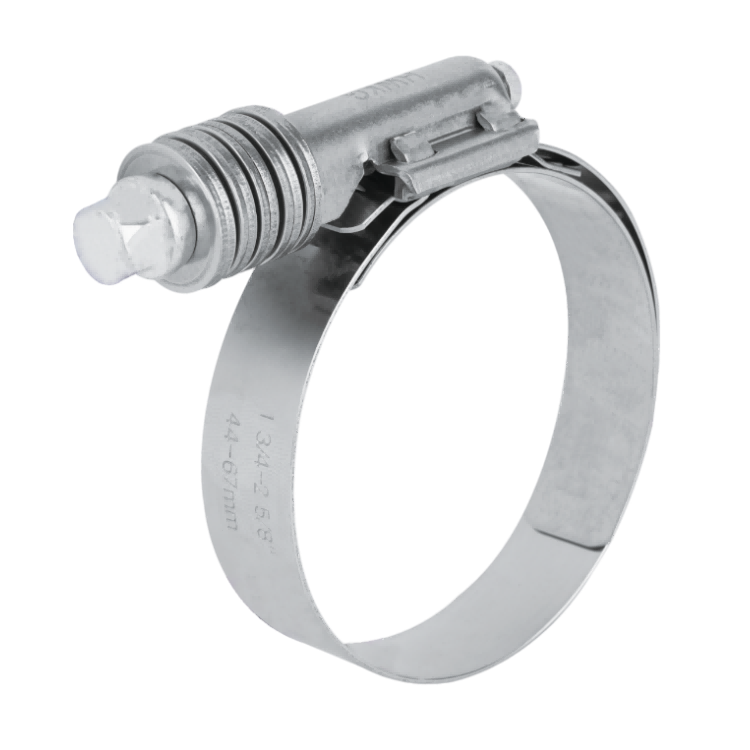
The biggest practical benefit is autonomous tension management. Belleville spring stacks sustain steady radial clamping pressure with zero periodic retightening. Traditional screw‑type hose clamps require scheduled inspection and re‑torquing, as rubber hoses compress, creep and age over operating time. Constant‑tension hardware eliminates this recurring maintenance overhead.
Many variants feature tool‑free snap‑on installation, streamlining high‑volume manufacturing assembly lines. Technicians simply position and snap the clamp into place. Spring‑capped force removes inconsistency from human tightening, eliminating both over‑clamping and insufficient pre‑load — a meaningful benefit for automotive serial production. The 360‑degree uniform circumferential pressure creates well‑distributed contact across the hose outer surface for durable joints.
Industries subjected to extreme thermal variation leverage this low‑upkeep property. Aerospace specifications deploy constant‑tension clamps for engine casing gasket retention and auxiliary‑power‑unit hardware, delivering stable radial force through extreme hot‑cold excursions. EV OEMs select these clamps for battery thermal management loops and power‑electronics cooling circuits, where compact footprints and consistent performance suit tightly‑packed modern vehicle layouts.
Vibration‑Resistant Sealing
Vibration‑driven screw back‑off is one of the top failure modes for conventional worm‑drive hose clamps; sustained shaking unwinds threads, producing loose joints and fluid leaks. Constant‑tension clamps use a spring‑loaded architecture without adjustable screw threads, so clamping pre‑load remains stable in high‑vibration environments.
Motorsport teams competing in Le Mans, IMSA and other endurance series fit spring‑type constant‑tension clamps on critical cooling and charge‑air plumbing. These circuits endure violent temperature swings and pressure surges that defeat standard clamps; thermally‑compensated clamping preserves sealing integrity throughout race duration. Turbocharger inlet and outlet plumbing also benefit greatly, combining intense mechanical vibration with rapid thermal transients.
Constant‑tension clamps retain sealing integrity under continuous movement and hose thermal expansion. This reliability makes them a preferred choice for primary cooling‑circuit hoses: upper‑ and lower‑radiator connections, heater cores and coolant bypass lines. Silicone‑hose installations see disproportionate benefit, as silicone materials exhibit higher thermal expansion rates and inherently smoother surface finishes relative to conventional rubber. Stable, non‑relaxing sealing pre‑load builds confidence for safety‑critical fluid systems.
Drawbacks & Failure Modes
How Constant‑Tension Clamps Maintain Pressure Through Thermal Cycling
Constant‑tension clamps rely on precision‑formed stacked Belleville disc springs to hold target clamping force. These conical‑profile springs store mechanical energy and react dynamically to temperature change. When heat expands the hose outer diameter, Belleville washers compress slightly and raise clamping tension. When cold causes hose contraction, washers relax and reduce force accordingly. This self‑regulating behaviour prevents thermal‑cycle‑originated leaks and removes the manual retorquing demanded by worm‑drive alternatives.
Belleville stacks operate as constant‑force spring groups. Each disc flattens under compressive load; stacking delivers large usable displacement travel while maintaining high force output, creating a wide compensation window. Clamping tension stays within a narrow working band even when hose diameter shifts significantly. Spring rates are engineered to align with thermal‑expansion coefficients of common hose elastomers.
High‑quality hardware uses heavier‑gauge, precision‑stamped Belleville springs. These deliver larger band‑tension swing and adjustment travel for more robust sealing performance.
Bench validation data demonstrates that well‑built units survive 1 000 thermal cycles from −40 °C to 120 °C, retaining spring force within a ±15 % tolerance band, with working clamp load ranging 10 N‑45 N. Consistent tension across thermal events suppresses leaks triggered by hose expansion, contraction or material ageing.
Operating Conditions Where Constant‑Tension Clamps Underperform
Despite strong thermal‑cycle performance, constant‑tension clamps have distinct application boundaries. Sustained heavy vibration or torsional stress can degrade spring hardware over time and eventually break the seal. Primary real‑world failure modes include:
- Micro‑gap leakage caused by spring fatigue from cyclic vibration deflection
- Clamp migration / slippage induced by engine harmonic vibration
- Joint pressure drop and fluid aeration secondary to lost sealing contact
Vibration cycles the Belleville washers repeatedly through their deflection range. This cyclic loading produces work‑hardening and can progress to spring cracking. Engine harmonic excitation can drive clamp slippage if spring output force is insufficient for the assembly. Exact sizing against hose outer diameter is non‑negotiable: undersized clamps yield inadequate grip; oversized clamps prevent correct spring‑stack engagement and defeat the core compensation function.
Long‑term service introduces material fatigue within disc springs. Repeated thermally‑driven hose‑diameter changes add further cyclic stress. Once springs lose elasticity, sealing performance deteriorates irreversibly.
Practical installation pain points also exist. Fitting these clamps within cramped engine bays is often awkward. Performance varies drastically with build quality: poorly manufactured constant‑tension clamps can prove less dependable than high‑grade worm‑drive alternatives. Their snap‑fit design offers no post‑installation fine‑tuning of clamping force.
For broad‑scope general‑purpose fastening, premium traditional hose clamps frequently deliver superior overall reliability. Constant‑tension clamps are a specialised solution, best deployed where thermal cycling represents the dominant failure risk. In other operating environments, standard worm‑drive hardware can out‑perform them.
Constant‑tension clamps excel under thermal cycling but are not universal fasteners. For general‑purpose use, extreme continuous vibration, or highly corrosive environments, high‑quality worm‑drive and band‑style hose clamps often provide more robust service life. Correctly‑specified clamps (whether constant‑tension or worm‑drive) maintain compression and resist leaks over years of operation. Specifiers must evaluate operating‑temperature range, vibration magnitude and material compatibility. For most general‑maintenance and aftermarket use‑cases, premium standard hose clamps represent the safer default selection.
常见问题
What distinguishes constant tension clamps from standard hose clamps?
Constant tension clamps use a spring to adjust themselves when temperatures change. Standard hose clamps need manual tightening, but they are easier to install and can handle more torque.
Are constant tension clamps the best choice for all applications?
No. They work well with temperature changes but can wear out under heavy vibration or torque. For most uses, standard premium hose clamps are safer and more flexible.
Do constant tension clamps require special tools for installation?
The snap-on design needs no tools, unlike standard hose clamps. However, technicians cannot adjust the tension after installation, which can be a problem in tight spaces.