





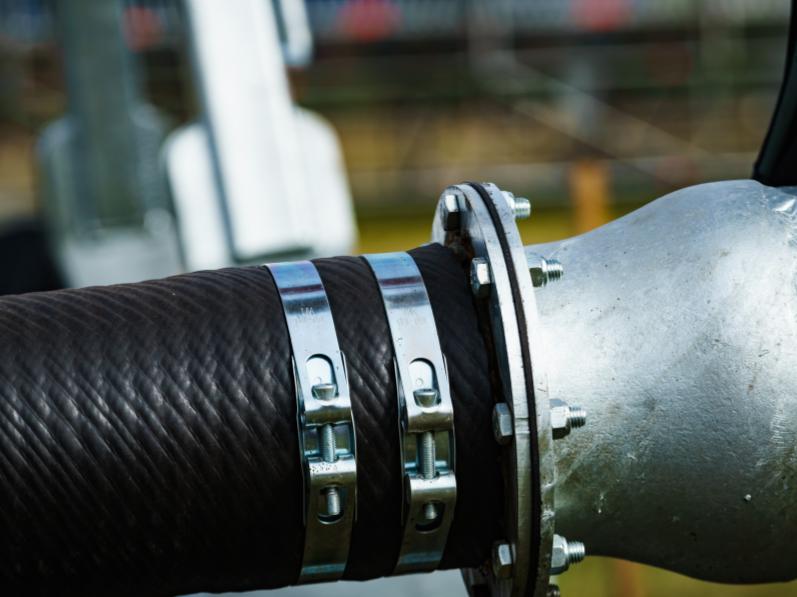
A stainless steel hose clamp is the quiet hero of any leak-free connection: it squeezes a hose against its fitting and holds pressure, heat, and vibration in check. Whether you are fixing a radiator hose, a garden line, or an industrial pipe, a 蜗杆传动夹 is the most common starting point because its perforated band and screw housing adjust to a wide diameter with one screwdriver. Stainless steel earns its place – while zinc-plated steel can rust within a single damp season, 304-grade stainless resists corrosion in wet or marine service. HWKG, a hose-clamp manufacturer with 20+ years of experience, IATF 16949 certification, and 50+ engineers, builds these clamps on 100% automated lines and tests every batch for torque and salt-spray resistance. This guide covers choosing the right type, installing it correctly, and keeping the seal.
主要收获
· Match the clamp’s adjustable range to the hose’s measured outside diameter, with the size near the middle.
· Slide the clamp over the hose before mating it to the fitting; seat it just behind the barb, never on top of it.
· Tighten until snug – over-tightening cuts soft hoses and strips the screw threads.
· Pick 316 stainless for saltwater and 304 for everyday use; corroded or thread-stripped clamps get replaced, not reused.
Choose the Right Stainless Steel Hose Clamp Type
Worm-Drive vs. Heavy-Duty Worm Gear
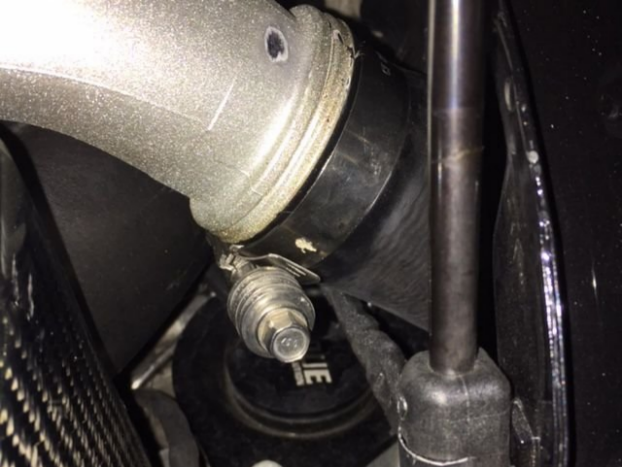
The standard worm-drive clamp pairs a 304 stainless band and housing with a 430 stainless screw. For trucks, turbo intercoolers, and construction machinery, move up to a 重型蜗轮夹. HWKG’s KG13 (12.7 mm band), KG14 (14.2 mm), and KG16 (15.8 mm) series widen the contact area to fight the 50-200 Hz vibration that walks a thin band loose. Torque is where the upgrade pays off: a 9 mm band clamps at 3.5-4.5 N·m, a 12 mm heavy-duty at 6.0-7.5 N·m, and a 14 mm high-torque model reaches 8.5 N·m – never exceed 90% of a clamp’s rated ultimate torque. When sealing soft silicone hoses, choose an embossed (non-perforated) band 12 mm or wider with an EPDM or silicone liner; it protects the hose at up to 8.5 N·m without cutting into it.
T-Bolt, Constant-Tension, and V-Band Options
Beyond the worm drive, three designs solve tougher jobs. A T-bolt hose clamp uses a high-tensile bolt and self-locking nut to apply uniform 360° radial force for high-pressure turbo and charge-air lines; nylon-insert nuts hold to 250°C and all-metal versions to 500°C. A constant-tension clamp adds a disc spring that keeps compensating as the hose expands and contracts through heat cycles – why truck cooling and marine engines favor it over ordinary clamps that loosen seasonally. V-band clamps seal flanged exhaust joints, rated -40°C to 800°C (titanium to 1200°C), and cut installation time by over 70% versus a multi-bolt flange. All come as standard or custom builds from a factory running SAE J1508 tooling.
Stainless steel hose clamp types at a glance:
| Clamp type | Band width | Typical torque / rating | Best application |
| Worm-drive (304 SS) | 9毫米 | 3.5-4.5 N·m | General plumbing, automotive cooling |
| Heavy-duty worm gear (KG13/14/16) | 12.7-15.8 mm | up to 8.5 N·m | Trucks, turbo, machinery |
| T-bolt (W4/W5 316 SS) | wide, high-tensile | self-locking to 500°C | High-pressure turbo, charge-air |
| Constant-tension (ZG14/16) | 14.2-15.8 mm | disc-spring compensated | Thermal cycling, marine |
| V 波段 | 12.7-15.8 mm | -40 to 800°C | Flanged exhaust, quick assembly |
Figures reflect HWKG published specifications; confirm exact sizes and materials with the supplier.
How to Install a Stainless Steel Hose Clamp
Tools and Prep
The right tool follows the clamp style. A flat-head screwdriver or nut driver handles worm-drive and heavy-duty worm gear clamps; a wrench or pliers suit T-bolt and wire types; a torque driver gives controlled tightening when the manufacturer publishes a torque spec. Slide the clamp over the hose before you push the hose onto the fitting – once the hose is seated, the clamp cannot pass the barb.
Step-by-Step Tightening
1. Measure the hose outside diameter and pick a clamp whose range covers it near the middle.
2. Slide the clamp over the hose, then seat the hose fully onto the fitting until flush against the retaining bead.
3. Position the clamp just behind the raised barb or ridge – not directly on it – and square to the hose axis.
4. Tighten in 1/4-turn increments to the spec (e.g., 6.0-7.5 N·m for a 12 mm heavy-duty clamp); stop when snug.
5. For high-pressure turbo or charge-air joints, a T 型螺栓软管夹 with a calibrated torque wrench removes the guesswork and holds through vibration.
Common Mistakes That Cause Leaks
· Under-tightening leaves gaps that seep under pressure.
· Over-tightening cuts thin-walled hoses and strips threads.
· Misalignment, or placing the clamp on the barb, reduces sealing force.
· Reusing a single-use or over-torqued clamp drops clamping power.
Measure, Remove, and Maintain Your Hose Clamp
Measure the Outside Diameter
Hose-clamp size is the clamp’s adjustable range, not the hose’s inner diameter. Slide the hose onto the fitting first – it stretches, so its real outside diameter is larger than the listed size – then measure at the clamp position with a caliper, or wrap a string and divide the circumference by pi. SAE J1508 is the common standard for worm-drive clamps; match the measured OD to the middle of the clamp’s range so it tightens firmly yet leaves a little spare capacity for pressurization swell.
Remove Safely and Decide Reuse vs. Replace
Back the screw or bolt off with the right driver; if threads seize from rust, soak them in penetrating oil rather than forcing the band, which can crack the pipe or tear the hose. Inspection decides reuse: replace any clamp with band rust, stripped threads, or deformation, and never reuse an over-torqued one. A manufacturer or wholesale supplier can confirm whether a style supports reuse and supply custom sizes for bulk orders; most factories offer flexible MOQ with OEM/ODM packaging for global buyers.
Measure the hose, choose the right stainless steel hose clamp, slide it on before mating, and tighten to spec – a final leak check confirms the job. With the correct size and a screwdriver or torque driver, anyone can make a connection that stays sealed through heat, pressure, and vibration.
常见问题
Q: How tight should a stainless steel hose clamp be?
A: Tighten until snug – the band presses the hose without cutting the rubber. Use a torque driver when a spec exists; a 12 mm heavy-duty clamp typically lands at 6.0-7.5 N·m. Too loose leaks, too tight strips threads or damages the hose.
Q: Can I reuse a stainless steel hose clamp?
A: Only if the band shows no rust, the threads are clean, and the housing is not bent. Replace any clamp that is corroded, stripped, or was over-torqued. A supplier can confirm whether a given style is reusable.
Q: What size clamp do I need for my hose?
A: Measure the hose outside diameter where the clamp sits, then pick a clamp whose adjustable range covers that number near its middle. SAE J1508 sizes are standard for worm-drive clamps.
Q: When should I choose a T-bolt over a worm-drive clamp?
A: Choose a T-bolt hose clamp for high-pressure or high-vibration lines – turbo, charge-air, and exhaust – where uniform radial force and self-locking nuts beat a worm drive. Worm drives remain ideal for general plumbing and low-pressure automotive work.
Q: Where can I get custom or bulk hose clamps?
A: A manufacturer or factory offering OEM/ODM can build clamps to exact band width, material, and diameter; most support flexible MOQ for wholesale orders.