


A 蜗杆传动管夹 is sized by an SAE number that carries a clamping range, running from a minimum to a maximum diameter listed in both inches and millimeters. Standard sizes span roughly 5/16 inch up to over 8-1/2 inches.SAE stands for the Society of Automotive Engineers, the body that sets these common engineering standards, and torque refers to the tightening force a screw receives. A size chart, category breakdowns for miniature, standard, and full-size clamps, and torque guidance make it easier to match a hose clamp to a hose.
HWKG’s worm drive hose clamps take this further, with digital quality control and in-house R&D behind a range that also covers T 型螺栓夹, 恒张力软管夹, band clamps, and pipe couplings. This guidance help readers match a clamp to their hose.
主要收获
- Worm drive hose clamps use SAE size numbers that cover a range of sizes, not just one size.
- Put the hose on the fitting first. Then measure the outside of the hose to choose the right clamp.
- Pick a clamp with a range that puts your hose measurement near the middle.
- Torque depends on the band width, so always check the manufacturer’s spec before you tighten.
- Pick the clamp type that fits the job: miniature for small hoses, standard for everyday use, and full-size for large pipes.
Worm Drive Hose Clamps Size Chart
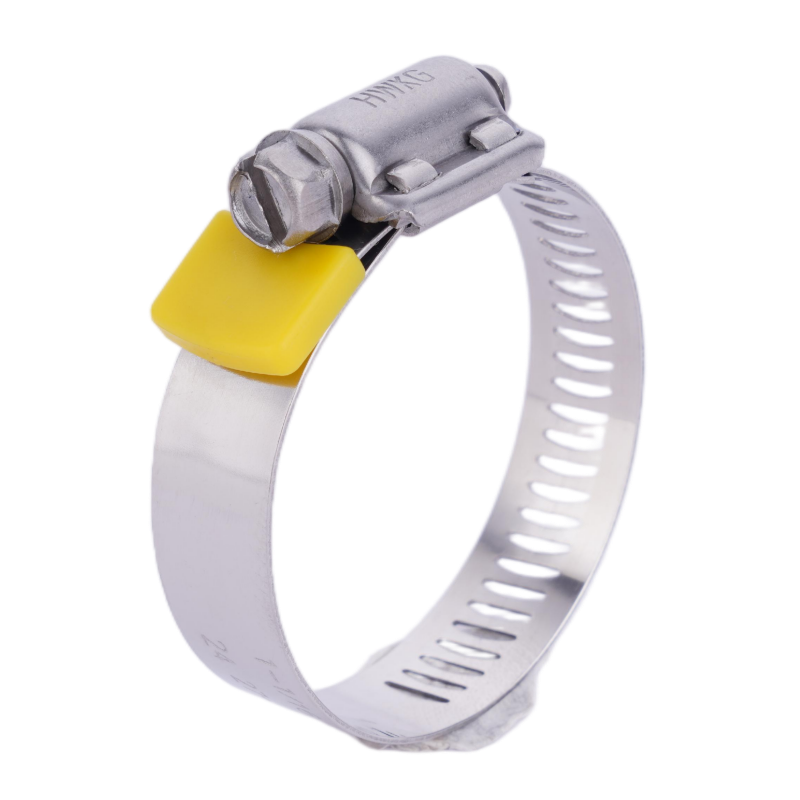
SAE Sizes in Inches and Millimeters
A standard worm drive hose clamp size chart lists each SAE size number next to its clamping range. The range shows the smallest and largest diameter the band can grip. A clamp does not have one fixed size. It covers a span, and the installer picks a clamp whose span brackets the hose diameter.
The table below combines data from AFT Fasteners and OneTouch Exim. It covers the most common sizes in both inches and millimeters.
| SAE 规格 | 夹紧范围(英寸) | 夹紧范围(毫米) |
|---|---|---|
| 6 | 3/8″ – 7/8″ | 10 mm – 22 mm |
| 8 | 7/16″ – 1″ | 11 mm – 25 mm |
| 10 | 1/2″ – 1-1/16″ | 13 mm – 27 mm |
| 12 | 1/2″ – 1-1/4″ | 13 mm – 32 mm |
| 16 | 13/16″ – 1-1/2″ | 21 mm – 38 mm |
| 20 | 13/16″ – 1-3/4″ | 21 mm – 44 mm |
| 24 | 1″ – 2″ | 25 mm – 51 mm |
| 28 | 1-5/16″ – 2-1/4″ | 35 mm – 57 mm |
| 40 | 2″ – 3″ | 51 mm – 76 mm |
| 56 | 3″ – 4″ | 76 mm – 101 mm |
| 72 | 4″ – 5″ | 102 mm – 127 mm |
| 88 | 5″ – 6″ | 127 mm – 152 mm |
Charts commonly run from #6 through #88. Large sizes also appear as metric ranges, such as 70–90 mm and 85–100 mm. AFT Fasteners lists a #128 clamp that reaches 8-1/2 inches (216 mm). The OneTouch Exim line chart below plots the midpoint of each SAE size range, which helps readers see how the sizes step upward.
Torque Values by Size
Torque depends on band width more than on SAE number. A narrow band needs less tightening force than a wide band. A U.S. Army technical manual (TM 5-3895-382-24) gives initial installation torque for new hose at 0.9 N·m (8 in-lb) for an 8 mm band, 4.5 N·m (40 in-lb) for a 13.5 mm band, and 7.5 N·m (65 in-lb) for a 16 mm band. Retightening torque runs lower: 0.7 N·m (6 in-lb), 3.0 N·m (25 in-lb), and 4.5 N·m (40 in-lb) for the same widths.
Published ratings from OneTouch Exim follow the same pattern. A 1/2 inch band standard worm gear clamp carries a 45 in-lb (5.1 N·m) rating. A 9/16 inch constant torque clamp reaches 70 in-lb (7.9 N·m). A 5/8 inch hi-torque clamp goes to 150 in-lb (16.9 N·m). Oetiker lists 2, 3, or 5 N·m for its 126/177 worm drive clamps, depending on range. Ideal-Tridon gives 35 in-lb as a typical target for 1/2 inch band clamps.
These figures are starting points. Always verify torque against the clamp manufacturer’s specification for the exact model. Band material, screw size, and hose type all shift the safe limit.
Miniature Clamp Sizes
Dimensions and Range
Miniature worm drive hose clamps use a narrow band, often about 5/16 inch (8 mm) wide. This slim profile lets the clamp sit in tight spots where a standard band will not fit. The smallest models tighten down to around 5/16 inch minimum, per Ourushop’s band width guide. A typical catalog entry, such as the 3I6204 stainless clamp, lists a clamp range of 0.25 inch to 0.625 inch (6.35 mm to 15.875 mm).
The miniature worm drive hose clamp size chart below shows how the small SAE sizes line up with band width and range.
| Category | 带宽 | 尺寸范围 |
|---|---|---|
| Miniature clamps | ~5/16″ band | SAE #4 for ~1/4″ (6 mm) hoses; SAE #6 covers 3/8″–7/8″ (10–22 mm) |
| Small #4–#8 clamps | 8 mm band | SAE #8 ~1/2″ to 1″ range |
These sizes suit hoses below one inch in diameter. A buyer checks the hose outside diameter first, then picks the SAE number whose range brackets that figure.
Applications and Torque
Small-diameter hoses show up in many systems. OneTouch Exim lists motorcycle and small engine fuel lines, windshield washer and vacuum lines, marine primer and tell-tale lines, and HVAC condensate drains as common homes for miniature worm drive hose clamps. Cable Ties Unlimited adds automotive air and fuel systems, food and beverage processing, irrigation, and household appliances. Many crews also call these parts micro hose clamps because of their tiny footprint.
Torque guidance for small screws stays low. The U.S. Army TM 5-3895-382-24 manual gives 0.9 N·m (8 in-lb) as initial installation torque for an 8 mm band. Over-tightening a narrow band can crush a soft hose or strip the screw housing. A torque wrench and the clamp maker’s spec keep the joint secure without damage.
Standard Worm Drive Hose Clamps
SAE Type F and Series
SAE J1508 Type F names the standard worm gear hose clamp family. Winlong Manufacturing notes that Type F clamps typically require a minimum destructive failure torque of 60 lb-in (6.8 Nm) for standard half-inch wide bands. That figure describes the point where the band or screw fails, not the working torque an installer applies.
Manufacturers also group these clamps into W30, W40, and W50 series. Each series generally signals a different level of corrosion resistance and band construction. A W30 clamp usually carries a zinc-plated band for dry, indoor duty. W40 and W50 clamps move toward stainless steel bands and housings for wet or outdoor service. Buyers should confirm the exact material grade with the supplier, because series labels vary between makers.
Band Widths and Ranges
Band width drives both the clamp range and the hose type a clamp suits. OneTouch Exim lists the common widths and their typical jobs.
| 带宽 | Approx. mm | Usual Name | Typical Jobs |
|---|---|---|---|
| 5/16″ | 8 mm | Mini, micro | Fuel, vacuum, small air lines |
| 3/8″ | 9–10 mm | DIN small | Coolant, fuel, crankcase vent |
| 1/2″ | 12.7 mm | Standard, SAE | General hose, coolant, water, air |
| 9/16″ | 14.3 mm | Wide standard | Truck coolant, heater hoses |
A narrow band fits small hoses and tight spaces. A wider band spreads pressure over more hose surface, which suits larger diameters and heat-cycling joints. The SAE size number then sets the exact clamp range. For example, SAE #6 covers 10 mm – 22 mm, #8 covers 11 mm – 25 mm, #10 covers 13 mm – 27 mm, and #12 covers 13 mm – 32 mm.
Torque for standard-size screws stays modest. The U.S. Army manual cited earlier gives 4.5 N·m (40 in-lb) for a 13.5 mm band. Installers should always check the maker’s spec before tightening.
Full-Size Clamp Sizes
Large-Diameter Ranges
Full-size worm drive hose clamps start where standard clamps end. Their ranges go past 2 inches and keep climbing from there. Common catalog entries include a 2.76″–3.54″ (70–90 mm) clamp and a 3.35″–4″ (85–100 mm) clamp. Bigger models keep moving up, and the largest ones reach 8-1/2 inches in diameter.
A full-size worm drive hose clamp size chart lists these big clamps as SAE numbers with wide spans. The clamp range on a large unit can cover several inches, so one part fits many pipe sizes. Buyers read the minimum and maximum figures, then compare them to the measured hose diameter. Sizes above 4 inches often show up in metric form on supplier charts. This makes cross-checking easy for crews who work in millimeters.
Heavy-Duty Applications
Large clamps serve systems that carry high flow and face tough conditions. Dixon Valve notes that hose clamps appear across agriculture, automotive, and industrial work. On farms, clamps must survive harsh environments and heavy use on irrigation hoses and equipment. Manufacturing plants use industrial clamps to join hoses to machinery.
Murray Corp lists several jobs that call for heavy-duty worm drive clamps:
- Heavy-duty truck and off-highway vehicle coolant, air intake, and exhaust connections
- Agricultural and irrigation pump discharge lines
- Marine engine and plumbing systems
- Mining and construction equipment fluid lines
- Municipal water and wastewater systems
- Industrial process piping and fluid transfer
YDS adds industrial machinery, gardening, and water plumbing to that list. These full-size worm drive hose clamps hold large coolant hoses on trucks and secure ducting in plants.
Torque guidance for large screws runs higher than for small bands. The exact figure depends on band width, screw size, and hose material. Installers should follow the clamp maker’s published specification and use a torque wrench. A wide band spreads force over more hose surface, which protects soft hose walls during tightening.
Choosing the Right Size
测量软管直径
A correct fit starts with one measurement. Ourushop advises measuring the hose outside diameter while the hose sits installed over the fitting. The fitting adds thickness, so a measurement taken off the hose alone can mislead.
Follow these steps to match a clamp to the hose:
- Measure the hose outside diameter with the hose seated on the fitting.
- Pick a clamp whose adjustable range covers that measurement.
- Aim for the middle of the range, not the edge.
- Skip nominal labels and SAE numbers as the only guide.
A hose clamp size chart helps here. The clamp range on the chart shows the smallest and largest diameter the band grips. Ourushop suggests moving one size up or down when the hose diameter sits very close to either end of the range.
Always rely on the actual diameter range. A “1 inch hose clamp” usually spans roughly 3/4 inch to 1-1/4 inch, not exactly 1.000 inch, per Ourushop.
Installation and Torque Tips
Positioning decides whether the joint seals. Cntopa recommends placing the clamp about 1/4 inch (6 mm) from the hose end and centering the band over the fitting’s barbed area. The band should sit evenly, away from the barb’s sharp edge.
Tighten with a driver that fits the screw head fully. Boshart gives 35–45 in-lb (3.96–4.52 Nm) for #6 and larger clamps. A torque wrench confirms the setting and prevents overtightening, which can crush the hose or strip threads.
Recheck the connection after the first use. Heat and pressure can settle the hose, so a second pass at the specified torque keeps the seal firm. A downloadable PDF chart and related worm drive hose clamps serve as handy references during selection.
Worm drive hose clamps follow SAE size numbers, and the full span runs from about 5/16 inch to over 8-1/2 inches. Miniature worm drive hose clamps cover the small end, standard worm drive hose clamps handle everyday jobs, and full-size units serve large pipe and duct work. A buyer measures the hose outside diameter first, then picks a clamp range that brackets that figure with margin on both ends. Correct torque finishes the job and keeps the joint leak-free. These worm gear hose clamps reward careful selection. Readers should keep the size charts and downloadable PDF handy as a quick reference, because one standard size number never tells the whole story.
常见问题
What does the SAE size number on a worm drive clamp mean?
The SAE number is a label for a clamping range, not a single diameter. SAE #8, for example, covers 7/16 inch to 1 inch (11 mm to 25 mm). Buyers match the number to the measured hose outside diameter.
Does a worm drive hose clamp have one fixed size?
No. Every clamp covers a span from a minimum to a maximum diameter. The band tightens anywhere inside that span. A clamp works best when the hose diameter sits near the middle of its range, not at either edge.
What torque should an installer apply to a worm drive clamp?
Torque depends on band width. The U.S. Army TM 5-3895-382-24 manual lists 0.9 N·m (8 in-lb) for an 8 mm band and 4.5 N·m (40 in-lb) for a 13.5 mm band. Always confirm the clamp maker’s published specification first.
Do W30, W40, and W50 series labels tell buyers the band material?
The series labels generally signal corrosion resistance and band construction. A W30 clamp usually carries a zinc-plated band for indoor duty. W40 and W50 clamps move toward stainless steel for wet or outdoor service. Series labels vary between makers, so buyers should confirm the grade with the supplier.
How does a buyer pick a clamp when the hose measures near the end of a range?
Ourushop advises moving one size up or down when the hose diameter sits very close to either end of the range. A clamp centered on the hose diameter spreads pressure evenly and holds the seal through heat cycling.