






V band clamps are not all the same. Manufacturers use different flange lip shapes and locking mechanisms even for parts of the same size. Unmatched components result in exhaust leaks, bent flanges and seized threads, and in severe cases, pressure can cause pipes to blow apart. Precisely engineered V-band components perform far better and ensure a robust seal every time.
Understanding V Band Clamps and Flange Profiles
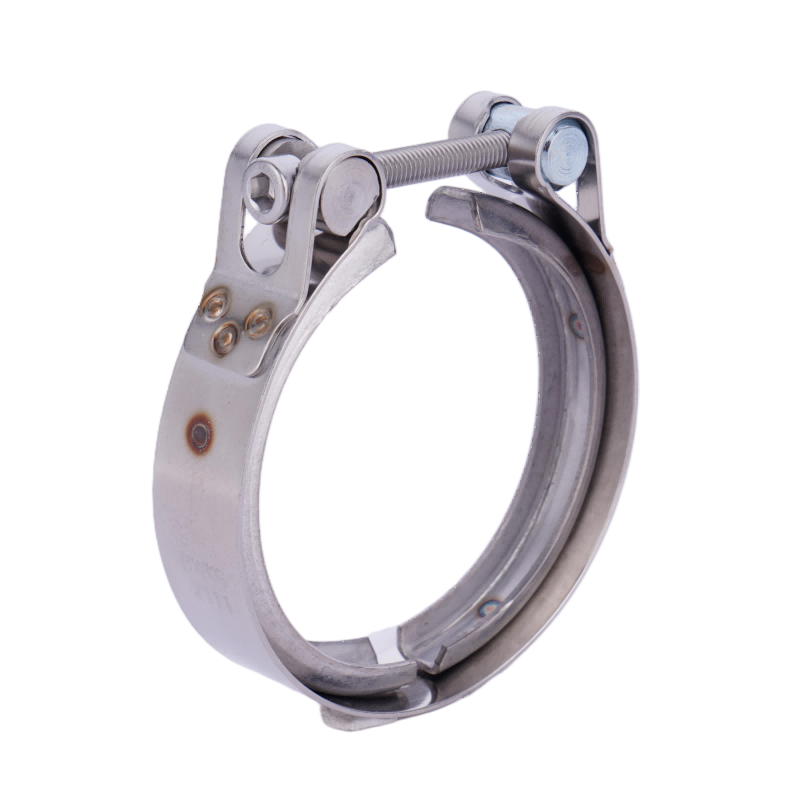
V band clamps are engineered to withstand high pressure. A properly constructed V-band joint firmly secures exhaust piping while reliably enduring extreme temperatures. Industrial suppliers provide V band clamps to serve a wide range of applications, delivering secure joining solutions for performance vehicles.
Male vs. Female V-Band Interlocking Lips
Interlocking lips are widely adopted by fabricators to align piping assemblies. Interlocking V-band profiles feature complementary ridge geometry: the male flange incorporates an elevated ridge, while the female flange is machined with a matching recess. These profiles automatically center and align two pipe ends. Flat-face connections do not feature these locating grooves. Mismatching flat-face flanges with interlocking lip flanges compromises the joint integrity, allowing exhaust gases to leak readily at the manifold. Custom manufactured components require perfectly matched flange profiles.
Standard vs. Quick-Release V-Band Designs
Latch configurations differ to suit various automotive applications. Heavy-duty V band clamps are built to sustain persistent intense vibration. Conventional V band clamps utilise a standard T-bolt assembly and are commonly fitted to engine manifolds, maintaining rigid connections under continuous vibration. Quick-release fasteners employ hinged latches to enable rapid servicing. Older traditional V-band setups require complete nut removal for disassembly, whereas quick-release variants open swiftly without risk of loose hardware. Conventional V band clamps feature distinct outer dimensions, and standard latches are not interchangeable with quick-release latch assemblies.
Flange Outer Diameters and Wedge Angles
Physical dimensions dictate the clamping force applied to the metalwork. Correct seating of V-band assemblies demands precise matching of wedge angles. Each flange profile carries unique outer diameter specifications; pipe bore size determines the primary inner dimension. Flange peripherals typically utilise standard wedge angles, most commonly 37° or 40°. The clamp’s outer channel bears against these angled surfaces, and this wedging action compresses the flange faces tightly together. Incorrect wedge angles drastically reduce contact surface area, triggering hazardous leaks adjacent to hot turbochargers. Premium-grade V-band components deliver consistent, reliable sealing and perform excellently for volume production orders.
Compatibility of the V-Band Turbo Flange
Turbocharger components are designed to channel high-temperature exhaust gas, with V-band turbo flanges creating a sealed connection for turbine piping. Many technicians mistakenly assume V-band hardware from all manufacturers is interchangeable. Mixing components from different manufacturers rapidly deteriorates manifold assemblies, whereas properly matched hardware helps maximise engine output.
Manufacturer Tolerances and Dimensional Variations
Top makers build v-band turbo flanges with unique sizes. Garrett, TiAL, and Precision Turbo use different lips.
- Lip and Groove Sizes: TiAL has small lips. Precision Turbo uses medium sizes. Garrett makes big lips.
- Flange Opening Dimensions: TiAL and PTE use two-inch openings. Garrett uses larger openings instead.
- Outer Dimensions: All three brands share three-inch outer sizes. Inner step heights are very different.
Small size errors cause bad exhaust leaks. They lower turbo boost speed very fast. This chart shows alignment step sizes for turbines:
| Housing Frame / Location | Garrett | TiAL | Precision Turbo (PTE) |
|---|---|---|---|
| VH3 Inlet Alignment Step | 60.0mm (2.36″) | 54.0mm (2.13″) | 57.0mm (2.24″) |
| VH3 Outlet Step | 82.0mm (3.23″) | 78.0mm (3.07″) | 78.0mm (3.07″) |
| VH5 Inlet Step | 78.0mm (3.07″) | 74.0mm (2.91″) | 74.0mm (2.91″) |
| VH5 Outlet Step | 95.0mm (3.74″) | 92.0mm (3.62″) | 92.0mm (3.62″) |
| VH6 Inlet Alignment Step | 84.5mm (3.33″) | 88.0mm (3.46″) | Cone seat (no step) |
Small Frame vs. Large Frame Turbo Applications
Daily street cars use small turbos for speed. Race cars use large turbos for power. Housing size changes clamp sizes instantly.
| Turbo Frame Category | Flange Outer Dimension / Type | Compatible Housings / Models |
|---|---|---|
| Small Frame Turbos | Standard 3.00″ outer dimension on the flange face | Common TiAL, PTE, HPT, and Garrett housings |
| Large Frame Turbos | Significantly larger size (e.g., TiAL V42V, PTE TH4V) | GT42/GT45, S400 (with TiAL housings), PT6870, PT7675, and Sportsman frame PTE |
Large racing car turbochargers get extremely hot and vibrate violently. Cheap clamps will quickly break under pressure. Reputable suppliers, however, produce robust and durable steel clamps.
Manufacturers must treat these components as specialized mechanical fasteners. Service personnel should purchase matching flanges and clamps. This practice maintains seal integrity and ensures optimal system performance. Always measure external dimensions to avoid simple installation errors. Applying a high-temperature anti-seize lubricant to T-bolts prevents thread seizing. Thermal friction can damage the threads of exposed metal bolts. To ensure reliable connections, HWKG offers custom-made V-clamps. Their robust stainless steel components can withstand extremely demanding work.
FAQ
Can mechanics mix different V-band clamp brands?
Mechanics must avoid mixing clamp brands. Makers use distinct lip shapes. Flange outer sizes differ. Wedge angles vary too. These prevent a tight seal.
How do mechanics choose the correct V-band clamp size?
Mechanics must measure three key areas:
- Flange outer diameter (OD)
- Inner pipe diameter (ID)
- Bevel wedge angle
Matching these dimensions stops leaks. It prevents pressure blow-offs.
Why do V-band clamps require high-temperature anti-seize?
High heat causes metal friction. T-bolts face thread damage. Anti-seize protects steel threads. It allows easy disassembly later.