





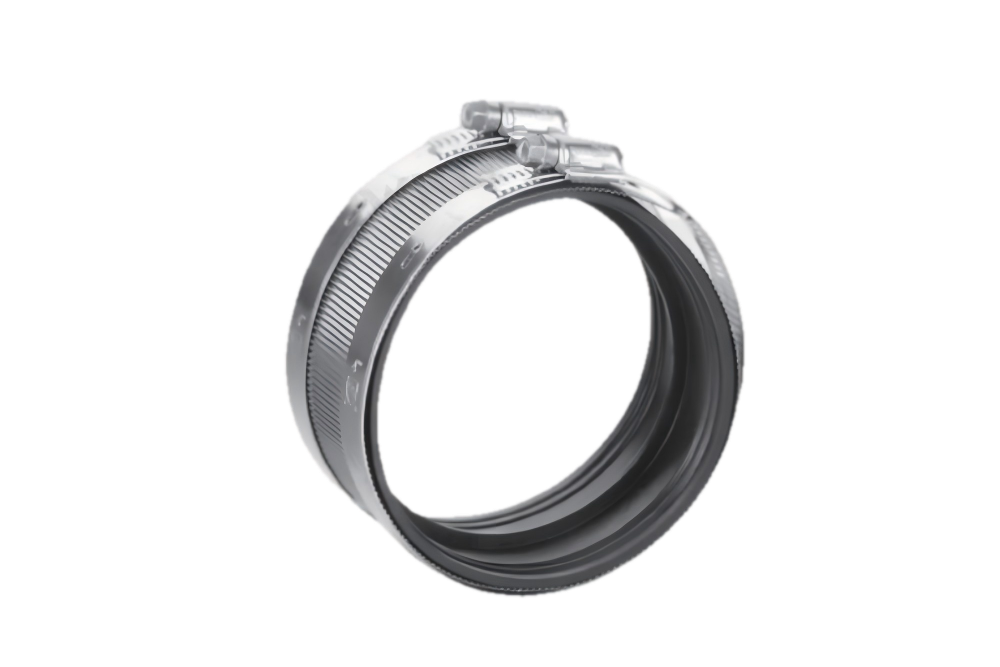
No‑hub couplings provide a popular joining method for cast iron DWV piping. A frequent question among plumbers, builders and property owners is whether these couplings are permitted for underground installations. While national standards allow below‑grade use under defined conditions, permission is not universal. Product type, material construction and local plumbing code amendments all determine acceptability. Using the wrong coupling or cutting corners during backfilling will lead to underground leaks, pipe separation and costly excavation repairs.
Key Takeaways
- Only shielded no‑hub couplings complying with ASTM C1277 and CISPI 310 are generally approved for underground applications. Unshielded no‑hub couplings are prohibited below grade in most jurisdictions.
- Select couplings fitted with Type 304 stainless steel bands to resist corrosion in damp, acidic or saline soils.
- Proper trench bedding, uniform bolt torque and controlled backfilling are essential to protect joints from ground settlement and lateral pipe movement.
- Establish a recurring inspection schedule for underground wastewater lines to detect gasket degradation early.
No Hub Coupling Code Compliance
Industry Standards & Specifications
National model plumbing codes reference recognised consensus standards that govern no‑hub cast iron pipe and couplings. Compliance with these standards is the baseline requirement, though local authorities may enforce tighter limits.
| Standard | Description |
|---|---|
| ASTM 888 | Production and labeling for no-hub cast iron and fittings |
| CISPI 301 | Production and labeling for no-hub cast iron and fittings |
| ASTM C1277 | Production and labeling for no-hub couplings |
| ASTM C564 | Production and labeling for no-hub couplings |
| ASTM C1563 | Production and labeling for no-hub couplings |
| CISPI 310 | Production and labeling for no-hub couplings |
Shielded no‑hub couplings feature an outer metallic reinforcing shell surrounding the rubber gasket. The shield distributes earth loads, restricts pipe pullout and maintains joint integrity during minor ground shifting. This reinforcement is the primary reason most codes permit these assemblies underground.Unshielded two‑band no‑hub couplings lack this outer shell. Without reinforcement, soil pressure and settlement can separate the pipe joint, so most code jurisdictions ban unshielded variants for all below‑grade work.
Local Code Variations
Model codes set minimum requirements, but municipal building departments often add local limitations:
- A small number of authorities operate pilot programmes allowing combined no‑hub cast iron and PVC underground installations subject to special inspection requirements.
- Some regions allow shielded no‑hub joints for residential below‑grade DWV lines under standard permit conditions.
- Certain areas require alternative joint methods (traditional bell‑and‑spigot lead and oakum joints) for cast iron piping in commercial buildings over 60 feet tall.
| Amendment Description | Impact on No-Hub Couplings |
|---|---|
| Pilot program for no-hub cast iron and PVC | Allows use under special permit in residential buildings not exceeding 60 feet in height |
| Changes to plumbing code | No-hub cast iron and PVC added as acceptable materials for below grade installations |
| Limitations on materials | Lead and oakum joints still mandated for hub and spigot cast iron in non-residential buildings over 60 feet |
Underground Performance of No‑Hub Couplings
No Hub Coupling Durability, Corrosion & Environmental Challenges
Underground joints operate in a hostile environment: constant soil moisture, fluctuating temperatures, soil chemical content, settlement and live loads from surface traffic.
Quality shielded couplings rely on two core durable components:
- EPDM rubber gaskets resistant to sewer gases, water and mild soil chemicals;
- Type 304 stainless steel clamps and shielding to slow rust formation in damp ground.
Type 301 stainless steel is not recommended for permanent underground service. It is more vulnerable to crevice corrosion when buried in wet soil and prone to stress cracking over time.
| Feature | Functional Benefit for Below‑Grade Service |
|---|---|
| Outer metallic shield | Resists vertical earth loads, prevents gasket extrusion |
| Type 304 stainless steel hardware | Improved rust resistance in wet or mildly corrosive soils |
| Precision shear ring structure | Limits excessive pipe displacement from settlement |
| Torqued multi‑band assembly | Maintains consistent compression on the rubber gasket |
Reference note: Pipeline industry data indicates joint and coupling failures account for a measurable share of underground drainage system failures. Proper material selection and installation drastically reduce this risk.
Hengwei, an established manufacturer with over 20 years of experience, produces stainless steel shielded couplings and pipe clamps engineered for buried cast iron DWV systems. All products undergo factory leak and corrosion testing, and custom configurations are available for non‑standard project requirements.
No Hub Coupling Critical Installation Guidance & Common Failures
Even compliant shielded couplings will fail if installed incorrectly. Below are the most frequent field errors and root causes:
| Installation Defect | Resulting Issue |
|---|---|
| Uneven or over‑torqued coupling bands | Ruptured rubber gasket or inconsistent sealing pressure |
| Rough, burr‑covered pipe ends | Gasket tearing once buried |
| Poor trench bedding / large sharp rock backfill | Point loads crack couplings or displace piping |
| Lack of pipe restraint/bracing | Horizontal movement pulls joints apart during settlement |
| Use of unshielded couplings below grade | Joint separation under earth pressure |
Standard recommended workflow for underground no‑hub joint assembly:
- Cut pipe square, remove all burrs and clean the outer pipe surface.
- Fit the shielded coupling evenly across the pipe joint centreline.
- Tighten bolt bands strictly following the manufacturer’s specified torque values.
- Prepare the trench with fine sand or granular bedding free of sharp rubble.
- Backfill gradually in compacted thin lifts; avoid heavy machinery directly above uncovered joints.
- Add mechanical restraints where long pipe runs risk lateral shifting.
Alternatives to No‑Hub Couplings for Below‑Grade Work
When local codes prohibit shielded no‑hub couplings, or for projects requiring higher resistance to pipe separation, installers can select alternative joining systems.
| Joint Type | Strengths | Typical Use Case |
|---|---|---|
| Bell‑and‑spigot cast iron (lead & oakum) | Proven long‑term stability, high pullout resistance | Commercial, high‑rise or projects with strict historic code requirements |
| Heavy‑duty shielded rubber transition couplings (Fernco‑style) | Compatible between dissimilar pipe materials (CI to PVC) | Mixed material underground drainage lines |
| HDPE heat‑fused joints | Zero‑leak monolithic joint, excellent chemical resistance | Long‑run gravity sewer and wastewater pipelines |
| PVC solvent weld couplings | Cost‑effective for PVC DWV, lightweight | Residential underground plastic drainage |
Key comparison consideration: Standard no‑hub cast iron systems are engineered for gravity DWV service. They are not designed for pressurised pipeline applications. If working with pressure piping, select purpose‑manufactured pressure rated mechanical couplings.
Recommended Best Practices for Underground Pipe Joints
- Build a recurring inspection schedule to monitor joint performance long‑term.
- Confirm code acceptance and product certification prior to purchasing materials.
- Specify only shielded couplings with Type 304 stainless steel hardware for burial.
- Protect all exposed rubber gaskets from direct sunlight before installation.
- Use clean, granular bedding materials; exclude sharp stones that can damage couplings.
- Install detectable warning tape above all buried drainage lines during backfilling.
- Complete mandatory hydrostatic or air pressure testing before final trench backfill.
FAQ
Can shielded no-hub couplings be used underground?
Yes, you can use shielded no-hub couplings underground. They follow ASTM C1277 and CISPI 310 rules. Makers say they are good for underground pipes because they last long and do not rust.
What is the best method for joining no-hub cast iron pipe underground?
Suppliers say to use shielded couplings with stainless steel bands. This way, the pipe stays strong and does not leak. It also follows the plumbing rules for pipes underground.
How often should underground pipe joints be inspected?
| Pipe Type | Inspection Frequency |
|---|---|
| Clean Water | Check every 2 or 3 years |
| Wastewater | Check every 6 to 12 months |