


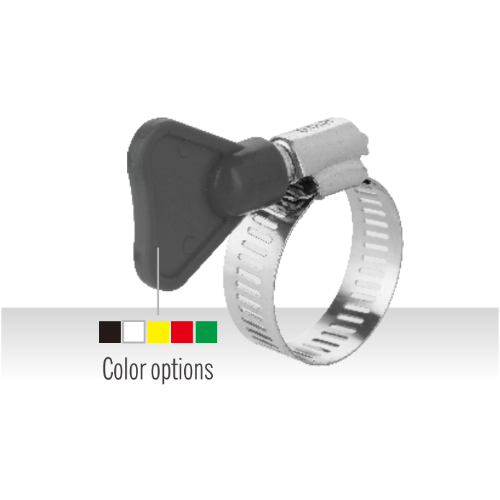
A worm drive hose clamp tightens a hose onto a fitting by turning a screw that draws the band through a housing. Its breaking torque usually ranges from about 5 to 25 Nm, depending on band width and size, and load capacity grows with clamp diameter and material.Two numbers are often mixed up. Breaking torque is the torque a clamp can survive, while installation torque is the torque used to tighten it. Real holding strength depends on band material, housing and screw quality, and dimensional tolerance, not torque alone.
HWKG’s worm drive hose clamps take this further, backed by digital quality control and in-house R&D, and supported by a range that includes T-bolt clamps, constant tension hose clamps, band clamps, and pipe couplings.This worm gear clamp guide treats each hose clamp specification as a strength question, not a pressure rating alone, and shows where a worm clamp suits high-pressure work.
Key Takeaways
- Worm drive clamps have different torque limits: breaking torque is the most you can apply before the clamp fails, while installation torque is the safe amount to tighten it.
- Always tighten clamps to the recommended installation torque, not the breaking torque. This avoids damage and keeps a safety margin.
- Wider bands and bigger clamp sizes make the clamp stronger. So choose the clamp size and band width that fit your hose and the job you need to do.
- For high-pressure or high-vibration jobs, think about heavy-duty worm clamps or T-bolt clamps, which give more clamping force.
- Check quality by asking for test records and specifications. Re-tighten clamps after heat cycles to keep a secure seal.
How Strong Are Worm Drive Clamps?
Breaking Torque and Clamp Strength
Breaking torque is the applied torque a clamp withstands before it reaches the tested failure condition. A higher breaking torque means a greater strength margin. This number tells buyers how much turning force the band, housing, and screw can survive before something gives way. The strength of worm drive clamps does not come from a spring or a lock. Friction and a shallow thread angle do the work, according to OnetouchExim. A few thread flanks on a few slot edges carry the entire load. The quality of the slots and the screw therefore matters out of proportion to their size. The band tension clamps the thread down into the slots, which raises friction exactly when it is needed. The housing holds the screw slightly preloaded against its seat, so a tiny vibration does not easily start it rotating. These details explain why two clamps with the same dimensions can show very different strength in service.
Typical Torque Ranges by Clamp Size
Published maximum torque values show how band width and screw type shape clamp strength. Clampco lists the following figures for its 300 series stainless steel worm gear clamp series:
| Series | Worm Size | Screw Type | Band Width | Maximum Torque |
|---|---|---|---|---|
| 90009 SERIES | 0.25 in. | Zinc plated worm screw | 0.50 in. | 50 in.-lbs. |
| 90038 SERIES | 0.312 in. | Stainless steel worm screw | 0.312 in. | 20 in.-lbs. |
| 90016 SERIES | 0.25 in. | Stainless steel worm screw | 0.50 in. | 50 in.-lbs. |
The table shows a clear pattern. The two series with a 0.50 in. band width reach 50 in.-lbs. of maximum torque. The series with a narrower 0.312 in. band tops out at 20 in.-lbs. Band width, not screw size alone, sets much of the strength ceiling. A wider band spreads the load over more material and resists deformation better.
Breaking torque is an upper limit, not an operating target. A clamp that survives 50 in.-lbs. in a lab test should not be tightened to that value in the field. The failure test pushes the part to its limit. Real installations need a safety margin below that point. Installation torque, covered in the next section, is the number that matters during assembly. Buyers who treat breaking torque as a working value risk stripped threads, distorted housings, and failed seals. The published maximum torque serves as a comparison tool between series and a guide for selecting a clamp class. It does not tell a technician how far to turn the screw. That distinction protects both the hose and the connection.
Installation Torque and Clamping Force
Free Driving Torque Explained
Free driving torque is the torque you need to turn the screw before the band touches the hose. A technician turns the screw and feels resistance. That resistance comes from thread friction, how the housing fits, and slot quality. A low, steady free driving torque shows good manufacturing control. The screw turns smoothly with little drag. Free driving torque that is high or not steady points to rough threads, a tight housing, or poor dimensional tolerance. These conditions make installation harder. They also cut down on the feel a technician needs to judge tightness. A quality worm gear clamp turns freely at this stage. That smooth start matters because the same screw must later give controlled clamp tension against the hose. Buyers can test a sample by hand. A few turns before contact should feel light and even. Any grinding or binding is a warning sign. This simple check costs little and shows a lot about production quality. The measurement is taken with the band open, so it reflects the clamp alone, not the hose. That open-band reading sets the baseline for the whole installation.
How Installation Torque Affects Clamping Force
A standard clamp with a 5/16 head worm screw is usually tightened to about 60 inch-pounds. That value is the installation torque. It sits far below the breaking torque we talked about earlier. The gap between the two numbers creates the safety margin. Installation torque turns into clamping force through the thread and band geometry. Turning the screw pulls the band through the housing. The band gets shorter around the hose. Band tension rises, and that tension becomes clamping force on the hose surface. A properly installed worm gear clamp therefore gives even pressure around the fitting. The link is direct: more installation torque produces more clamping force, up to the design limit. Technicians who stop at the specified value protect the hose from crushing and the clamp from damage. They also keep a reserve of strength for thermal cycling and vibration. A calibrated torque wrench gives the most reliable result. Hand feel varies between technicians, and a wrench removes that variation. The wrench reading confirms the setting before the hose sees service.
Worm gear clamps work best where you need precise control of clamping force. The screw thread gives fine adjustment. A small turn changes the band diameter by a small, predictable amount. This control lets a technician reach enough clamping force without overtightening. It also supports steady clamping force across many connections on a production line. A worm clamp holds its setting once tightened. Vibration may slowly relax it, so periodic checks help. Still, the first setting is repeatable and easy to check with a torque wrench. That repeatability is why these clamps work well in automotive, plumbing, and industrial work. A well-fitted clamp balances holding power against hose protection. The right installation torque is the tool that achieves that balance. Too little torque leaves the joint loose and prone to leaks under pressure. Too much torque crushes the hose and weakens the band. The specified value marks the safe middle ground. Writing the torque value on a work instruction helps every technician apply the same setting. A simple log of torque values supports quality checks over time.
Pressure Resistance and Heavy-Duty Applications
Pressure Ratings and Thermal Cycling
Pressure ratings for worm drive clamps depend on band thickness, hose size, and operating conditions. HoseCandy publishes typical ranges that help buyers set realistic expectations:
| Condition | Pressure Rating (PSI) |
|---|---|
| Burst pressure (standard worm gear clamps) | 50–150 PSI |
| Safe working pressure (ideal conditions) | 30–60 PSI |
| 9/16-inch stainless clamp on 1-inch hose (controlled lab) | 80–120 PSI |
| Thicker bands (3/4-inch) | 150 PSI or more |
| 1.5-inch radiator hose at 200°F | 40–50 PSI reliably |
| Ideal conditions (maximum) | 100 PSI |
| Daily driver’s hot, vibrating engine bay (reliable long-term) | 30–50 PSI |
HoseCandy also puts these numbers side by side in a chart, and the wide spread shows why one psi number rarely tells the whole story:
Thermal cycling slowly wears down how well a hose stays put over time. Heat makes the hose and the fitting expand. Cold makes them shrink back again. Each thermal cycling event can loosen the band just a little. A clamp that thermal cycling has relaxed may still look tight. Then a hard boost event sends a pressure spike through the line and pushes the hose off the fitting. Hoses in demanding service, such as diesel engines running 10 hours a day, need periodic re-torque checks. A short checklist helps: confirm the installation torque with a wrench, inspect the band for cracks, check for hose shrinkage under the housing, and re-tighten to spec after the first heat cycle.
Standard vs. Heavy-Duty Worm Drive Clamps
Standard worm gear clamp designs use a band and a screw mechanism for adjustable tension, as KSI Group describes. Some models add a plastic thumb screw so you can adjust them without tools. Heavy-duty versions build on that layout with a heavier housing and band, so the worm screw sits in a stronger stainless band. The heavier design accepts more tightening torque without tilting or stretching. Some heavy-duty models add a stack of Belleville spring washers on the screw. That stack takes up hose shrinkage through thermal cycling, which keeps clamping pressure steadier across heat cycles.
Heavy bands do not conform as easily as thin ones. At the small end of a size range, a stiff band can leave a step at the overlap. A thin standard band pulls that step flat. Buyers should therefore match size carefully when they choose stainless steel heavy duty hose clamps. Standard clamps suit light plumbing and general routing. Heavy-duty clamps fit high-pressure, heavy-duty needs such as vibration, high psi lines, and long service. Both classes serve their purpose well.
Worm Drive Clamps vs. T-Bolt Clamps
Torque Capacity and Clamping Performance
Heavy-duty worm drive clamps have a wider band, thicker material, and a strong screw mechanism. These features give them a higher load capacity and a longer service life. Youde’s data shows T-bolt clamps can handle up to 120 in-lb of torque, while a typical worm clamp handles around 60 in-lb, as reported by Ourushop. HoseCandy notes that a standard worm gear clamp makes roughly 100–200 inch-pounds of clamping force at a reasonable torque. A T-bolt clamp can easily make 400–600 inch-pounds. The gap in torque capacity comes from the mechanism. A worm gear clamp uses a threaded screw that fits into slots cut into a metal band. A T-bolt threads through a saddle into a nut. One forum comment puts it plainly:
The t bolt is going to give a ton more clamping force than the worm gear because it’s not holding the band in place with the edge of the screw.
Band width is different too. Worm gear clamps usually use a 1/2″ band, while T-bolt clamps usually run 5/8″ to 3/4″. A wider band spreads the pressure over more hose surface.
Choosing the Right Clamp for the Application
Each class fits a different job, so the heavy-duty vs standard clamping choice comes down to the line. Specialty Sales describes worm gear clamps as a good starting point for general hose clamping, with a wide take-up range for flexible sizing and usually the most economical option. Ourushop lists household plumbing, garden hoses, automotive coolant hoses, and gas lines among common uses. T-bolt clamps suit heavy-duty clamping where vibration, pressure, or machinery movement are part of the job. Their main advantage is clamping strength, and they are built for high torque work, though the take-up range is narrower, so size must be more exact. Murray Corp notes that T-bolt clamps excel in high-pressure and high-temperature environments where a secure, uniform clamping force is essential. These clamps offer a cost-effective, flexible solution for lower performance requirements. Both options are fit for purpose. A buyer comparing t-bolt vs worm gear clamps should match the clamp to the line, not rank one above the other.
How to Evaluate Worm Drive Clamp Quality
Reading Torque and Pressure Specifications
Specification sheets reward careful reading. YD Severeon advises engineers to treat breaking torque, free driving torque, and installation torque as three separate measures. Breaking torque shows mechanical strength. It does not prove greater clamping force at a given installation torque. Free driving torque describes screw effort before the band grips the hose. Installation torque is the turning force applied during assembly, and clamping force is the compression that results. Friction and deformation use up part of the applied torque, so two designs tightened to the same value may clamp differently.
| Specification | How to Interpret It | What to Check |
|---|---|---|
| Breaking Torque | Torque at a defined failure condition during testing | Test method, acceptance criteria, size, material, units |
| Free Driving Torque | Screw effort before clamping resistance begins | Inspection records and consistent acceptance criteria |
| Installation Torque and Clamping Force | Applied torque versus resulting compression | Recommended torque for the exact series and full-connection testing |
A compliance mark alone does not settle suitability. YD Severeon notes that SAE J1508 covers relevant hose clamp types, yet high-pressure suitability depends on the complete connection, including the hose, fitting, and installation procedure.
Quality Control and Buyer Considerations
Buyers should ask for documents, not promises. Mika Clamp recommends material grades, dimensional tolerances, pressure range, and traceability records. Test evidence should link to a batch number and cover torque testing, axial pull testing, pressure cycling, vibration resistance, and leak performance. Metal worm gear clamps also need corrosion results, weld quality, edge finish, and thread condition. Reports should name the equipment, procedures, and acceptance limits, and they must match the ordered size, coating, and material.
Winlong Manufacturing adds three inspection points: deburred slots and rolled band edges, a secure housing-to-band interlock, and consistent screw thread pitch. A supplier’s ISO 9001:2015 quality system, inspection plan, and change-control process deserve review too. For demanding joints, stainless steel heavy duty hose clamps with documented testing give buyers a stronger basis for comparison. Ask how each worm gear clamp controls pressure distribution across the band. Every hose clamps purchase should end with lot codes, photographs, and torque records on file.
Worm drive clamps handle moderate to high torque loads. Three measures define their strength: breaking torque, installation torque, and clamping force. No single number tells the full story. Buyers should match clamp size, band width, material, and clamp class to the job’s torque, pressure, and vibration demands. A worm gear clamp works best with a safety margin below its breaking torque. A heavy-duty worm clamp suits high-pressure lines and long service.
Check published ratings and quality control records before purchase. The right clamp is the one whose specifications fit the application.
FAQ
How much torque can a worm drive clamp take?
Breaking torque typically falls between 5 and 25 Nm, depending on band width and clamp size. A wider band raises the ceiling. Published data shows a 0.50 in. band reaching 50 in.-lbs., while a 0.312 in. band tops out at 20 in.-lbs. Treat these figures as limits, not working targets.
What installation torque should a technician apply?
A standard clamp with a 5/16 head worm screw usually tightens to about 60 inch-pounds. That value sits well below the breaking torque and leaves a safety margin. A calibrated torque wrench gives the most reliable result. Too much torque crushes the hose and weakens the band.
What pressure can a worm gear clamp handle?
Standard clamps typically handle about 50–150 PSI at burst pressure, with a safe working pressure of roughly 30–60 PSI under ideal conditions. Real service pressure depends on band thickness, hose size, and temperature. A hot, vibrating engine bay lowers the reliable range to roughly 30–50 PSI. Thermal cycling can relax the band over time.
When should a buyer choose a T-bolt clamp instead?
T-bolt clamps handle higher torque, rated up to approximately 120 inch-pounds, and they suit very high-pressure, high-vibration joints. Worm drive clamps offer precise clamping force control and broad size adjustability. Each class fits a different job. Buyers should match the clamp to the line.