





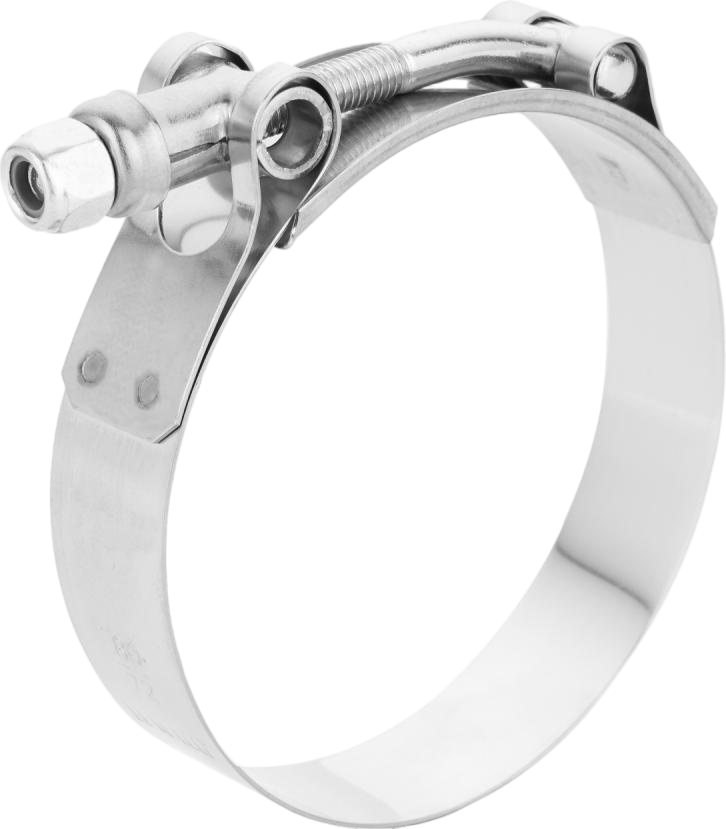
T-bolt clamps are widely adopted across automotive, marine, agricultural, industrial fluid transmission and exhaust systems for reliable, high-integrity hose connection solutions. Compared with conventional worm gear clamps, T-bolt designs deliver uniform, high clamping force, making them the preferred choice for pressurized pipeline assemblies.
The mainstream T-bolt clamp styles on the market include:
- Standard T-bolt clamps (universal heavy-duty type)
- Channel tongue T-bolt clamps
- Floating bridge T-bolt clamps
- Vibration resistant T-bolt clamps
- Lap-style & Butt-style T-bolt band clamps
As a high-performance hose fastener, the structural differences of each T-bolt clamp directly determine its applicable pressure range, temperature resistance, anti-vibration performance and compatibility with different hose materials.
Key Takeaways
- T-bolt clamps are heavy-duty hose fasteners engineered for high-pressure, high-temperature working conditions, delivering consistent circumferential clamping force to prevent leakage and hose detachment.
- Multiple structural variants exist: standard, channel tongue, floating bridge, anti-vibration, lap joint and butt joint styles. Each structural design targets distinct working conditions and hose types. Proper selection ensures sealing reliability and extends service life.
- Correct clamp selection relies on three core dimensions: material compatibility, system working pressure, operating temperature and ambient corrosive environment. Installation torque and hose material hardness are critical overlooked factors.
Different Styles of T-Bolt Clamps
T-bolt clamps belong to the heavy-duty band hose clamp family, characterized by high clamping force and long service life. Manufacturers such as Hengwei produce a full portfolio of T-bolt clamps serving automotive, agricultural machinery, marine and general industrial markets. Every structural variant features targeted design elements to match specific application requirements. Understanding style differences eliminates improper selection and premature assembly failure.
Standard T-Bolt Clamps
Standard T-bolt clamps feature a wide, smooth continuous band, avoiding localized stress concentration that cuts or damages hose surfaces. The structure generates large uniform clamping force and performs excellently under cyclic vibration. The floating bridge design evenly distributes circumferential pressure to achieve consistent sealing around the hose outer diameter.
| Design Feature | Description |
|---|---|
| Wider smooth band | Minimizes hose abrasion; ideal for silicone, EPDM and rubber turbo hoses |
| High uniform clamping force | Suitable for medium-to-high pressure fluid and gas pipelines |
| Superior vibration resistance | Optimized for turbocharger assemblies, construction machinery and engine peripherals |
| Floating bridge design | Balances band tension to eliminate partial gap and improve sealing uniformity |
Typical Applications: Turbo intake pipes, coolant pipelines, water pumps, flexible exhaust connections.
Hengwei standard T-bolt clamps primarily adopt 304 / 316 stainless steel bands paired with zinc-plated carbon steel or stainless steel T-bolts. All units undergo dimensional and tensile inspection during production to resist atmospheric oxidation and moderate corrosion.
Channel Tongue T-Bolt Clamps
Channel tongue T-bolt clamps integrate a reinforced formed channel along the band joint area to improve overall band rigidity. The channel structure strengthens tensile resistance while maintaining smooth inner band surfaces to prevent cutting soft-walled hoses. This style effectively avoids band warping under high tightening torque.
Key Features:
- Reinforced channel structure improves band rigidity and ultimate tensile load
- Smooth inner band profile protects soft rubber, PVC and composite hoses
- High deformation resistance under continuous tightening load
Channel tongue T-bolt clamps are widely specified for food-grade fluid systems, clean water pipelines and agricultural irrigation equipment. Hengwei supplies this style in multiple nominal diameters, configurable with 304 stainless steel, 316 stainless steel and carbon steel materials.
Floating Bridge T-Bolt Clamps
Floating bridge T-bolt clamps incorporate an independent floating bridge liner. The floating structure allows adaptive displacement when hoses expand thermally at elevated temperatures or contract in low-temperature environments, maintaining stable sealing pressure without over-compressing or loosening the hose.
| Design Element | Description | Applications |
|---|---|---|
| Floating Bridge Liner | Compensates thermal expansion & contraction of hoses | Marine vessels, industrial process equipment, commercial vehicles |
| Standard Band Width | 3/4″ (19 mm) | Widely interchangeable for general heavy-duty assemblies |
| Band & Housing Material | 304/316 stainless steel | Corrosion resistance for humid and coastal environments |
| Bolt & Fastener | Zinc-plated carbon steel / stainless steel with prevailing torque locknut | Resists loosening under continuous vibration |
Floating bridge variants are common in marine engine piping, factory hydraulic circuits and vehicle cooling systems. Hengwei implements automated dimensional inspection to guarantee consistent clamping performance across production batches.
Vibration Resistant T-Bolt Clamps
Vibration resistant T-bolt clamps are engineered for equipment enduring sustained mechanical oscillation, such as off-road machinery, racing vehicles and generator sets. Optimized fastener configurations prevent spontaneous loosening caused by cyclic vibration, eliminating leakage and hose slippage.
Features:
- Enhanced locking assembly maintains preset tightening torque under continuous vibration
- Sustained clamping force prevents relative movement between clamp band and hose outer surface
- Higher ultimate failure torque margin compared to standard models
This style is favored by automotive modification factories and heavy machinery manufacturers. Hengwei completes vibration cycle testing during product validation to verify long-term fastening stability.
Lap-Style and Butt-Style T-Bolt Band Clamps
Lap joint and butt joint T-bolt clamps differ fundamentally in how they connect mating pipe/hose ends, selected based on joint geometry.
| Clamp Type | Structure Description | Sealing Characteristics |
|---|---|---|
| Lap Joint (Lap-Style) Clamp | One pipe/hose end inserts into the mating larger diameter component (slip-fit overlap) | Overlap creates double-wall contact area; generally achieves superior sealing performance |
| Butt Joint (Butt-Style) Clamp | Two equal-diameter pipe ends face-to-face; relies on an internal sleeve/gasket for sealing | Sealing performance highly dependent on gasket quality and alignment precision |
Application Guidance:
- Lap-style band clamps: Slip-fit connections, common for exhaust flex pipes and large-diameter industrial pipelines
- Butt-style band clamps: End-to-end connection of identical-diameter rigid pipes, requiring auxiliary gaskets
Hengwei manufactures both lap and butt joint T-bolt clamps customizable according to pipe outer diameter and operating pressure requirements.
Selection Tip: Match your T-bolt clamp style according to joint form, hose material, working pressure and required sealing grade.
All T-bolt clamps utilize high-grade base materials including stainless steel bands and alloy fasteners to resist corrosion and extend service life. Hengwei adopts automated processing and finished-product testing to deliver consistent quality recognized by industrial buyers globally.
Comparing Hose Clamp Types and T-Bolt Variations

T-Bolt Clamps vs. Other Common Hose Clamp Types
Hose clamps serve pipeline fastening across industries. T-bolt clamps stand out by supporting far higher working pressure and delivering longer service life under harsh operating conditions.
| Clamp Type | Typical Maximum Working Pressure Level | Durability Profile |
|---|---|---|
| T-bolt clamps | High | Excellent; suited for high-pressure, vibration-prone harsh environments |
| Worm gear clamps | Moderate | Cost-effective universal solution, limited performance in heavy-duty pressurized systems |
Heavy-duty T-bolt clamps are the preferred alternative when worm gear clamps risk slippage, insufficient clamping force or premature failure in automotive, marine and industrial equipment.
Key Differentiating Specifications Among T-Bolt Styles
Selecting suitable T-bolt variants requires comparison of core technical indicators:
| Specification Type | Technical Meaning |
|---|---|
| Recommended Installation Torque | Target torque range to achieve rated clamping force without hose crushing or band yielding |
| Destructive Failure Torque | Threshold torque at which the bolt or band undergoes permanent deformation or fracture |
| Salt Spray Resistance Hours | Standard corrosion testing indicator (Hengwei stainless steel series reaches ≥500h neutral salt spray) |
| Band Tensile Strength | Determines resistance to band stretching under continuous load |
| Vibration Resistance | Supported by locknut hardware to avoid torque loss under cyclic oscillation |
High-performance heavy-duty variants adopt floating bridge or channel tongue reinforcement structures. Anti-vibration versions feature specialized locking fasteners, while marine-grade options upgrade material grades for superior corrosion resistance.
Choosing the Right T-Bolt Clamp
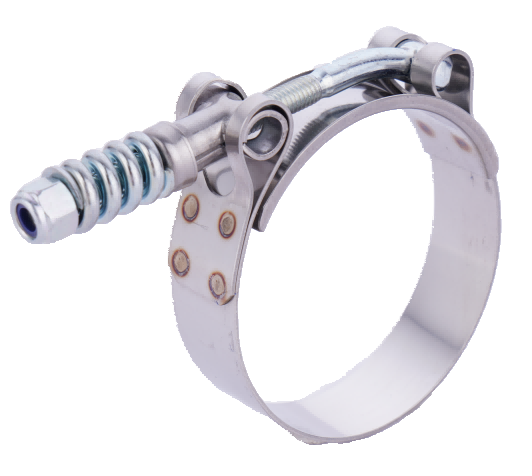
Four core factors govern T-bolt clamp selection:
- Material compatibility: 316 stainless steel recommended for coastal, chemical and saltwater environments; 304 stainless steel for general outdoor and engine bay use; carbon steel for dry indoor low-corrosion environments.
- Working pressure requirements: Specify heavy-duty reinforced styles for high-pressure fluid/gas circuits.
- Ambient operating conditions: Match material grade and structural design to temperature extremes, humidity, chemical splash and UV exposure.
Manufacturers including Hengwei supply heavy-duty T-bolt clamps in comprehensive diameter ranges and multiple material grades to cover cross-industry application demands.
Selection Tip: Prioritize clamps with structural features matching your exact working conditions to maximize sealing performance and service life.
T-bolt clamps are renowned for high clamping force and durability under high-pressure operating environments.
| Clamp Type | Typical Application | Performance Characteristics |
|---|---|---|
| T-bolt clamps | High-pressure, high-temperature pipelines | Uniform strong circumferential clamping force, reliable long-term sealing |
| Worm drive clamps | Low-pressure general plumbing, low-load hoses | Economical, flexible installation, limited upper pressure threshold |
Quick selection reminders:
- Choose T-bolt clamps for critical joints requiring leak-free sustained sealing
- Verify material corrosion resistance and temperature rating against site environment
- Hengwei’s product portfolio covers marine, automotive and general industrial equipment requirements
FAQ
What makes T-bolt clamps different from worm gear clamps?
T-bolt clamps rely on bolt-nut tension to generate uniform circumferential clamping force. Worm gear clamps utilize a threaded worm screw mechanism. T-bolt designs deliver higher maximum clamping force and far better performance under high pressure and vibration, making them suitable for critical heavy-duty assemblies.
Can Hengwei Hose Clamps be used outdoors?
Yes. Hengwei stainless steel T-bolt clamps offer good resistance against oxidation and atmospheric corrosion. They are applicable to irrigation systems, outdoor agricultural machinery and exposed pipeline installations. For coastal salt spray environments, 316 stainless steel variants are strongly recommended.
How do I choose the right T-bolt clamp size?
Measure the outer diameter of your assembled hose or pipe. Select a clamp whose adjustable range covers the measured outer diameter. Hengwei provides a full size chart covering metric and imperial specifications for diverse pipeline sizes.