




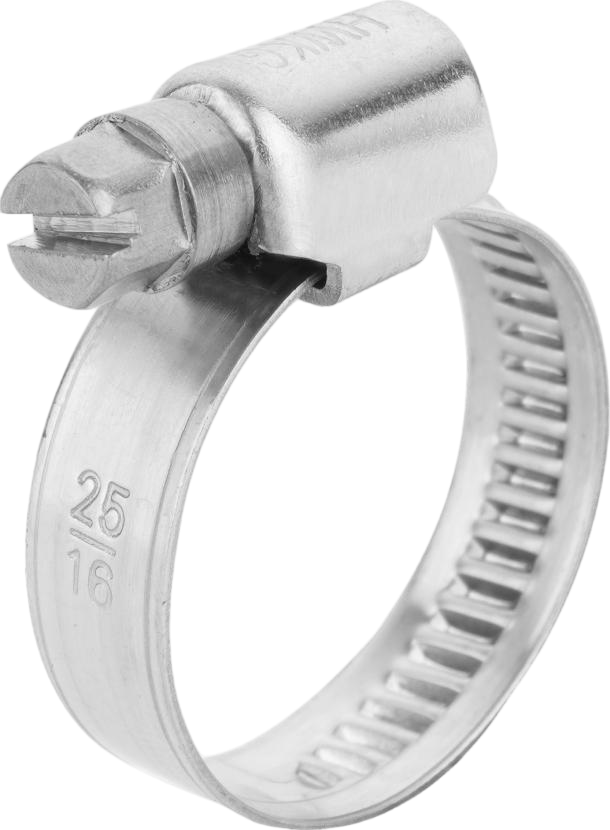
Design disparities between German-style worm clamps and American perforated worm clamps stem from two distinct globally standardized industrial specifications with separate engineering priorities:
- DIN 3017-1:2021 (German industrial standard) — Documented and published by DIN Deutsches Institut für Normung. The standard’s core design mandate prioritizes long-term hose protection, uniform circumferential compression and sustained clamping stability under cyclic thermal change and mechanical vibration for safety-critical automotive, marine and industrial fluid circuits. It enforces solid, non-perforated steel bands with fully rolled inner contact edges as a mandatory construction clause.
- SAE J1508:2023 (North American automotive standard) — Released via SAE Mobilus. This specification targets cost efficiency and wide diameter adjustability for light/medium load auxiliary piping in passenger vehicles, residential plumbing and construction, permitting slotted perforated bands with flat unprocessed stamped edges with no mandatory hose-protection edge rules.
Key Takeaways
- DIN 3017 German-style hose clamps use seamless solid bands with full rolled safety edges to reduce hose abrasion risks and maintain consistent sealing performance through continuous thermal cycling, making them the primary specified hardware for pressurized fuel, coolant and marine exhaust fluid circuits.
- SAE J1508 American perforated clamps deliver broad diameter adjustability and lower base production cost, suited for low-vibration, light-pressure residential irrigation, general construction piping and entry-level OEM auxiliary vehicle lines with limited service-life requirements.
- W1/W2/W4/W5 corrosion material grades are exclusive DIN 3017 classifications and do not apply to SAE J1508 hardware. Zinc-coated carbon steel W1 material is restricted to dry, low-temperature indoor non-fluid piping per DIN 3017 Clause 5 due to limited anti-rust performance in humid environments. Stainless steel W4/W5 grades are recommended for outdoor, marine and high-temperature fluid applications under both standards.
- Application matching principle: Specify DIN solid band clamps for safety-critical pressurized fluid systems with continuous vibration or thermal fluctuation; select SAE perforated clamps for temporary, frequently replaced low-load hose connections to balance hardware cost and installation flexibility.
American Hose Clamp Overview
Design and Structure
All American worm-drive hose clamp design boundaries are defined within SAE J1508:2023 dimensional and performance clauses. The signature construction feature is a continuous perforated slotted band; the worm drive screw engages internal rectangular slots to adjust clamping diameter.
Most mass-produced standard SAE bands use thin stamped steel to reduce manufacturing costs, while heavy-duty T-bolt variants upgrade to wider solid band profiles with machined hex fasteners to deliver elevated clamping force for medium-load fluid lines. The simple open stamped housing enables high-volume mass production but creates uneven point-focused contact pressure against hose outer surfaces during tightening.
Materials and Sizes
SAE J1508 does not enforce unified material corrosion grading; manufacturers freely deploy mild carbon steel, 304 stainless, brass and nylon based on cost targets. Each material carries distinct lab-verified service limits:
| Material | Standard Compliance | Corrosion & Temperature Limits |
|---|---|---|
| Mild Carbon Steel (W1 equivalent) | SAE J1508 general grade | Zinc coating only, max 120°C continuous temp, 96h maximum salt spray resistance |
| 304 Stainless Steel (W4) | SAE J1508 heavy-duty | 400h ASTM B117 salt spray, continuous 450°C heat tolerance |
| Brass/Copper | Optional non-standard custom | Low vibration indoor plumbing only, poor high-temperature tensile strength |
| Nylon Plastic | Light auxiliary piping only | Max 80°C, zero resistance to hydrocarbon fuel contact |
Size marking follows US SAE numerical sizing codes (Size 6, Size 10, Size 36) rather than metric DIN diameter labels; custom metric conversion sizes are available from manufacturers including HWKG for cross-region equipment matching.
Locking Mechanism
Perforated slot locking operates via discrete point-to-point engagement between the worm screw and individual band slots. All tightening force concentrates at isolated slot contact locations, generating intermittent uneven pressure distribution around the hose circumference. Standard unmodified stamped SAE clamp housings contain no asymmetric load-balancing geometry, leading to measurable progressive torque loosening after repeated heat-cool cycles and sustained engine vibration — a consistent recurring failure documented across commercial automotive repair networks.
Common Applications
SAE J1508 perforated clamps dominate low-to-medium load scenarios with limited continuous vibration exposure:
- Automotive auxiliary cooling and low-pressure vacuum lines on mass-market daily passenger vehicles
- Construction site temporary water pump, garden irrigation and fire suppression hoses
- Residential household pool, outdoor faucet and light-duty PVC piping connections
German Hose Clamps Explained
Band design and construction
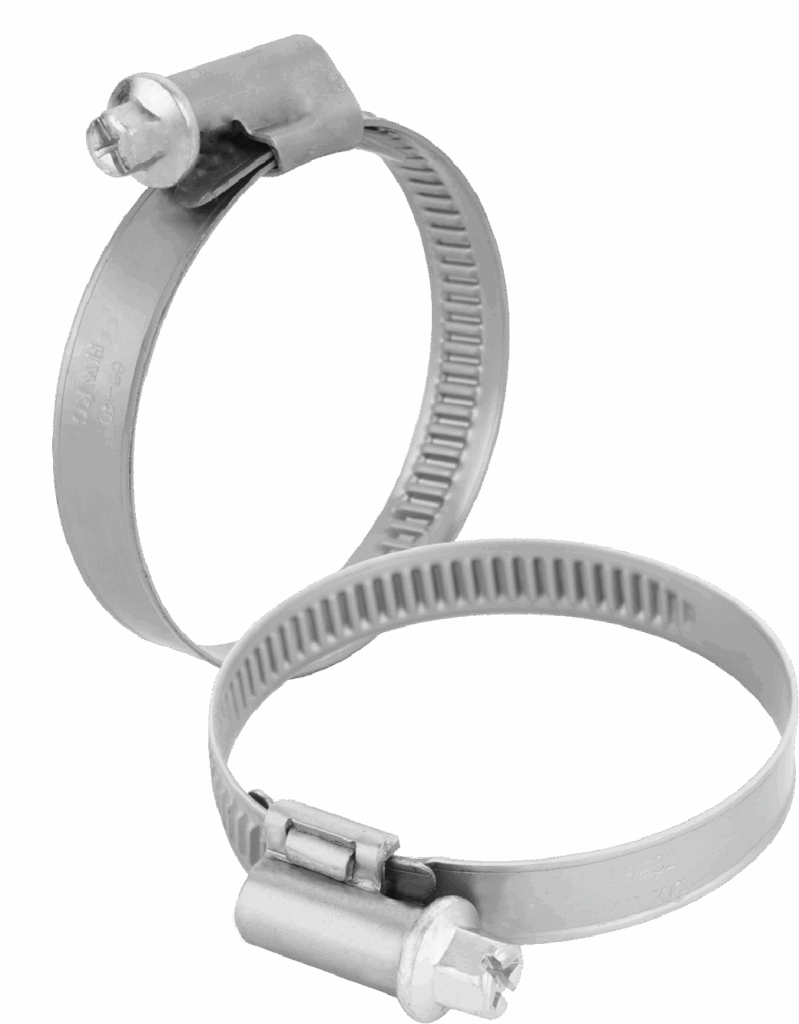
DIN 3017-1:2021 mandates solid non-perforated steel band construction with fully rolled inner and outer radius edges (minimum edge rounding dimension specified in Clause 4.2) to eliminate sharp contact points that abrade soft rubber and silicone hose surfaces. Industry standard band widths are fixed at 9 mm and 12 mm with uniform consistent band thickness to deliver balanced radial load distribution during tightening.
The worm drive screw engages external continuous stamped tooth ridges formed directly onto the band inner surface (rather than through perforated slots) to create uninterrupted full-circumference metal-to-hose contact. Standard screw head dimensions are limited to compact 7 mm hex to enable installation within confined engine bay and machinery clearance spaces.
Materials and variants
DIN 3017 establishes four official W-grade material classifications with quantified ASTM B117 salt spray test thresholds, eliminating ambiguous material quality labeling:
- W1: Zinc-plated mild carbon steel, 144h minimum salt spray, dry indoor low-temp use only
- W2: Mixed carbon steel screw + stainless band, 240h salt spray, general industrial moderate humidity
- W4: Full AISI 304 stainless steel, 400h salt spray, automotive coolant / exhaust cold side
- W5: AISI 316 marine-grade stainless steel, 1000h salt spray, coastal marine and chemical fluid piping
HWKG manufactures three DIN-compliant German-type sub-variants to match different installation workflows:
- Welded heavy-duty DIN clamps: Reinforced band joints for burst pressure resistance up to 25 bar
- Modular split DIN clamps: Quick disassembly without full screw removal for frequent service components
- Butterfly hand-tight DIN clamps: Tool-free plastic handle design for low-pressure quick-fit temporary connections
Locking and Spring Mechanism
DIN tooth-on-band worm drive architecture distributes tightening load evenly across the full circular band surface without discrete slot-based stress concentration points. Premium DIN 3017 asymmetric split housing designs balance tensile load on the worm screw to minimize long-term torque decay during thermal cycling. High-performance DIN variants integrate factory-fitted constant-tension spring inserts that passively compensate for hose dimensional expansion and contraction as operating temperatures rise and fall, eliminating mandatory post-install retightening steps on closed fluid systems per standard service guidelines.
Typical uses
DIN German-style clamps are specified for all safety-critical pressurized fluid circuits with continuous vibration or extreme thermal fluctuation:
- Automotive turbo hot-side exhaust, high-pressure fuel injection and heavy-duty diesel engine coolant manifolds
- Off-highway agricultural machinery, marine boat seawater cooling and industrial hydraulic piping
- Process chemical transfer lines with soft silicone or fluoropolymer hoses prone to surface abrasion
HWKG DIN-series solid band clamps are widely specified by equipment OEMs for systems where leakage or hose rupture creates safety hazards, as the rolled-edge solid band construction removes two primary failure modes of perforated American clamps: slot-induced hose cutting and uneven pressure blow-by.
German vs American Hose Clamps Comparison
Structure and Band Core Engineering Differences
DIN 3017 German Hose Clamp
- Solid seamless non-perforated band with fully rolled inner/outer safety edges (DIN mandatory standard requirement)
- External continuous tooth ridges on band surface for uniform 360° clamping contact
- Compact 7mm small hex screw head for tight confined installation spaces
- Asymmetric split housing design for balanced radial load distribution
SAE J1508 American Hose Clamp
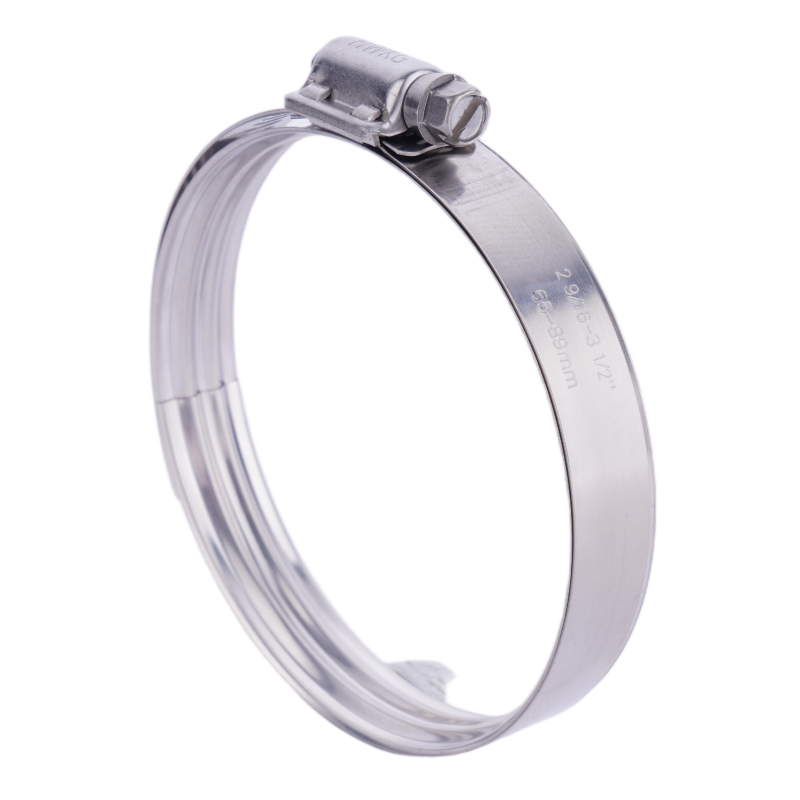
- Perforated through-slotted band with flat unrounded stamped edges (SAE permitted construction)
- Internal rectangular screw engagement slots creating discrete point pressure contact
- Larger 8–10mm hex/Phillips screw heads optimized for wide open bay access
- Symmetric simple stamped housing for low-cost mass manufacturing
| Feature | German Hose Clamp (DIN3017) | American Hose Clamp (SAE J1508) |
|---|---|---|
| Band Design | Solid non-perforated continuous band | Perforated slotted adjustable band |
| Edge Treatment | Mandatory full rolled radius inner edges | Flat unrounded stamped edges (no standard mandate) |
| Standard Screw Head Size | Fixed 7mm compact hex | Variable 8–10mm hex/Phillips |
| Official Governing Standard | DIN 3017 with unified W-grade material specs | SAE J1508, no standardized corrosion grading |
| Adjustable Diameter Tolerance | Narrow ±6mm | Wide ±12mm |
Locking Mechanism, Torque Retention & Sealing Consistency
All worm-drive clamps rely on screw tension to generate clamping force, yet structural differences create measurable long-term sealing performance gaps visible during routine vehicle maintenance:
- DIN solid continuous tooth worm drive: Balanced load distribution minimizes progressive torque loss through repeated thermal cycling and sustained vibration
- SAE perforated slot worm drive: Isolated point screw-slot engagement creates uneven pressure distribution; progressive torque loosening is a standard recurring maintenance complaint documented across global commercial repair fleets
Perforated slot gaps on SAE hardware create potential micro-leak pathways under elevated boost pressure, as clamping force only engages discrete slot intersection points rather than the full hose circumference. DIN gapless solid band contact eliminates this recurring leakage risk on undamaged matched flange assemblies. Heavy-duty T-bolt SAE variants improve sealing consistency but carry elevated upfront component cost relative to entry-level perforated worm-drive SAE clamps.
Durability and Corrosion Resistance
Corrosion resistance mainly depends on alloy material grade rather than clamp style, yet band structure accelerates rust formation on low-cost zinc-coated hardware.
Perforated slots on SAE clamps trap salt, coolant and dust residues, forming crevice corrosion points that shorten service life in coastal or chemical industrial environments. Smooth solid DIN band surfaces avoid residue accumulation and maintain stable anti-rust performance over longer service intervals.
Application Suitability Matrix
DIN 3017 German Clamp Recommended Operating Scenarios
- Pressurized fluid systems requiring consistent sealing stability with sustained vibration and thermal cycling
- Thin-walled soft silicone, fluoropolymer and lightweight rubber hoses susceptible to surface abrasion damage
- Long-service closed fluid circuits requiring minimal scheduled post-install maintenance retightening
- Marine, coastal salt-spray and industrial chemical processing piping environments
SAE J1508 American Clamp Recommended Operating Scenarios
- Low-pressure temporary irrigation, residential pool and construction-site water transfer piping
- Mass-market passenger vehicle entry-level auxiliary vacuum and mild-temperature cooling lines
- DIY modification and frequent hose replacement projects prioritizing wide adjustable diameter range and low upfront hardware cost
- Dry indoor low-vibration non-critical air and light fluid piping assemblies
Complete Step-by-Step Guide to Selecting the Correct Hose Clamp
Core Standard-Aligned Selection Decision Factors
All selection guidance aligns directly with published clauses within DIN 3017-1:2021 and SAE J1508:2023 formal industrial standards:
| Selection Factor | Long-Term Performance Impact | Recommended Clamp Construction Type |
|---|---|---|
| Operating Fluid Pressure | Elevated sustained pressure requires uniform gapless circumferential compression to prevent blow-by leakage | DIN 3017 solid band German clamps (T-bolt DIN variants for heavy elevated pressure assemblies) |
| Repeated Thermal Cycling | Hose material expands and contracts with temperature fluctuation, creating risk of torque loosening over service life | DIN constant-tension spring integrated German clamp variants |
| Zero-Leak Sealing Mandate | Safety-critical fluid circuits require uninterrupted full-circumference metal-to-hose contact to eliminate micro-leak pathways | DIN non-perforated solid band design compliant with full rolled edge rules |
| Hose Wall Material (Soft Silicone/Rubber) | Sharp unprocessed band edges create permanent abrasion damage on thin flexible tubing under sustained clamping tension | DIN fully rolled inner edge German clamps |
| Corrosive Operating Environment (Salt, Chemical Coolant) | Crevice buildup of corrosive media accelerates surface oxidation on slotted perforated band hardware | W4/W5 grade smooth solid band DIN clamps |
| Frequent Disassembly / DIY Service | Broad adjustable diameter window simplifies repeated hose removal and replacement workflows | SAE J1508 perforated American worm clamps |
When to Specify SAE J1508 American Hose Clamps
American-style worm clamps are engineered to comply with all dimensional and performance rules defined in SAE J1508:2023. They are suited for general low/medium-load piping assemblies across automotive, residential and construction industries. Formal hardware selection workflow for SAE clamp specification:
- Identify base hose material and select matching alloy grade compatible with operating temperature and environmental exposure
- Measure nominal hose outer diameter to match available SAE numerical size coding or custom metric conversion sizing
- Evaluate operating environment for sustained heat, salt spray or chemical media exposure to select appropriate corrosion-resistant alloy
- Source hardware from verified standard-compliant manufacturers to avoid substandard thin-stamped band construction prone to premature service failure
SAE perforated clamps accommodate a broad range of mixed hose nominal diameters and support simple fast installation/removal workflows, making them a cost-effective choice for temporary or frequently replaced low-load piping assemblies.
When to Specify DIN 3017 German Hose Clamps
German-style solid band clamps adhere fully to all mandatory construction clauses within DIN 3017-1:2021, alongside supplementary Q675 domestic reference dimensional alignment guidance (Q675 is not a globally recognized international industrial standard). The rolled-edge solid band construction prioritizes long-term hose surface protection and consistent sealing stability for high-demand fluid circuits subject to vibration and extreme thermal fluctuation. DIN hardware is widely specified for automotive turbo assemblies, heavy-duty industrial machinery and marine fluid piping where operational safety and extended service life are primary design priorities. Tool-free butterfly DIN clamp variants enable quick hand tightening without auxiliary service tools to reduce assembly labor time for low-pressure temporary connections.
Universal Pre-Installation Clamp Selection Checklist
- Record exact nominal pipe/hose outer diameter and sustained operating fluid pressure range
- Document full operating environment conditions: indoor/dry, outdoor humid, coastal salt spray, continuous high vibration or elevated exhaust heat
- Calculate long-term service-life requirements and scheduled maintenance frequency
- Select clamp construction style matching pressure, vibration and hose material protection requirements
- Confirm alloy material grade aligns with corrosion and temperature exposure rules outlined in applicable industrial standards
- Cross-verify minimum physical clearance space around the fitting to accommodate clamp screw head dimensions
- Source standard-certified hardware to avoid non-compliant untested generic clamp construction
| Evaluation Consideration | DIN 3017 German-Style Clamp | SAE J1508 American-Style Clamp |
|---|---|---|
| Long-Term Sealing Performance | Continuous 360° metal contact, low leakage risk for high-pressure fluid lines | Discrete point compression, higher long-term micro-leak risk under vibration |
| Installation Labor Speed | Single fastener, rotational alignment capability available | Sequential tightening, fixed flange orientation |
| Hose Surface Protection | Full rolled edges eliminate abrasion on thin soft hoses | Perforated slots create scratching risks for silicone tubing |
| Upfront Hardware Cost | Medium-High (precision solid band processing) | Low-Medium (simple perforated stamping) |