


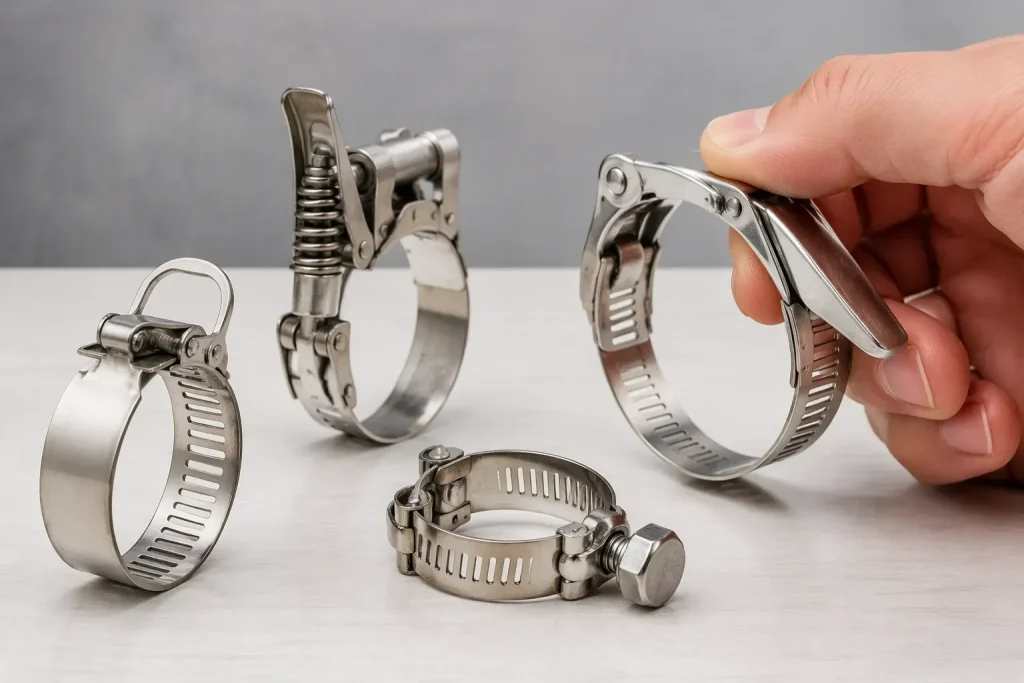
A worm gear clamp is one way among several to secure a hose. Five other designs are worth knowing: T-bolt clamps, spring-loaded T-blot clamps, constant tension clamps, ear and pinch clamps, wire clamps, and heat-shrink clamps. Each can deliver steadier clamping force, resist vibration, fit cleaner, or seal better on a specific hose type.
HWKG’s hose clamp range takes this further, covering worm drive clamps, T-bolt clamps, constant tension hose clamps, band clamps, and pipe couplings, backed by digital quality control and in-house R&D.This guide compares each alternative against a worm gear clamp, so the right choice for a given hose becomes clear.
Key Takeaways
- T-bolt clamps hold high pressure best for thick hoses and charged air lines.
- Spring-loaded clamps adjust to heat and keep a steady grip on radiator hoses.
- Pinch clamps offer a cheap, permanent seal for small hoses like fuel lines.
- Wire clamps grip thin-wall hoses gently and suit classic cars.
- Heat-shrink clamps seal fuel joints completely against leaks and chemicals.
T-Bolt Clamps: Maximum Holding Power

Performance and Pressure Ratings
A single worm gear clamp suits low-pressure work well. A T-bolt clamp holds considerably more pressure, and that gap defines the fair comparison point. The T-bolt design spreads force across a wide, flat band. A sturdy bolt draws the band tight, so the clamp grips the hose with even tension around the full circumference.
This even grip matters on thick-wall hose and on charged air lines. The T-bolt resists flexing better than a narrow worm gear band. A worm drive clamp still works fine on a garden hose or a low-pressure drain line. Neither a worm gear clamp nor a T-bolt replaces a crimp clamp where a permanent crimp is required. A crimp clamp forms a factory-style seal that no reusable T-bolt can match.
Best Fits and Cost
T-bolt clamps shine on charge-air hose, coolant lines on heavy equipment, and marine exhaust hose. A supplier often stocks them for turbo plumbing and industrial hose assemblies. The T-bolt style also fits silicone hose well, because the wide band avoids cutting into soft material.
Expect to pay more per piece than for a basic worm gear clamp. The added hardware and heavier band explain the price. A wholesale order lowers the unit cost, and a manufacturer can custom-size the band for a specific hose diameter. Buyers who need a reusable clamp for high-pressure or fixed systems will find the T-bolt a sound investment. The extra holding power protects the hose and the connection over many service cycles.
Spring-Loaded Clamps: Constant Tension
Thermal Cycling and Clamping Force
Constant tension clamps are a good swap for worm gear clamps when a connection gets hot and cold. A spring steel band holds energy and pushes inward as the hose relaxes. The clamp then lets that energy go when the hose swells again. This self-adjusting motion keeps pressure on the hose through every cycle.
A worm drive clamp cannot track that movement. The screw holds one set diameter, so heat cycling slowly weakens the grip. Factory band spring types show the same constant tension idea in original equipment. These clamps often need pliers to remove, and that tight fit explains their long service life.
Where They Fit and What They Cost
Spring clamps work well on smaller hoses, like fuel lines, vacuum lines, and coolant bypass hoses. They also show up on larger hoses, including radiator hoses in some vehicles. The compact shape clears tight engine bays, and the smooth band will not cut a soft hose wall.
A wholesale supplier stocks constant tension clamps in many diameter ranges. Unit cost runs higher than a basic worm gear clamp, yet the clamp often outlasts the hose it holds. A manufacturer can custom-build a band clamp for a specific radiator hose or charge-air hose. Buyers who service fleet vehicles value the reusable design. The clamp comes off with pliers and goes back on the same hose without a torque wrench. That convenience suits maintenance shops and factory assembly lines alike.
Ear Clamps and Pinch Clamp Basics
Pinch clamp is a broad term. It covers crimp-style clamps that squeeze a metal band closed around a hose. Oetiker-style clamps are a great, cheap alternative to worm gear hose clamps, especially when bought in quantity. A wholesale supplier can ship them in bulk, and a factory can custom-size the band for a given hose diameter.
Crimping Performance and Vibration Resistance
A crimping tool presses the ear flat against the band. The band then grips the hose with a permanent, non-adjustable connection. The clamp stays non-adjustable after crimping, so the seal will not loosen on its own. This design suits high-vibration conditions well. The crimped fitting holds steady on fuel lines, vacuum lines, and small coolant hose. Shops that build crimped assemblies rely on a specialized crimping tool for repeatable results. The tight grip creates vibration-resistant connections that outlast many screw-type bands on a moving engine.
Fit, Compliance, and Per-Clamp Cost
These clamps fit small hose well. The low profile clears tight spaces, and the smooth band will not cut a soft hose wall. Per-clamp cost stays low, and bulk orders push the price down further. Compliance matters on OEM work, where a factory may specify a crimped band by part number. One caveat applies. These clamps are not ideal where frequent replacement is planned. The band must be cut off, and a fresh clamp goes on each time. Installation also requires a variety of clamps and pliers to cover different hose sizes. A pinch clamp still earns its place on a permanent, secure connection that will not come apart in service.
A worm drive clamp remains the easy choice for a hose that comes off often. Pinch clamps trade that convenience for a lower profile and a lower price. A single pinch clamp costs little, and the crimp holds for years. Buyers who plan a long service life will find pinch clamps a smart pick, and a supplier can bundle the right sizes with the pliers.
Wire Clamps: Lightweight Grip
Performance on Thin-Wall and Vacuum Lines
A wire clamp uses a single loop of spring steel wire instead of a flat band. The wire presses a narrow ring of force onto the hose surface. That focused grip suits thin-wall hose well, because the wire bites into soft material without crushing it. A wide band can spread force too broadly on a delicate wall, and the connection may still weep.
Vacuum lines also benefit from this design. The spring wire holds light, steady tension and follows small movement at the fitting. A worm gear clamp relies on a screw that holds one fixed diameter, so a thin wall may relax under it over time. Wire clamps keep a gentle, even hold on small-diameter hose, and they resist loosening from engine vibration.
Application Fit and Budget
Wire hose clamps are a common alternative for classic cars such as a Model A Ford. Restorers pair them with NOS Ford clamps and adjustable clamps to match original factory appearance. The simple wire form looks period-correct, and it fits the narrow hose found on vintage cooling and fuel systems.
Budget matters here. A wire clamp costs little per piece, and a wholesale supplier can ship them in bulk for a restoration shop. A manufacturer can custom-form the wire diameter for a specific hose size. Some designs add a quick release tab, which speeds service on a hose that comes off often. A factory that builds vintage-style assemblies often stocks several sizes.
These clamps suit low-pressure work best. A driver who needs a strong seal on a modern high-pressure line should look at a T-bolt or constant tension clamp instead. For a classic car, a light vacuum line, or a small coolant hose, the wire clamp delivers a clean fit at a low price. Buyers who order in quantity keep the per-unit cost down and always have the right size on hand.
Heat-Shrink Clamps: Sealed and Streamlined
Sealing Performance and Chemical Resistance
A heat-shrink clamp is a tube of adhesive-lined polymer. The installer slides it over the hose and the fitting, then applies heat. The tube shrinks down and the adhesive liner melts into every gap. The result is a uniform and reliable seal that covers the joint completely.
This design blocks moisture, dust, and road spray from reaching the connection. It suits automotive fuel lines, where vapor escape and contamination both matter. The seal also holds up against fuels, oils, and common solvents. The adhesive liner resists chemical attack and protects a crimped fitting from corrosion. A worm gear clamp relies on band pressure alone, so small gaps can remain at the fitting edge. Heat-shrink closes those gaps with a bonded layer.
Installation Fit and Total Cost
Installation takes one step and one tool. A heat gun softens the tube, and the material contracts around the hose and fitting. The clamp needs no re-tensioning later, and it will not loosen from vibration. The low profile clears tight spaces, and the smooth outer surface will not snag nearby parts. A soft hose wall also stays safe, because the shrink force spreads evenly.
Total cost runs higher per unit than a plain metal band. The price buys two functions in one part, since the tube fastens and seals at once. A wholesale supplier can ship these clamps in bulk, and a manufacturer can custom-cut each hose size for a specific assembly. A factory that builds sealed fuel or coolant lines often prefers this approach. Buyers should weigh the higher piece price against the labor saved on a hose that needs no retorque. For a permanent, clean connection, the heat-shrink clamp earns its cost.
Pinch Clamp vs Worm Drive: Which Hose Clamp Wins?
Matching Clamps to Pressure and Hose Material
No single clamp wins every job. A worm gear clamp remains a solid default for low-pressure work, and it costs little. The screw offers adjustability, reusability, or ease of installation on a hose that comes off often. Each alternative simply wins in a narrower situation.
Match the clamp to the pressure first. A T-bolt suits charged air lines and high-pressure coolant hose. A spring-loaded band tracks thermal cycling on a radiator hose. A pinch clamp holds a small fuel or vacuum line with a permanent crimp. A wire clamp grips thin-wall hose, and a heat-shrink tube seals a fuel joint outright.
Hose material decides the rest. Soft silicone needs a wide band that will not cut the wall. A stainless worm gear clamp works fine on a garden hose, yet a heavy-duty bolt clamp protects a thick industrial hose under load. A wholesale supplier can match band width and material to each hose type.
Cost vs. Performance at a Glance
Budget and duty cycle shape the final call. A basic worm gear clamp costs the least per piece, and a factory can ship stainless worm gear clamps in bulk. A pinch clamp costs little too, and bulk orders push the price lower still. A T-bolt or heat-shrink clamp costs more, yet each buys longer service or a sealed joint.
| Clamp | Best For | Cost Level |
|---|---|---|
| Worm gear | Low-pressure, removable hose | Lowest |
| T-bolt | High pressure, charge air | Higher |
| Spring-loaded | Thermal cycling | Moderate |
| Pinch | Permanent small hose | Low |
| Wire | Thin-wall, classic cars | Low |
| Heat-shrink | Sealed fuel lines | Higher |
A quick release tab adds convenience on a hose that sees frequent service. HWKG supplies worm drive clamps, heavy-duty bolt clamps, EPDM-cushioned band clamps, and pipe couplings, backed by 20+ years of manufacturing and digital quality control. The company positions these five alternatives as complementary choices, and a custom order covers any hose size.
Five solid alternatives exist, and each one beats worm gear clamps in a specific situation. Worm drive clamps still serve low-pressure work at the lowest cost, yet a better match often sits one row down the list.
- T-bolt: high-pressure charge air and thick-wall hose.
- Spring-loaded: radiator lines that heat cycle.
- Pinch: permanent small hose connections.
- Wire: thin-wall and classic car lines.
- Heat-shrink: sealed fuel joints.
Readers should match the clamp to hose type, pressure, and budget. A supplier or factory can confirm sizes in bulk. Upgrade from the worm gear clamp or pinch clamp where duty demands it, and keep a worm drive clamp on hand for quick service work.
FAQ
Which clamp suits high-pressure hose best?
A T-bolt clamp holds high pressure best. Its wide band grips thick-wall hose evenly. A worm gear clamp still works well on low-pressure hose.
Why do spring-loaded clamps hold better through heat cycles?
A spring steel band tracks thermal cycling. The clamp pushes inward as the hose relaxes and releases as the hose swells. A worm drive clamp holds one fixed diameter.
Are ear clamps a good choice for bulk orders?
Yes. Oetiker-style ear clamps cost little in bulk. A wholesale supplier ships them in quantity. They suit permanent small hose connections, not hose that comes off often.
When should a buyer choose a heat-shrink clamp?
Choose heat-shrink for a sealed fuel or coolant joint. The tube bonds to the hose and fitting. It blocks moisture and chemical attack on the hose.
Can a supplier match a clamp to a custom hose size?
Yes. A manufacturer can custom-cut each clamp for a specific hose diameter. A factory matches band width and material to the hose type.