





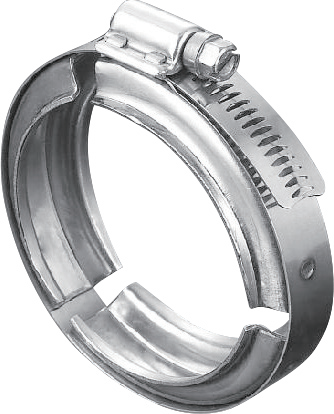
V-band clamps and band clamps serve fundamentally different roles in fluid and exhaust system connections. A V-band clamp uses a precision-machined V-profile retainer to join two flanged pipe ends — delivering a gas-tight, 360° seal rated for high-pressure and high-temperature applications up to the material grade limits of the assembly. A band clamp uses a wrap-around metal strap tightened by a screw or bolt mechanism, providing affordable, tool-free clamping for hoses, pipes, and general-purpose connections. This guide compares both types across clamping mechanism, sealing performance, strength, cost, reusability, and ideal use cases — so you can select the right clamp for your specific application.
Key Takeaways
- V-band clamps deliver a gas-tight, 360° radial seal by wedging interlocking flanges — ideal for turbocharger downpipes, exhaust headers, chemical processing lines, and marine engines where high pressure, thermal cycling, and frequent disassembly are required.
- Band clamps provide an economical, bolt-tightened wrap-around solution for coolant hoses, air intake piping, drain lines, and general fluid transfer — no special flanges or welding required.
- When choosing, prioritize: operating temperature and pressure range → required reusability → installation access and tool clearance → budget. A decision matrix is provided in Section 5.
What is a V-clamp?
How a V-Band Clamp Works
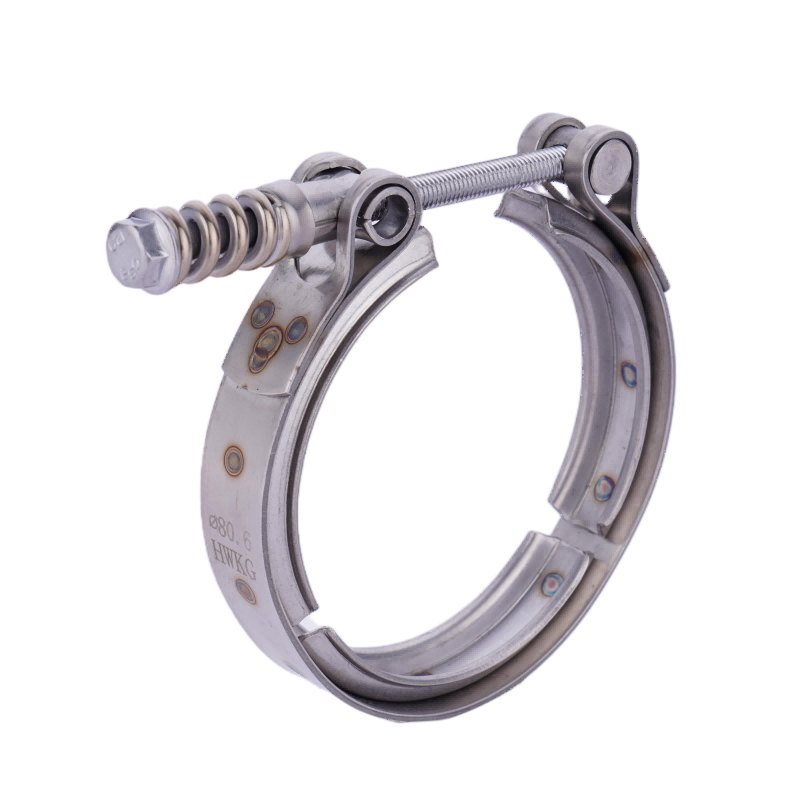
A V-band clamp consists of three components: two weld-on flanges (typically male-female interlocking) and a V-profile outer retainer with a single T-bolt fastener. When torqued, the retainer’s angled inner surface exerts radial force that converts into axial clamping load — wedging the flanges together evenly around the full 360° circumference. This uniform load distribution eliminates the weak points inherent in traditional multi-bolt flange designs.
Standard References
V-band coupling design is governed by SAE AS4751 (aerospace) for high-temperature ducting up to 800°F (~427°C) continuous service. Industrial applications commonly reference Clampco’s engineering load formulas for internal pressure, bending moment, and axial tension calculations.
Common Material Grades
- 304 Stainless Steel — general-purpose, good corrosion resistance, suitable for automotive exhaust and industrial ducting
- 316 Stainless Steel — enhanced chloride resistance, preferred for marine and chemical environments
- 321 Stainless Steel — titanium-stabilized, superior performance under thermal cycling
- Inconel 625 / 718 — nickel-based superalloy for extreme-temperature applications (turbocharger turbine outlets, aerospace)
Precision and Fitment
V-band flanges require CNC machining to ensure the V-groove profile matches the clamp retainer within specified tolerances. Misalignment during welding is the single most common cause of V-band leaks — the pipework should sit naturally flush before any welding tack is applied. Always match flanges and clamp as a set from the same manufacturer to avoid profile mismatch.
Typical Applications
V-band clamps are used in many places where safety and performance are important. Some common uses are:
- Automotive exhaust systems and turbochargers
- Aircraft exhaust systems
- Power generation equipment
- Chemical plants
- Marine engines and ship exhausts
These clamps make sure connections do not leak, even with high heat, pressure, and shaking. People use them a lot in new engines and big machines because they are very reliable.
Why Choose a V-band Clamp?
- Makes a strong, even seal for high-pressure systems
- Works in very hot and tough places
- Easy to put on and take off for repairs
V-band clamps are the best pick for companies that need strong and dependable connections. They are great when you need things to fit exactly and last a long time.
What Is a Band Clamp?
How a Band Clamp Works
A band clamp (also called a strap clamp or worm-drive hose clamp) consists of a flexible metal band with a threaded worm-gear mechanism or bolt-tightened saddle. As the screw or bolt is tightened, the band constricts radially around the hose or pipe, compressing it against the fitting barb to create a fluid-tight seal. Band clamps do not require welded flanges, making them a plug-and-play solution for field installations and repairs.
Common Types
• Worm-drive hose clamps — slotted band with a captive screw; industry standard for coolant, fuel, and vacuum lines (SAE J1508 compliant)
• T-bolt band clamps — heavy-duty bolt with a spring-loaded saddle; designed for silicone turbo and intercooler hoses under boost pressure
• Spring band clamps — constant-tension design that self-adjusts with thermal expansion; common in OEM automotive cooling systems
• Lap-joint exhaust band clamps — wide stainless band with Grade 8 bolts; provides 360° seal on butt-joint exhaust connections without deforming the pipe
Material and Finish
Band clamps are typically manufactured from 304 or 201 stainless steel. Marine and chemical environments call for 316 grade. The band edge should be radiused or deburred to prevent hose cutting under vibration. Zinc-plated carbon steel variants are available for cost-sensitive, non-corrosive indoor applications only.
Difference Between V-band Clamp and Band Clamp
| Dimension | V-Band Clamp | Band Clamp |
|---|---|---|
| Clamping Mechanism | V-retainer + interlocking male-female flanges | Wrap-around band tightened via screw, worm gear, or T-bolt |
| Flange Required | Yes — flanges must be TIG-welded to pipe ends | No — clamps directly onto pipe/hose OD |
| Seal Type | Metal-to-metal, 360° radial compression, gasket-free | Compressive, hose-to-fitting seal; some designs gasket-free |
| Pressure Rating | High — suitable for boosted applications (40+ PSI) | Low to medium — depends on hose and fitting rating |
| Temperature Limit | Up to material grade upper limit (e.g., 304 SS: ~870°C intermittent) | Limited by band material and hose rating |
| Disassembly | Single T-bolt; reusable dozens of times | Screw/bolt removal; may need replacement after multiple cycles |
| Typical Cost (2026) | $35–$85 per assembly (flanges + clamp) | $2–$35 depending on type and material |
| Installation Skill | Professional welding required | Hand tools only |
Reusability and Service Life
V-band Clamp Reuse
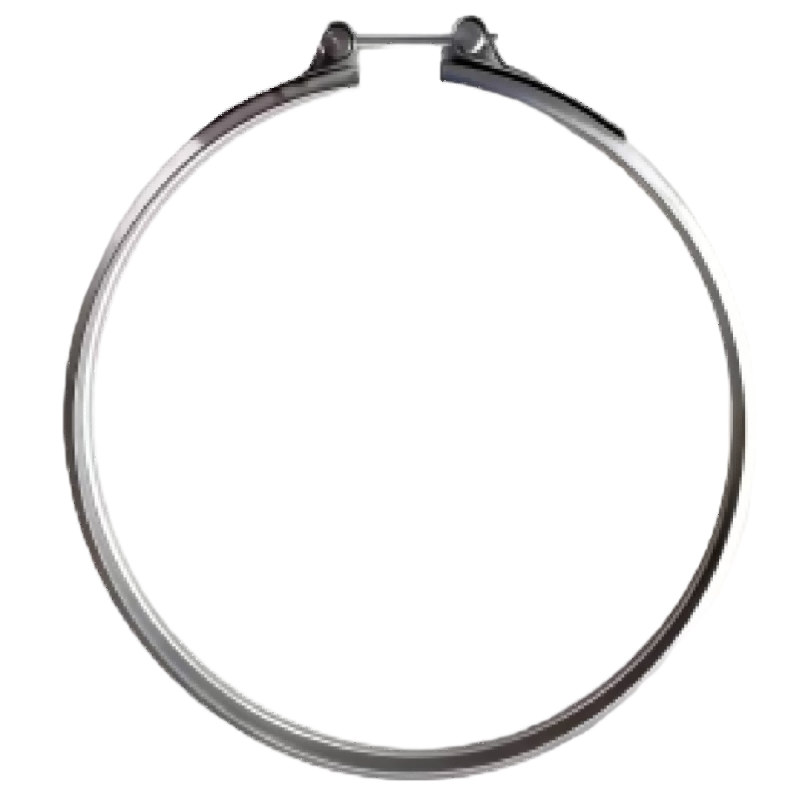
The gasket-free, mechanical-interference design of V-band clamps enables dozens of disassembly cycles without seal degradation — a critical advantage in motorsport, where turbocharger downpipes may be removed every race weekend. To maximize service life: use a small amount of high-temperature anti-seize compound on the T-bolt threads to prevent galling; inspect flange faces for warping or carbon buildup before each reassembly; recheck torque after the first heat cycle.
Band Clamp Longevity
Band clamps are designed for long-duration static installations. Worm-drive clamps can be reused 3–5 times before slot deformation reduces clamping force. Spring-type constant-tension clamps are preferred for OEM applications where thermal cycling occurs, as they self-adjust to maintain consistent pressure as the hose expands and contracts. For permanent installations that require a set-and-forget joint, T-bolt or lap-joint exhaust band clamps offer 10+ year service life when properly torqued to manufacturer specifications.
Best Applications for Each Clamp
When to Use V-Band Clamps
• Turbocharger downpipes and wastegate dump tubes — compact packaging, high thermal cycling, frequent service access required
• Modular exhaust systems in motorsport — quick disconnect between race sessions
• High-pressure chemical process lines — flange-to-flange metal seal eliminates gasket degradation risks
• Marine engine exhaust — corrosion-resistant grades (316 SS / Inconel) paired with V-band joints handle salt spray and high EGT
• Aerospace ducting — SAE AS4751-compliant V-band couplings for bleed air and ECS systems
When to Use Band Clamps
• Automotive cooling systems — worm-drive or spring clamps on radiator hoses, heater hoses, and overflow lines
• Turbo intercooler piping — T-bolt clamps on silicone couplers rated to 30+ PSI boost
• Cat-back exhaust connections — lap-joint band clamps for non-modular, set-and-forget muffler and resonator joints
• Industrial fluid transfer — bolt-tightened band clamps on suction and discharge hoses
• Cable and conduit management — light-duty band clamps for bundling and mounting
Decision Matrix
| If you need | Choose |
|---|---|
| Frequent disassembly (weekly/monthly) | V-Band Clamp |
| Permanent or annual-maintenance-only joint | Band Clamp (Lap-Joint or T-Bolt) |
| Budget under $40 per joint | Band Clamp |
| High-pressure gas seal (turbo, chemical line) | V-Band Clamp |
| No access to welding equipment | Band Clamp |
| Compact packaging in tight engine bay | V-Band Clamp |
FAQ
What is the difference between a V-band clamp and a band clamp?
A V-band clamp uses a V-profile retainer to mate two welded flanges for a gas-tight, 360° metal-to-metal seal — ideal for high-pressure, high-temperature, or frequently serviced connections. A band clamp wraps around the pipe or hose and tightens via screw or bolt — best for low-to-medium pressure, permanent or occasional-maintenance joints at lower cost.
Do V-band clamps leak?
When installed correctly — with properly aligned, flat flanges and a matched clamp — V-band clamps provide a leak-free, gasket-free seal. Most leaks result from: misaligned weld flanges, mixing different manufacturers’ clamps and flanges, or insufficient torque. Always recheck after the first heat cycle.
Do I need to weld to use a V-band clamp?
Yes. V-band flanges must be TIG-welded to the pipe ends. This is not a DIY bolt-on part. Professional fabrication is strongly recommended — misaligned welds are the #1 cause of V-band leaks.