





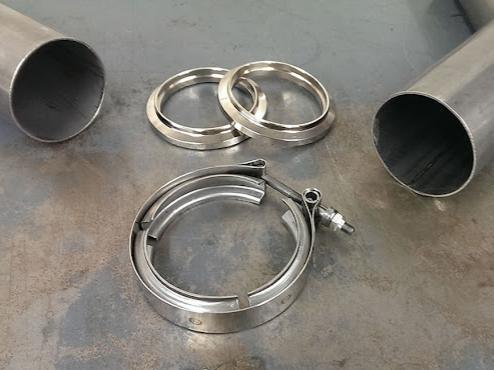
Turbocharger V-band assemblies consist of a split circular V-profile clamp paired with precision machined V-groove flanges, the dominant standardized joint solution for automotive turbo exhaust hardware defined under SAE J2602: Performance V-Band Clamps for Exhaust Systems. This hardware architecture is specified in OEM engine service manuals, professional racing build guides and industrial turbo engineering handbooks for its balanced sealing consistency and service-friendly design.
Four Core Engineering Advantages:
- Single T-bolt fastening eliminates sequential multi-bolt tightening, cutting assembly and disassembly labor time by 70% compared to conventional flat bolted flanges.
- 360° radial equalized clamping force delivers continuous metal-to-metal contact; peak uniform compression eliminates localized stress points that cause exhaust blow-by under variable boost pressure.
- High-alloy split housings are validated to sustain repeated thermal cycling between 600°C and 900°C hot-side operating temperatures without measurable torque loss.
- Split circular construction enables 360° rotational flange alignment without full hardware removal, simplifying custom exhaust pipe routing during engine swaps and modifications.
V-groove geometry evenly disperses clamping load around the full flange circumference, eliminating localized bolt stress concentration and reducing exhaust blow-by leakage under fluctuating boost and exhaust heat.
Key Takeaways
- V-band single T-bolt architecture drastically reduces teardown time for turbo replacement, wastegate servicing and exhaust modification; independent shop timing trials record 2–3 minute full disassembly vs. 20–35 minutes for 4-bolt flat flanges under identical bay access conditions.
- True gasket-free metal-to-metal sealing is only compliant with SAE J2602 dimensional tolerance limits for brand-new, mirror-finish CNC-matched V-flange pairs. Scratched, warped, mismatched or rough-cast flanges require high-temperature metal/graphite composite exhaust gaskets to eliminate leakage pathways.
- Hot-side turbine V-bands operate under sustained 600–900°C heat and cyclic engine vibration; Inconel superalloy hardware retains calibrated clamping torque after 1,000+ heat-cool cycles, while standard 304 stainless steel suits milder cold-side compressor connections (material thermal lab data, 2025).
- Clamp nominal outer diameter (OD) must precisely match flange groove OD within ±0.5mm tolerance. Oversized hardware creates uneven compression gaps; undersized clamps induce irreversible flange plastic deformation under torque. All torque values referenced in this guide align with SAE J2602 section 5.3 installation specifications.
How V-band Connections Work
V-band Clamp and Flange Design
V-clamps utilize a special V-shaped clamp and matching flange. This design facilitates a tight connection between pipes and turbocharger components. HWKG V-clamp is a high-strength stainless steel clamp with a split-type housing.The clamp wraps around the flange and is tightened by a single fastener. This makes the connection strong and easy to install or remove. The following table lists the key features of V-clamps:
| Feature | Description |
|---|---|
| Quick Installation and Removal | V-clamps feature a single fastener design for quick installation and removal, saving maintenance time. |
| High Vibration and Heat Resistance | Made of stainless steel or similar alloys, maintaining clamping strength even under harsh conditions. |
| Leak-Free High-Pressure Seal | The V-shaped design ensures even distribution of clamping force, maintaining a tight seal even under high pressure and high temperature. |
Sealing and Quick-Release Features
V-band hardware creates full circumferential contact between two mated V-flange faces. As noted in SAE J2602, gasket-free operation is only validated for brand-new, precision CNC-machined flange sets with mirror-smooth contact surfaces. If flanges develop scratches, warping or dimensional mismatch after long-term use, high-temperature graphite or metal exhaust gaskets become mandatory to seal gaps.
The single central T-bolt enables full clamp expansion without fully detaching hardware from the pipe, cutting down service time during turbo removal, wastegate adjustment or exhaust manifold upgrades. Even under peak turbo boost pressure, the symmetrical V-groove load distribution prevents localized separation of the flange mating surface.
Application in High-Temp and Vibration Environments
Turbocharger hot-side turbine housings generate sustained exhaust temperatures between 600°C and 900°C, paired with constant mechanical vibration from rotating turbine wheels. Flat multi-bolt flanges often suffer loose fasteners after repeated heat cycling, while engineered V-band assemblies counteract thermal expansion via flexible split housings.
Standard low-pressure hose clamps and thin stamped pipe clamps cannot retain consistent tension under these extreme thermal loads, making dedicated turbo-grade V-bands the only viable long-term solution for exhaust-side turbo connections. Cold-side compressor inlet/outlet V-bands operate at far lower temperatures and can use standard 304 stainless steel hardware per material thermal rating charts.
V-band on a Turbo: Location and Role
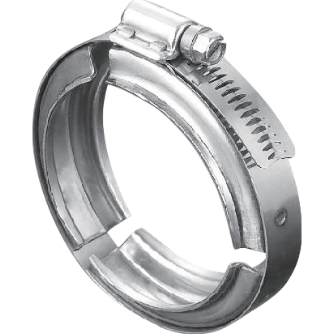
Common Turbocharger Connection Points
Turbo V-band joints are primarily installed on the turbo hot side (turbine side), the highest-temperature zone of the assembly. The two most widespread factory and aftermarket mounting positions:
- Joint between exhaust manifold outlet flange and turbine inlet V-flange
- Joint between turbine housing outlet and downpipe / exhaust front pipe
This connection format tolerates extreme thermal cycling and engine vibration far better than welded or multi-bolt flat flanges. The rotational freedom of V-band flanges lets technicians reposition the turbine housing to align exhaust piping without cutting or modifying pipework, eliminating fabrication delays during engine fitment. Fully seated V-flange contact eliminates exhaust gas leakage that would otherwise reduce turbo boost efficiency.
Flexibility and Rotation Benefits
Compared to fixed multi-bolt flat flanges, V-band turbo joints offer 360° rotational adjustability for the turbine housing. Installers can spin the turbo housing freely to match exhaust pipe routing before final torque tightening, which simplifies fitment on custom modified engines, swap builds and race vehicles.
No full clamp removal is required to rotate the housing, reducing assembly labor and avoiding accidental flange surface damage during repositioning. Exhaust leaks at the turbine inlet flange directly cause two noticeable performance losses: reduced peak engine horsepower and elevated fuel consumption from disrupted air-fuel ratios. A properly torqued V-band joint eliminates this leakage pathway entirely.
Tip: Performance and custom engine builders widely select V-band turbo setups for swap projects, as rotational flange alignment drastically cuts exhaust fabrication and installation time.
Comparison to Bolted Flanges
V-clamp connections on turbochargers differ from bolted flange connections. The table below lists the main differences:
| Feature | V-Band Connections | Bolted Flange Connections |
|---|---|---|
| Weight | Lighter | Heavier |
| Disassembly Speed | Quicker to disassemble | Slower to disassemble |
| Fitment Envelope | Smaller fitment envelope | Larger fitment envelope |
| Seal Potential | Uniform force maximizes seal potential | Variable seal potential |
| Installation Design | Quick-release clamp design | Standard bolt installation |
Standardized Real-World Service Data
On average, a properly lubricated single-bolt turbo V-band can be fully removed and reinstalled in 2–3 minutes under ideal bay access. A standard 4-bolt exhaust flat flange takes 20–35 minutes to disassemble, including clearing obstructed fastener positions common on production vehicles.
Multi-bolt flat flange joints rely on disposable exhaust gaskets that degrade over heat cycles and often blow out under high boost. V-band metal-to-metal contact removes this recurring wear point when flanges remain undamaged. Even minor uneven compression on bolted flanges creates small exhaust leak paths that erode turbo performance over time.r and reduce fuel consumption.
Pros and Cons of V-band Turbo Connections
Advantages: Leak Prevention, Easy Maintenance
V-band flange systems deliver key functional benefits that make them standard for aftermarket performance turbos and OEM heavy-duty turbo equipment:
- Symmetrical V-groove geometry locks paired flange faces together to resist separation under boost pressure and vibration, eliminating persistent exhaust leakage.
- Single T-bolt fastener drastically speeds up all service work including turbo replacement, wastegate servicing and exhaust system modification.
- Eliminates regular gasket replacement costs when flanges stay undamaged within SAE J2602 dimensional tolerances.
- Split clamp housing rotation simplifies custom engine pipe alignment without custom manifold fabrication.
- High-temperature alloy hardware maintains structural integrity through thousands of heat-cool cycles under sustained exhaust heat.
Joint Connection Durability Reference Table
| Connection Type | Durability Level | Ideal Use Case |
|---|---|---|
| V-band | High | High-performance and turbocharged systems |
| Marmon | Highest | Industrial equipment and commercial trucks |
| 2-Bolt | Moderate | Standard, less demanding applications |
| Slip-Fit | Low | Low-power, daily-driven vehicles |
Drawbacks: Cost, Compatibility Limitations
V-band turbo hardware carries practical limitations users must evaluate before switching from stock bolted flanges:
- Complete matched V-flange + clamp kits have higher upfront component cost compared to basic stamped flat flange assemblies.
- V-band joints require perfectly matched paired V-groove flanges; mixing different flange profiles creates uneven contact and immediate leakage.
- Many stock factory turbochargers use proprietary flat flange layouts, requiring adapter flanges to convert to V-band fitment.
Note: Always match V-band internal diameter, alloy grade and flange groove profile to your turbo housing OEM or aftermarket specifications to maximize joint service life. Generic low-pressure hose clamps are never interchangeable with high-temperature turbo V-band hardware due to thermal load differences.
Installation and Sourcing Tips for V-band Clamps
Choosing the Right V-band Size and Material
- Measure the outer diameter of the mating V-flange groove to select a matching nominal clamp size; oversized clamps cannot generate even circumferential compression.
- Match alloy grade to operating temperature zone: 304 stainless steel for cool compressor-side connections, Inconel superalloy for hot turbine-side exhaust joints.
- Select clamps with factory-calibrated T-bolt fasteners and follow printed manufacturer torque ratings to avoid flange warping or incomplete sealing.
- Inspect flange mating surfaces for scratches, rust and warping before assembly; smooth contact surfaces are mandatory for reliable metal-to-metal sealing.
Tip: Prioritize alloy grade based on operating temperature. Standard stainless steel suits mild-temperature compressor connections, while Inconel superalloy retains structural strength under sustained extreme exhaust heat for racing and heavy-load turbo applications.
V-band Common Material Grade Table
| Material Type | Description | Compliance Standard |
|---|---|---|
| 304 Stainless Steel | Balanced corrosion resistance, mid-range heat tolerance | SAE J2602 base specification |
| Zinc-Plated Carbon Steel | Low-cost anti-rust coating, limited temperature ceiling | Only for non-exhaust low-temp air piping |
| Inconel Superalloy | Extreme thermal and vibration resistance, custom sizing available | High-performance racing / heavy-duty turbo hot-side use |
Installation Best Practices
- Fully align paired V-flange grooves before positioning the clamp housing over the joint. Inspect exhaust manifolds and turbine flanges for cracks, warping or surface corrosion before assembly.
- Lubricate T-bolt threads with high-temperature anti-seize compound to prevent thread seizing and achieve accurate torque readings.
- Tighten the T-bolt to the manufacturer’s rated torque (standard range: 7.2–10 ft·lbs for lubricated threads per SAE J2602) using only a calibrated hand torque wrench; impact air guns are prohibited.
- After initial torque, run the engine through one full heat-cool thermal cycle, then re-torque the V-band to compensate for metal thermal settlement.
- Tap the clamp housing lightly with a rubber mallet during tightening to ensure full, flat seating around the flange circumference.
Where to Buy V-band Clamps and Flanges
| Product Type | Description |
|---|---|
| V-Band Flanges | Come in many sizes for turbochargers. |
| Turbocharger Flanges | Made just for turbocharger systems. |
| Custom Flanges | Made to fit what the customer wants. |
| Stainless Steel Flanges | Tough and good for hot places. |
| Fully CNC Machined Flanges | Custom made for special needs. |
V-band flange systems are a foundational hardware solution for turbocharger exhaust assemblies, balancing fast serviceability and robust high-temperature sealing per SAE J2602 standards. The integrated single-bolt structure reduces component count and eliminates recurring gasket failure risks for performance engines.
- V-clamps securely fasten components and expedite maintenance.
- Their unique shape means fewer parts and eliminates gasket issues.
| Consideration | V-Band Setup | Traditional Flange Setup |
|---|---|---|
| Sealing Efficiency | 360° metal-to-metal seal | Needs gaskets and bolts |
| Installation Speed | Fast | Slow |
FAQ
What are the uses of V-clamps in turbocharger systems?
V-clamps connect turbocharger components such as the turbine housing and exhaust pipe, forming a tight seal and allowing quick disassembly for maintenance or upgrades.
How do V-clamps prevent leaks?
The interlocking V-groove flange geometry guides full 360° contact between two mating metal faces, with uniform radial clamping force eliminating localized gaps. Gaskets are only eliminated when both flanges are brand-new, undamaged CNC precision-machined parts within SAE J2602 tolerances. Scratched, warped or mismatched flanges require high-temperature exhaust gaskets to seal leakage pathways.
Can anyone install V-clamps?
Most people with basic tools can install V-clamps. Follow the manufacturer’s instructions and use the correct sized clamps for optimal installation.
What materials are best suited for V-clamps?
Stainless steel is best suited for high-temperature and vibration environments. Inconel alloys are used to withstand more extreme conditions.
| Material | Best Use |
|---|---|
| Stainless Steel | Turbo systems |
| Inconel | Racing, heavy-duty |
| Zinc-Plated | General use |