


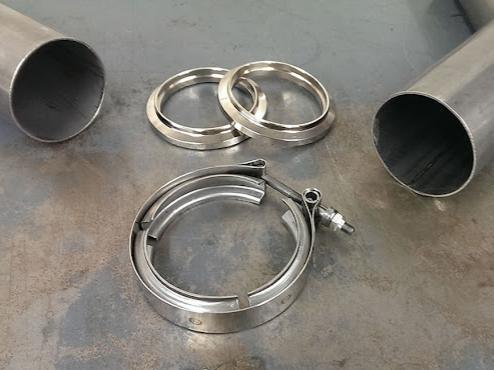
V-clamps on turbochargers are a special clamp and flange system used to connect the various components of a turbocharger. Many industries use V-clamp connections because they facilitate assembly and disassembly of components. HWKG V band clamp testing results show that these clamps are robust and reliable, suitable for turbocharged systems.V band clamp manufacturers choose V-clamp connections for several reasons:
- They facilitate assembly and disassembly.
- They provide a tight seal.
- They can withstand high temperatures.
- They are durable.
V-clamp connections also distribute stress evenly, reducing bolt stress. This design helps turbocharged systems operate efficiently and prevents leaks.
Key Takeaways
- V-clamp connections facilitate component assembly and disassembly, saving maintenance time. These clamps form a tight seal, preventing leaks and helping turbochargers operate better, improving energy efficiency. V-clamps can withstand high temperatures and severe vibrations, making them ideal for turbochargers. Using V-clamp connections eliminates the need for gaskets, thus reducing the risk of leaks. Choosing the right size and material helps V-clamps extend their service life and achieve optimal performance.
How V-band Connections Work
V-band Clamp and Flange Design
V-clamps utilize a special V-shaped clamp and matching flange. This design facilitates a tight connection between pipes and turbocharger components. HWKG V-clamp is a high-strength stainless steel clamp with a split-type housing.The clamp wraps around the flange and is tightened by a single fastener. This makes the connection strong and easy to install or remove. The following table lists the key features of HWKG V-clamps:
| Feature | Description |
|---|---|
| Quick Installation and Removal | V-clamps feature a single fastener design for quick installation and removal, saving maintenance time. |
| High Vibration and Heat Resistance | Made of stainless steel or similar alloys, maintaining clamping strength even under harsh conditions. |
| Leak-Free High-Pressure Seal | The V-shaped design ensures even distribution of clamping force, maintaining a tight seal even under high pressure and high temperature. |
Sealing and Quick-Release Features
V-clamps create a 360° all-around seal at the connection. This seal requires no gaskets, thus reducing potential leak points. The clamp uses only one bolt for easy opening and closing. Service personnel can quickly remove or install the clamp, saving time during maintenance or upgrades. Even under high pressure in turbocharged systems, the clamp’s even stress maintains a tight seal.
Application in High-Temp and Vibration Environments
Turbochargers and exhaust systems operate at high temperatures and experience severe vibrations. V-clamps excel under these harsh conditions. They remain secure even with rapid temperature changes. The clamps can withstand the thermal expansion and contraction that occurs when metal is heated and cooled. Standard clamps may not be adequate in these situations. V-clamps remain tight and do not loosen even under system vibration or high temperatures. This makes them ideal for turbocharger installation.
V-band on a Turbo: Location and Role
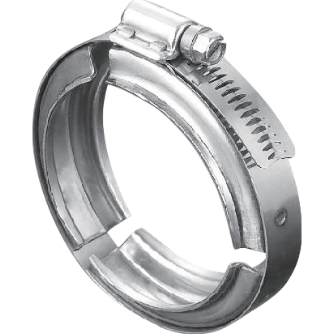
Common Turbocharger Connection Points
V-clamps on turbochargers are typically located at the hot end. Engineers place these connection points between the turbine intake flange and the exhaust manifold. V-clamp turbocharger units also connect the turbine housing to the exhaust system. This connection method allows the V-clamp turbine intake to withstand high temperatures and severe vibrations. Mechanics prefer V-clamp turbine connections because they facilitate turbine housing movement. This design eliminates the need for bolts or welding, thus avoiding construction delays. When V-clamps are used with the turbine intake flange, a tight seal is formed. This contributes to proper turbocharger operation.
Flexibility and Rotation Benefits
Compared to bolted flanges, V-clamps on turbochargers offer greater flexibility. V-clamp turbine intakes allow the housing to rotate, resulting in a better fit. This helps technicians move the turbocharger to fit different engines. V-clamp turbocharger connections simplify the alignment of the exhaust pipe and other components. When using V-clamp turbine intakes, installers can rotate the turbine housing without removing the clamps. This saves time and reduces the risk of leaks. The tight V-clamp connection on the turbocharger ensures a sealed system and helps the engine operate better. If a leak occurs at the turbocharger intake flange, engine power will decrease and fuel consumption will increase. A tight V-clamp turbocharger connection avoids these problems.
Tip: Technicians often choose V-clamp turbochargers for custom modifications because their rotating mechanism makes installation faster and easier.
Comparison to Bolted Flanges
V-clamp connections on turbochargers differ from bolted flange connections. The table below lists the main differences:
| Feature | V-Band Connections | Bolted Flange Connections |
|---|---|---|
| Weight | Lighter | Heavier |
| Disassembly Speed | Quicker to disassemble | Slower to disassemble |
| Fitment Envelope | Smaller fitment envelope | Larger fitment envelope |
| Seal Potential | Uniform force maximizes seal potential | Variable seal potential |
| Installation Design | Quick-release clamp design | Standard bolt installation |
V-clamp turbochargers are easier to install than bolted flange connections. Removing a V-clamp on a turbocharger takes only two minutes, while removing a bolted flange can take more than thirty minutes. V-clamp turbocharger inlet connections do not require gaskets. Gaskets can be blown out, causing leaks in bolted flange systems. The even force distribution generated by the V-clamp on a turbocharger ensures a tight seal at the turbocharger inlet flange. This contributes to proper turbocharger operation.
- V-clamp turbocharger connections are easier to install.
- Removal is also faster.
- No gaskets are needed, thus reducing the likelihood of leaks.
V-clamps on turbochargers help the engine work better by keeping the connection tight. This design allows you to move the turbocharger intake flange for better performance. When the seal is strong, the turbocharger delivers more air to the engine. This can provide more power and reduce fuel consumption.
Pros and Cons of V-band Turbo Connections
Advantages: Leak Prevention, Easy Maintenance
V-clamp connections offer many advantages for turbocharged systems. These advantages make them popular in racing and factory settings.
- V-clamps hold turbocharger components tightly together. This prevents leaks and ensures the system functions well.
- The V-grooves push the pipe ends together. This design resists wobbling and pressure, thus maintaining a strong seal.
- Mechanics can quickly install or remove V-clamps. A single screw makes maintenance quick and easy.
- V-clamps require no gaskets, which reduces the risk of leaks and simplifies maintenance.
- This design facilitates quick disassembly, making it particularly suitable for turbocharger applications requiring extensive inspection or maintenance.
- V-clamps function reliably in high-temperature environments, remaining secure and safe even at extremely high temperatures.
The table below shows the durability of various connection types:
| Connection Type | Durability Level | Ideal Use Case |
|---|---|---|
| V-band | High | High-performance and turbocharged systems |
| Marmon | Highest | Industrial equipment and commercial trucks |
| 2-Bolt | Moderate | Standard, less demanding applications |
| Slip-Fit | Low | Low-power, daily-driven vehicles |
HWKG V-clamps are robust, durable, and easy to use. Hengwei hose clamps are suitable for a variety of applications.
Drawbacks: Cost, Compatibility
V-clamp connections also present some challenges.
- V-clamps are more expensive than standard pipe sections. This higher price may be a burden for some.
- These clamps require the correct flange type. Not all turbocharged systems use the same flanges, so they may not match.
- Some users may require new parts or adapters to use V-clamps with their turbochargers.
Note: Choosing the right V-clamp, such as the HWKG brand, can help extend the system’s lifespan. Hengwei hose clamps are suitable for other hoses and pipes.
Installation and Sourcing Tips for V-band Clamps
Choosing the Right V-band Size and Material
Choosing the right V-clamp flange is crucial. Measure the flange’s outer diameter to ensure a fit. Stainless steel performs well in high-temperature environments, such as in turbochargers. The clamp’s rated load helps maintain a tight seal without damaging the flange. Using high-strength bolts and applying the correct torque ensures all components are securely connected. A smooth surface helps prevent leaks.
Tip: Always check the material before purchasing clamps. Stainless steel is durable. Inconel alloy offers higher strength and is better suited for high-intensity operations.
The table below lists common materials for V-clamps:
| Material Type | Description |
|---|---|
| Stainless Steel | Many grades are strong and last long |
| Zinc-Plated Carbon Steel | Resists rust and costs less |
| Inconel | Very strong and can be custom ordered |
| Compliance | Made to meet world standards |
Installation Best Practices
Proper installation ensures a tight, leak-free connection. Align and tighten the V-clamps according to the instructions. Before starting installation, check the manifold for bends or cracks. After installation, always check for leaks. All bolts should be tightened to the manufacturer’s torque values. Replace gaskets between the manifold and turbocharger if necessary. When tightening the clamps, gently tap them with a soft hammer to ensure they are in place.
- Do not overtighten the clamps. Overtightening can cause pipe bending or flattening, increasing maintenance difficulty.
- Use clamps of the correct size to avoid pipe cracking and stress concentration.
Where to Buy V-band Clamps and Flanges
Many shops sell high-quality V-clamps and turbo flanges. HWKG manufactures robust and durable V-clamps and flanges in various sizes. Hengwei offers hose clamps for automotive and other applications. Buyers can choose from a wide range of products, such as turbo flanges, custom flanges, and stainless steel flanges.
| Product Type | Description |
|---|---|
| V-Band Flanges | Come in many sizes for turbochargers. |
| Turbocharger Flanges | Made just for turbocharger systems. |
| Custom Flanges | Made to fit what the customer wants. |
| Stainless Steel Flanges | Tough and good for hot places. |
| Fully CNC Machined Flanges | Custom made for special needs. |
Note: HWKG and Hengwei products are suitable for both standard and custom projects.
V-clamp connections are essential in turbocharged systems. They allow for quick assembly of components and prevent leaks. Many experts choose V-clamp connections because of their high performance and ease of maintenance. HWKG and Hengwei products are suitable for such applications.
- V-clamps securely fasten components and expedite maintenance.
- Their unique shape means fewer parts and eliminates gasket issues.
| Consideration | V-Band Setup | Traditional Flange Setup |
|---|---|---|
| Sealing Efficiency | 360° metal-to-metal seal | Needs gaskets and bolts |
| Installation Speed | Fast | Slow |
For best results, it is recommended to consult relevant documentation or an expert before installation.
FAQ
What are the uses of V-clamps in turbocharger systems?
V-clamps are used to connect turbocharger components, such as the turbine housing and exhaust pipe. They form a tight seal and allow for quick disassembly for maintenance or upgrades.
How do V-clamps prevent leaks?
V-clamps evenly press flanges together. This design creates a 360° metal-to-metal seal. Mechanics do not need to use gaskets, thus reducing the likelihood of leaks.
Can anyone install V-clamps?
Most people with basic tools can install V-clamps. Mechanics recommend following the instructions and using the correct sized clamps for optimal installation.
What materials are best suited for V-clamps?
Stainless steel is best suited for high-temperature and vibration environments. Some clamps use Inconel alloys to withstand extreme conditions. The following table lists commonly used materials:
| Material | Best Use |
|---|---|
| Stainless Steel | Turbo systems |
| Inconel | Racing, heavy-duty |
| Zinc-Plated | General use |