





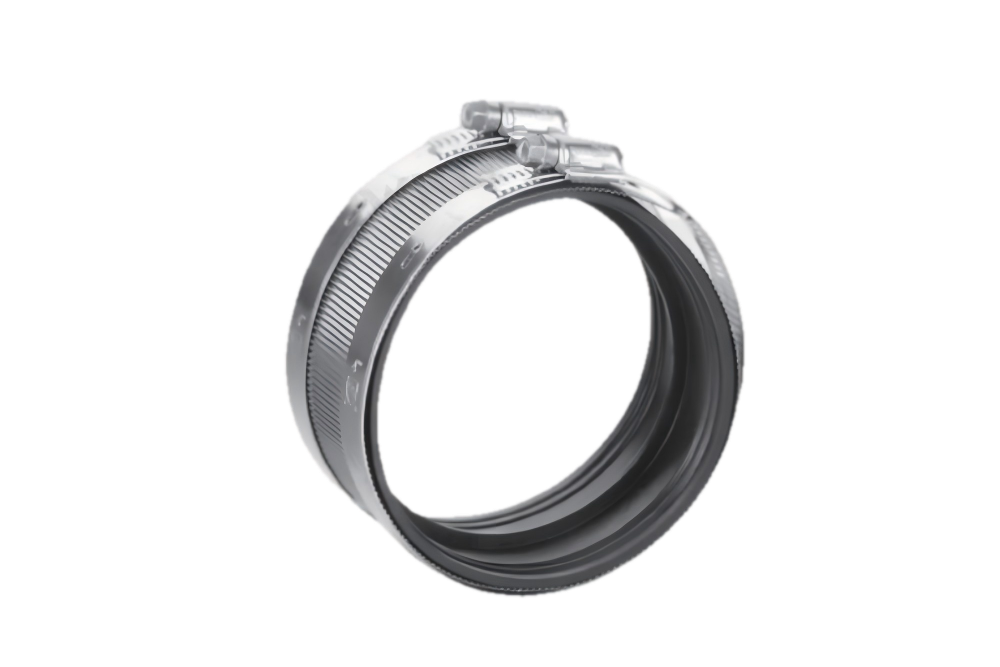
Shielded no-hub couplings: YES, code-approved for above-ground PVC DWV connections per IPC Section 705.10 and UPC Section 705.5.1. Unshielded couplings: UNDERGROUND ONLY per IPC 705.10 Exception. Never install unshielded couplings inside walls, above ground, or in concealed spaces — they lack the metallic shield required to prevent pipe sagging and gasket failure.
Key Takeaways
- Shielded couplings (metal jacket) are required for all above-ground PVC DWV connections. The metal shield prevents the rubber gasket from sagging or shifting under pipe weight. Unshielded couplings are only permitted underground per IPC 705.10.
- PVC Schedule 40 pipe has a larger outside diameter (OD) than cast iron — 3″ and 4″ PVC requires a No-Hub Adapter fitting to bridge the OD gap. Without an adapter, the inner gasket stretches too much and cannot form a reliable seal.
- Tighten all no-hub coupling clamps to 60 inch-pounds of torque using a torque wrench. Under-tightening causes leaks; over-tightening distorts the gasket and can strip the clamp screws.
- Always perform a water flow test for 5–10 minutes after installation. Check for drips, movement, or vibration at every coupling joint before closing up walls or backfilling trenches.
- For 1-1/2″ and 2″ PVC-to-cast-iron transitions, a standard no-hub coupling may work without an adapter. For 3″ and larger, always use a PVC No-Hub Adapter fitting.
What Are No-Hub Couplings?

No-hub couplings fall into two categories that determine where they can legally be installed. The difference comes down to one component: the stainless steel metal shield.
| Feature | Shielded Coupling | Unshielded Coupling |
|---|---|---|
| Construction | Stainless steel shield + neoprene gasket + worm-gear clamps | Thick rubber sleeve + two stainless steel clamps only |
| Code Requirement | Required for all above-ground DWV (IPC 705.10 / UPC 705.5.1) | Permitted underground only (IPC 705.10 Exception) |
| Shear Strength | Withstands pipe weight and prevents sagging | No shear resistance — pipes can shift and break the gasket |
| Appearance | Corrugated metal band wraps the rubber sleeve | Smooth black rubber with exposed stainless clamps |
How to identify: if you see a corrugated metal jacket wrapped around the rubber sleeve, it is a shielded coupling approved for above-ground use. If you see only a black rubber sleeve with two stainless steel clamps, it is unshielded — restricted to underground only.
How They Work
No hub couplings have a stainless steel shield, bands, and a neoprene gasket. These parts work together to seal pipes tightly.
| Component | Function |
|---|---|
| Shield (corrugated 300-series stainless) | Adjusts to pipe OD variations; corrugations interlock as clamps tighten, applying pressure crosswise and parallel against the gasket. |
| Clamp Bands | Tighten to 60 in-lbs torque to press the gasket evenly around the pipe circumference. |
| Gasket (neoprene / polychloroprene) | Creates the watertight seal and prevents pipe pull-out. |
No-Hub Couplings Compatibility & Codes
Fitting No-Hub Couplings to PVC
No hub couplings can join PVC pipe, but you must check the size and seal. PVC Schedule 40 pipe has a larger OD than cast iron, especially in 3-inch (OD 3.50″ vs 3.30″) and 4-inch sizes (OD 4.50″ vs 4.30″). This size difference can make the coupling not fit or seal well. For small pipes like 1-1/2 inch or 2 inch, no-hub couplings often fit ABS and PVC pipe to cast iron without issues — the OD difference is negligible at these diameters. Bigger pipes (3″ and above) require a no-hub adapter fitting to make a tight seal.
| Requirement | Details |
|---|---|
| Adapter Fittings | Use PVC No-Hub Adapter fittings — one side glues onto PVC pipe, the other side matches cast iron no-hub OD — to connect to cast iron. |
| Sealing Considerations | Without adapters, the inner gasket may stretch too much, compromising the seal. |
| Compatibility | ABS and PVC cannot be glued together; specific adapters are necessary for each type of pipe. |
Code Compliance & Safety
Under the International Plumbing Code (IPC) and Uniform Plumbing Code (UPC), mechanical joint shielded couplings are the approved method for connecting PVC to cast iron in DWV systems above ground.
| Code Section | Description |
|---|---|
| IPC 705.10 | Mechanical joint shielded couplings required for above-ground hubless cast-iron pipe and fittings. Unshielded couplings permitted underground only. |
| UPC 705.5.1 | Above-ground mechanical joints for hubless pipe shall have a metallic shield. Flexible rubber couplings without a shield are restricted to underground installations. |
| IPC 705.14.2 | PVC Schedule 40 pipe permitted for DWV in residential dwellings, hotels, motels, and similar establishments. |
| IPC 705.16 | Restrictions on PVC/ABS use in commercial kitchens, laundry rooms, and public toilet facilities — check local amendments. |
| New Jersey Plumbing Code (N.J.A.C. 5:23) | New Jersey enforces its own state-specific coupling requirements. Always verify local amendments — NJ and several other states modify the model code. |
Key takeaway: IPC and UPC agree — shielded above ground, unshielded below ground. But local amendments (New Jersey, California, New York) may impose stricter rules. Always call your local building department before starting.
How to Install a No-Hub Coupling on PVC Pipe
Follow these seven steps for a code-compliant, leak-free connection:
- Measure the OD. Use calipers to measure the outside diameter of both pipes. For 3″ and 4″ PVC-to-cast-iron transitions, confirm whether you need a PVC No-Hub Adapter fitting.
- Cut square and deburr. Cut the PVC pipe at a 90-degree angle using a hacksaw or reciprocating saw. Remove all burrs with 80-grit sandpaper or a deburring tool — sharp edges will tear the neoprene gasket.
- Dry-fit the coupling. Slide the coupling onto the PVC pipe first, then align both pipes. The center stop ridge inside the coupling should sit evenly over the joint.
- Apply silicone-based lubricant. Use a thin layer of silicone grease (not petroleum-based — it degrades neoprene) on the gasket interior to ease insertion.
- Push pipes to the stop. Insert both pipes fully until they contact the internal stop ridge. Each pipe should have at least 1/2 inch insertion depth.
- Torque to 60 in-lbs. Tighten both stainless steel clamps evenly using a 5/16″ nut driver and torque wrench. Torque to 60 inch-pounds. Under-tightening causes leaks; over-tightening distorts the gasket.
- Test with water. Run water through the system for 5–10 minutes. Check every joint for drips or movement. If leaks appear, tighten the clamps in small increments — never exceed 80 in-lbs.
Alternatives to No-Hub Couplings: When to Use What
Potential Issues
No hub couplings can connect pipes fast. But they might cause problems later. Leaks can show up as drips or puddles near the coupling. Some people hear strange noises, like rattling or squeaking. These sounds mean the fittings are loose or worn out. Water pressure or flow can drop if pipes are not lined up right. Vibrations can shake the coupling and make it weaker. Most failures trace back to three root causes: using the wrong coupling type (unshielded above ground), skipping the No-Hub Adapter on 3″+ PVC, or improper torque (under or over 60 in-lbs).
Real Alternatives for Connecting PVC
| Method | Pros | Cons | Best For |
|---|---|---|---|
| Solvent Weld (PVC Cement) | Permanent, leak-proof, cheapest ($5–$10) | Irreversible; requires dry, clean surfaces; useless for cast iron transitions | New PVC-to-PVC construction; same-material runs |
| Shielded No-Hub Coupling | Code-approved above ground; absorbs vibration; removable for maintenance | Requires torque wrench (60 in-lbs); needs adapter for 3″+ PVC | PVC-to-cast-iron transitions; repairs in tight spaces; DWV above ground |
| Compression Fitting | No glue or primer needed; moderate alignment tolerance | More expensive ($20–$40); bulkier; fewer size options | Pressurized lines (non-DWV); where solvent welding is impractical |
| Fernco Unshielded Coupling | Cheapest ($5–$8); fastest install | Underground only; no shear resistance; not code-compliant above ground | Underground DWV connections; temporary repairs |
Decision rule: If you are connecting PVC to cast iron above ground, use a shielded no-hub coupling with the correct adapter. If it is a new PVC-to-PVC run, solvent weld is the permanent choice. Unshielded couplings should only appear underground.
FAQ
Can no-hub couplings connect PVC to cast iron pipes?
Shielded no-hub couplings are the code-approved method for connecting PVC to cast iron in DWV systems. For 1-1/2″ and 2″ pipes, a standard no-hub coupling typically fits without an adapter. For 3″ and larger, you must use a PVC No-Hub Adapter fitting — PVC Schedule 40 OD (3.50″ for 3″) exceeds cast iron OD (3.30″), and without the adapter the gasket cannot seal properly.
Are no-hub couplings approved for underground use?
Unshielded couplings are permitted underground per IPC 705.10 Exception. Shielded couplings may also be used underground but are not required there — the metallic shield’s primary purpose is above-ground shear resistance. For buried applications, always use couplings rated for soil pressure and root intrusion (ASTM C1173 shielded or CISPI 310-rated products). The New Jersey Plumbing Code and several other states have additional requirements — check with your local building department.
Do I need a torque wrench to install a no-hub coupling?
Yes — and this is one of the most overlooked steps. No-hub couplings require 60 inch-pounds of torque on each 5/16″ hex-head clamp screw. Under-tightening causes leaks because the gasket never fully compresses against the pipe wall. Over-tightening above roughly 80 in-lbs distorts the neoprene gasket and can strip the stainless steel worm gear. A $20–$30 torque wrench is far cheaper than opening up a finished wall to fix a leak.